
Hello everyone. This week, we will look to the past to better understand today's flora, in our first-ever themed week: Paleo Week. This series of five articles will explore what we can learn about plant evolution from the fossil record, how this information relates to plants today and biases in the information we have. The first article on Ancient Secrets of the Fibonacci Spiral is already posted, more to follow daily.
Last week, we covered stories related to extinction. In good news, a Guatemalan passionflower long thought to be extinct was recently redisovered thanks to the efforts of a cross-cultural group of passionate passionflower hunters. In bad news, Antarctica's first assessed plant is already endangered. Our other stories asked how a parasitic plant changes its floral scent to lure the right insect and provided an interview with Dr Adaises S. Maciel-Silva who works on mosses, liverworts and hornworts.
Next week, join us for the latest Botany One stories, botanical news, conversations from Mastodon and Bluesky, as well as career postings. at the usual time.
Until then, take care,
Sarah (webmaster@botany.one)
On Botany One
 Victor H. D. Silva
 Pablo O. Santos
 Carlos A. Ordóñez-Parra
 Andrés Pereira-Guaquetá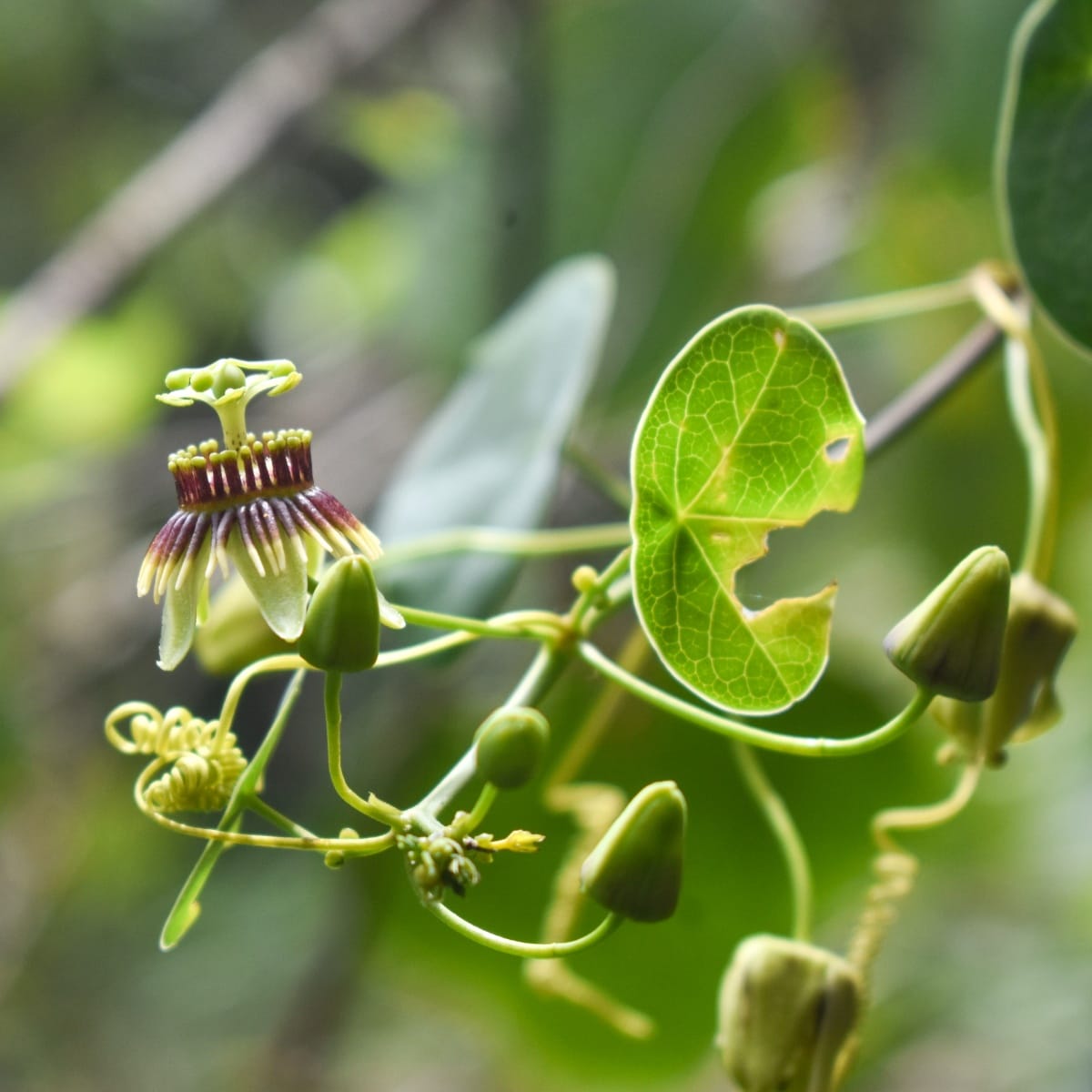
There was also Science Shared, Sudoku Garden, Plant Hunt and Equisetum arvense was plant of the week. And there's last week's Week in Botany too.
In AoBC Publications
- Special Issue: Role of Fossils in Reconstructing Plant Evolution 🆓
- Virtual Issue: Growing Insights into Plant and Algal Cell Walls 🆓
- Squirrels reduce post-fire regeneration potential in serotinous pines 🆓
News & Views
Obituary: James Lewis Hamrick III
obituaries.nationalcremation.com
BSBI Handbook: Whitebeams, Rowans & Service Trees 2nd edition: author interview
There’s a new addition to the series of BSBI Handbooks: we are delighted to announce that a second edition of Whitebeams, Rowans and Service Trees is due to be published in late Spring 2026. I spoke to Tim Rich, nationally-recognised expert on this group of plants and lead author of the new Handbook, to find out more.
bsbi.org
Why Europe’s trees are dying
Deviations from the usual climate are causing trees to die prematurely. Even favourable growing conditions can have a negative impact.
wsl.ch
The negative effects of an allelopathic invader on native plant photosynthesis are amplified after tree canopy closure
Evan A. Perkowski, Kieran Carroll, Jessie Mutz, Snehanjana Chatterjee, Xianyu Yang, Lalasia Bialic-Murphy, Stephanie N. Kivlin, Susan Kalisz, Nicholas G. Smith This is a plain language summary of a…
fesummaries.wordpress.com
How do we study the seed bank?
Poster by Andrea Kučerová, Anna Šolcová, F. Curtis Lubbe, & Jitka Klimešová from the Institute of Botany of the Czech Academy of Sciences. The illustration above shows three seeds resting under…
plantlifebelowground.wordpress.com
“I Am an Unabashed Optimist About the Long-Term Future of Science.”
The new president of the National Academy of Sciences talks about learning to see as a scientist and communicating science in a noisy information landscape.
issues.org
Community Spirit: Plasmids for All
How a decade of plasmid-wrangling at The Sainsbury Laboratory grew into a movement — and the unexpected friends now helping us open the doors wider.
medium.com
Early Flowering Plants May Have Relied on Dinosaurs to Eat Their Fleshy Fruits and Spread Their Seeds
According to fossils preserved by volcanic ash, the plants, known as angiosperms, began producing relatively large, blueberry-size fruits millions of years earlier than previously thought.
smithsonianmag.com
Plant pathogens and nutrient cycling
Plant pathogens are ubiquitous in terrestrial ecosystems, but their role in these ecosystems is understudied. One aspect of their ecology that has not been studied is their influence on nutrient cycling.
irishplants.org
Science Shared
Three botany papers widely shared on Bluesky this past week were:
1. OpenEvo: An Open-Source Platform for Automated Evolution and Analysis
Cocioba, S. S. et al. · bioRxiv · 1 post · 105 likes · 33 reposts on Bluesky
Here we introduce OpenEvo, a fully open-source, low-cost turbidostat platform for automated continuous culture and directed evolution experiments. Existing tools are expensive, complex, or lack open-source hardware; OpenEvo addresses this gap with a complete, fully automated evolution platform with detailed, illustrated construction instructions for beginners, open-source software and firmware, priced around $300.
2. Distinguishing leaf scorching from senescence under climate extremes 💰
Bergström, M. et al. · Nature Climate Change · 1 post · 53 likes · 25 reposts on Bluesky
Global temperatures have risen rapidly in recent decades, leading to more frequent extreme events such as droughts, heatwaves and their co-occurrence — so-called hot droughts. These events have caused widespread and abrupt leaf discolouration in temperate forests, as observed during the 2021 Pacific Northwest heat dome and the 2018 and 2022 European widespread hot droughts. Because leaf colour change is commonly associated with autumn senescence, such discolouration is often interpreted as premature or stress-induced senescence. However, not all early discolouration reflects an activated senescence program: thermal damage and hydraulic failure under hot droughts can cause passive leaf scorching.
3. Siderophore production by the lichen fungus Xanthoria parietina supports its algal symbiont
Happacher, I. et al. · Nature Communications · 1 post · 45 likes · 20 reposts on Bluesky
Here, we characterize the iron acquisition system of Xanthoria parietina, a globally distributed lichen-forming fungus associated with the microalgal photobiont Trebouxia decolorans.
You can see the full list with more details at Science Shared: July 11.
Careers on Bluesky
Please note these are not jobs I am offering. Nor can I help you with any visa requirements. At time of writing there are around 95 other jobs posted at Botany One.
Junior researcher landscape history – Verborgen verhalen uit het Veen // Wageningen
www.wur.nl/en/vacancy/j...
Please be aware that a good command of the Dutch language is mandatory for this position.
PhD Studentship: Using Single-cell Transcriptomics to Understand Plant Disease // University of East Anglia
www.jobs.ac.uk/job/DSE560/p...
This project offers broad training on cutting-edge, interdisciplinary technologies as well as transferable skills.
Research Associate in Quantitative Plant Development // University of Cambridge
www.jobs.ac.uk/job/DSE353/r...
The successful candidate will use mathematical analysis and computer modelling to understand how plants take up and manage their internal resources.
Senior Technical Officer, Plant Histopathology and Biological Imaging // University of Adelaide
uniroles.com.au/display-job/...
The role delivers expert services in plant sample preparation, histology and imaging using advanced light and electron microscopy techniques.
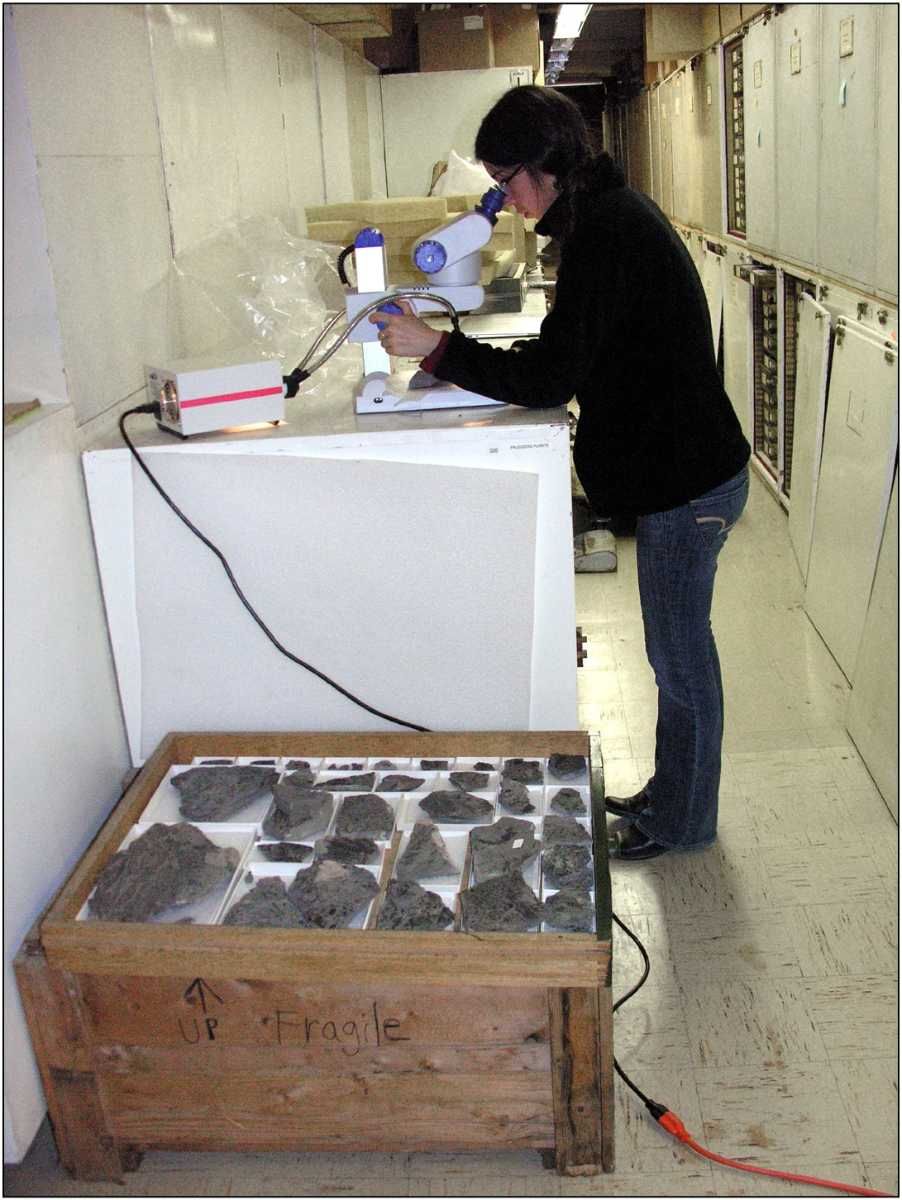
Cover Image: The picture shows Dr. Kelly Matsunaga (University of Kansas) examining Early Devonian plant fossils in the collections of the U.S. National Museum of Natural History - Smithsonian Institution, in Washington D.C. Photo by Prof Alexandru Tomescu.