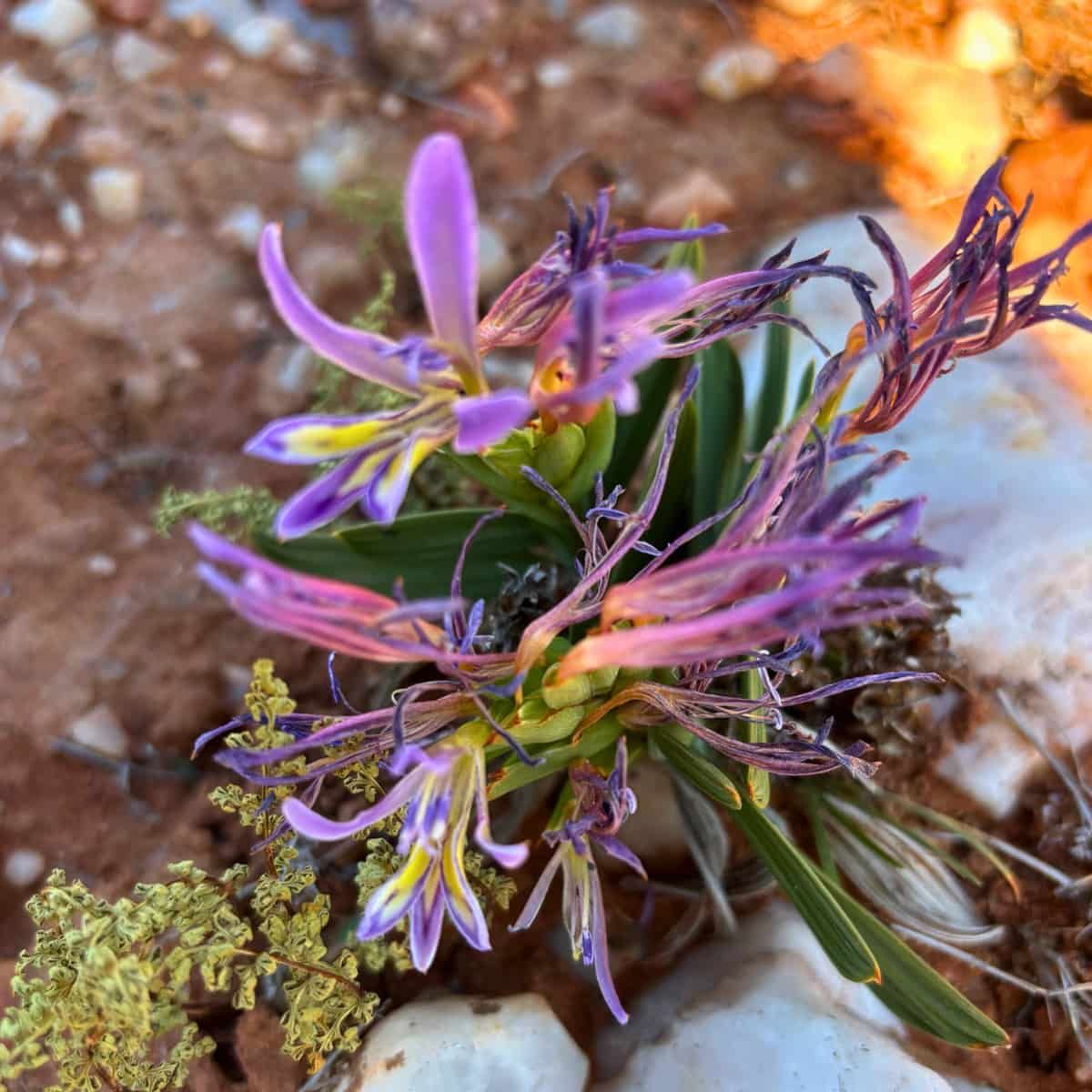

If you wonder why something is plant of the week, it can be for a number of reasons. It might be something that ties in with a theme, or maybe an event. Most of the time, it's just me looking at what interesting thing is making an appearance on iNaturalist. So, this week, Babiana gariepensis, could have been plant of the week. The photo I've used as the cover, by Riaan van der Walt, looks like floral fireworks. The reason it isn't is that I need a few photos for plant of the week, and this is the only Creative Commons licenced image I can find, and the only paper I see one that mentions it as a new species.
This coming week looks like a pollinator week, though we'll start with what lemurs look for in a tree. later today. There'll be another email sharing what we've posted this week as well at the stories you're sharing on Mastodon and Bluesky, and career postings. at the usual time next week.
Until then, take care,
Alun (webmaster@botany.one)
On Botany One
A Hidden Secret in the Only Terrestrial Plants With Pyrenoids May Inspire the Photosynthesis of Future Crop Plants
Hornworts have evolved their own version of a carbon-concentrating mechanism, offering a surprising model for improving the photosynthetic efficiency of future crops.
Dale Forrister: An “Inguero” Exploring the Chemical Lives of Tropical Trees
Botany One interviews Dr Dale L. Forrister, a chemical ecologist exploring how plants defend themselves, interact with other organisms and solve distinct ecological challenges.
The Amazon’s Invisible Network: How Animals and Trees Sustain the World’s Largest Rainforest
By mapping interactions across more than 5,000 Amazonian tree species, researchers reveal that protecting the forest also means protecting its pollinators and seed dispersers.
There was also Science Shared, Sudoku Garden, and Nelumbo nucifera, the sacred lotus, was plant of the week. You can also see last week's Week in Botany too.
In AoBC Publications
- Cryptic diversity, polyploidy, and intraspecific divergence in Erysimum (Brassicaceae) species endemic to the western Balkans 🆓
- Envirotyping of abiotic stresses: Large spatial and temporal variations across Australian barley production regions 🆓
- Savannas are built to burn: plant-trait evidence from the Cerrado 🆓
News & Views
Rising deer numbers drive decline in native forests - research
Ecologists are calling for a deer management strategy, as a new report finds the pests threaten native forests' regrowth.
rnz.co.nz
This El Niño is set to be the largest on record by a ‘mind-blowing margin’
Forecasters predict that the monster climate pattern will combine with global warming to push global temperatures in 2027 to new heights.
nature.com
Internationally recognized plant ecophysiologist William Hammond joins MSU
The Plant Resilience Institute welcomes William (Bill) Hammond to its faculty, advancing research on climate resilience, forest health, and the future of Earth's ecosystems.
plantresilience.msu.edu
Bullied in science: I quit my job and launched an advocacy non-profit
Ahead of the Academic Parity Movement’s annual conference, co-founder Morteza Mahmoudi describes how it supports whistle-blowers.
nature.com
Natural history is dying; long live the natural historians
One of the formative papers I read in my first year of graduate school was a lament about the state of the field I was trying to enter. It was a 1998 essay by Doug Futuyma, “Wherefore and wither the naturalist?” published in, appropriately, The American Naturalist.
denimandtweed.jbyoder.org
Session 1: Agroecology as a social movement
What is agroecology, and how is it understood across different communities and stakeholder groups?
Agroecology-TRANSECT / youtube.com
Wildfires are raging – and the world has junked 45 climate pledges. Disaster looms, and little wonder | Bill McGuire
Five years ago, I wrote an open letter asking climate scientists to speak out. Now governments are in retreat, it is surely time to act, says climate professor Bill McGuire.
theguardian.com
One of world's rarest flowers being saved from brink of extinction
There are only 30 critically endangered Queen of Sheba orchids left on earth, but scientists at Kings Park have made a breakthrough using a cloning technique that could save the species.
abc.net.au
A Botanical Podcast
The Botanical Society of America is thrilled to announce a new podcast series with interviews from a variety of botanical science researchers.
buzzsprout.com
‘It’s too fast, too big’: speed of climate crisis is devastating crops, say farmers
Drought and extreme heat are killing plants, driving up prices while also making some farms economically unviable.
theguardian.com
Will brutal wildfires force French leaders to take climate crisis seriously?
Campaigners worry politicians will have moved on by time of elections in which Marine Le Pen is expected to challenge.
theguardian.com
URGENT: ACT NOW to ensure your images and other media are not lost forever! Integrated Digitized Biocollections (iDigBio)
iDigBio is permanently shutting down its servers at the University of Florida in August. All images and media will be permanently deleted. Hence, access to all media and image files currently visible in the iDigBio Portal will terminate on 31 August 2026. Here is what you must do to preserve your images...
idigbio.gbif.us
Science Shared
Three botany papers widely shared on Bluesky this past week were:
1. The Arabidopsis SPFH protein HIR2 modulates receptor signaling and plasma membrane organization
Weber, H. et al. · The EMBO Journal · 2 posts · 36 likes · 13 reposts on Bluesky
Plant plasma membrane proteins are organized into distinct domains; however, the principles that govern this spatial organization are not fully understood. HYPERSENSITIVE-INDUCED REACTION (HIR) proteins are plant-specific members of the stomatin/prohibitin/ flotillin/HflK/C (SPFH) family implicated in membrane organization... AlphaFold 3 predicts a multimeric cup-like assembly for HIR2, consistent with high molecular weight complexes identified through blue-native PAGE. These findings indicate that HIR2 contributes to the formation of membrane sub-compartments, providing a potential structural framework for spatial membrane organization that influences the dynamics and function of membrane-resident receptors.
Mauricio Contreras @mpcontreras.bsky.social · on Bluesky
New in @embojournal.org from @birgitkemmerling.bsky.social's lab: HIR2 assembles into giant ring-like complexes at the plasma membrane, shaping receptor dynamics and immune signalling. Genetics + biochem + super-res imaging + AF3 modelling, all in one! Check it out👇
link.springer.com/article/10.1...
2. Decoding plants cell by cell: opportunities and challenges in single-cell and spatial biology 💰
De Veylder, L. et al. · The Plant Cell · 2 posts · 29 likes · 14 reposts on Bluesky
In this review, we summarize the emerging opportunities and key bottlenecks in plant single-cell and spatial biology. We discuss how embedding single-cell data within evolutionary developmental frameworks can accelerate the discovery of functionally relevant genes, and how spatial transcriptomics may enable comparative study designs, the study of cell-to-cell communication, and multi-organism spatial analyses.
Tatsuya Nobori @tatsuyanobori.bsky.social · on Bluesky
A collection of perspectives on the opportunities and challenges in single-cell and spatial biology is now published in
@ThePlantCell
.
academic.oup.com/plcell/advan...
Happy to have contributed the chapter, “Spatial transcriptomics in plants: where next?”
 View on Bluesky →
3. Multiplication of peat moss (Sphagnum L.) species for climate action
Parsons, J., Decker, E. L., Reski, R. · Journal of Experimental Botany · 1 post · 25 likes · 15 reposts on Bluesky
Sphagnum farming is a promising approach to combat climate change. Here, we review state of the art research with a focus on the establishment of a peat moss collection and their growth in vitro, especially in photobioreactors.
Journal of Experimental Botany @jxbotany.bsky.social · on Bluesky
🌿 EXPERT VIEW 🌿
Peat moss farming can contribute to climate protection 🌍
Parsons et al. review state of the art research with a focus on Sphagnum biomass gain in photobioreactors 🧪🔬
🔗 doi.org/10.1093/jxb/...
#PlantScience Ralf Reski
 View on Bluesky →
You can see the full list with more details at Science Shared: August 1.
Careers on Bluesky
Please note these are not jobs I am offering. Nor can I help you with any visa requirements. At time of writing there are around 104 other jobs posted at Botany One.
Teaching Fellow in Plant Molecular Sciences // Durham University
www.jobs.ac.uk/job/DSK470/t...
Applications are invited for a Teaching Fellow with a particular emphasis on Plant Protein Modifications. The appointed fellow will report directly to Professor Ari Sadanandom.
Arborist // Oxford Botanic Garden and Arboretum
www.bgci.org/job/arborist...
This is a post for a qualified arborist, who will work as part of a small team to maintain and develop the collection of plants grown at the arboretum.
Seed Bank Coordinator // Cambridge University Botanic Garden
www.bgci.org/job/seed-ban...
Cambridge University Botanic Garden is recruiting to a new position of Seed Bank Coordinator to support the development of the Garden’s seed bank and its associated activities.
Postdoctoral position in Plant Evolutionary Genomics and Pangenomics // Uppsala
www.slu.se/en/about-slu...
A postdoctoral position in plant evolutionary genomics is available in the Yant Lab at the Swedish University of Agricultural Sciences (SLU) in Uppsala, Sweden.
Cover Image: Babiana gariepensis by Riaan van der Walt / iNaturalist CC BY-NC