
I'm going to be a bit unusual with the Introduction this week because it's been an unusual week – the sports pages broke a botanical story about a newly discovered plant species that is endemic to the Andes of Peru.
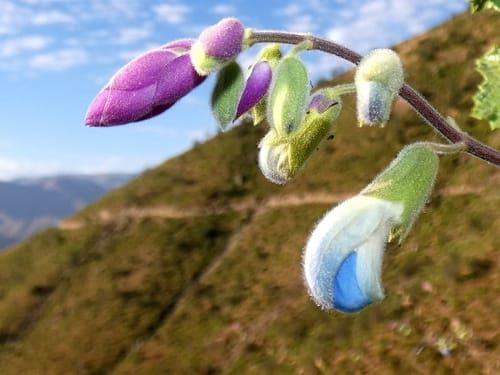
Researchers identified a new species of Salvia, and because the flower's colouring is similar to the Argentinean flag, they decided to honour Lionel Messi, widely regarded as Argentina's best football player of all time, who retired from international competition after this year's World Cup, by naming the species after him.
Sports enthusiasts learned that the new species will be called Salvia messii. And the announcement is so recent, I was unable to find a verified picture using the species name. So the unusual bit of the Introduction is that I'm including the lead researcher's Instagram announcement. The video is in Spanish, but even if you don't speak Spanish, the images speak for themselves.
Amazingly, this means Messi has broken his own Guinness World Record for most species named after a football player. His other eponymous species are a lizard, spider, Miocene-era fossil brachiopod, Pliocene-era fossil condor, and a fungus. Sadly, Salvia messii is already considered endangered and in need of conservation. But hopefully its association with the sports world will bring needed attention to the species, its habitat, and conservation efforts generally to a wider, nonacademic audience.
In the meantime, there will be another email sharing what we've posted, as well as the stories you're sharing on Mastodon and Bluesky, and career postings at the usual time next week.
Until then, take care,
Sarah (webmaster@botany.one)
On Botany One
How do you eat a poisonous seed?
Very carefully, or you pay attention to the indigenous people who have been doing it safely for a long time.
The weeds that help farmers
A tidy orchard might not be a happy orchard.
From Hunter to Healer: How the "Deadly Embrace" of a Carnivorous Plant Inspires Skin-Healing Patches
Inspired by the ecology of the Cape sundew, a team of scientists combined 4D printing and Artificial Intelligence to develop a microneedle patch capable of "gripping" the skin, preventing infections, and accelerating wound healing.
How Global Warming Weakens Plant–Pollinator Partnerships
An experimental study reveals that warming erodes the relationship between flowers and bees, even when temporal overlap is maintained.
There was also Science Shared, Sudoku Garden celebrated botanical pioneer Marianne North, and Drosera capensis was Plant of the Week. You can also see last week's Week in Botany too.
In AoBC Publications
- Genome-wide association analysis identifies candidate miRNA-targeted genes associated with spatial grain size and weight variation in barley
- Comparative floral morphoanatomy and the progamic phase reveal conserved reproductive organization in Pilostyles (Apodanthaceae)
- Altered Volatile Emissions and Incomplete Photosynthetic Recovery after Heatwave-Associated Drought and Rewetting in the Woolly Feather-Moss Tomentypnum nitens
News & Views
Lionel Messi has newly-discovered plant species named in his honor
Salvia messii, literally ‘Messi’s plant’, has light blue and white flowers which are similar in colour to Argentina’s national flag.
nytimes.com
How Peatland Bogs Sequester Massive Amounts of Carbon | The Scientist
By analyzing peat moss cell surface chemistry, researchers identified how these bogs store more carbon than all other living organisms combined.
the-scientist.com
The Overlapping Plagues Quietly Devastating American Forests
Trees are suffering one devastating epidemic after another, unleashed by insects and bacteria that enter the country because of global trade.
nytimes.com
Green Cities Network | Green Cities Initiative | Food and Agriculture Organization of the United Nations
One of the objectives of the Green Cities Initiative is to establish a Network of cities actively engaged in addressing their urbanization challenges by integrating urban and peri-urban forestry, urban and peri-urban agriculture, as well as bio circular economy.
fao.org
Agrifood solutions for climate, biodiversity and resilience
Climate change and biodiversity loss are reshaping agrifood landscapes worldwide. Explore the science-based solutions that can restore ecosystems, strengthen resilience and support sustainable food production.
fao.org
Honeybees are barging aside wild pollinators in hunt for pollen and nectar, study finds
As a surge in beekeepers has led to increased numbers of honeybees, researchers record them pushing bumblebees and other rival species away from flowers
theguardian.com
Fires Char New Guinea - NASA Science
Emissions on both sides of the island are unusually high as human-set fires spread in a landscape parched by drought.
science.nasa.gov
Illinois is America’s pumpkin capital; here's why
About 90% of the canned pumpkin in the United States comes from Illinois for reasons meteorological, climatic, economic and historical.
chicago.suntimes.com
Science Shared
Three botany papers widely shared on Bluesky this past week were:
1. Shoot to root transport of the HY5 transcription factor drives root developmental plasticity under neighbour shade.
van der Velde, K. et al. · bioRxiv · 2 posts · 75 likes · 34 reposts on Bluesky
This work showcases in detail how a small general transcription factor functions as a long-distance signal between shoot and root and integrates environmental signalling over long distances in the plant.
Kasper van Gelderen @kaspervangelderen.bsky.social · on Bluesky
And now the second preprint of the lab! doi.org/10.64898/202...
HY5 shoot-root movement is real and it is necessary and sufficient for the root developmental response to neighbour shading.
This is a story in collaboration with the lab of @ronaldpierik.bsky.social + @kyravandervelde.bsky.social
2. Functional diversification of ERF transcription factors in land plants
Bonter, I. et al. · bioRxiv · 1 post · 45 likes · 26 reposts on Bluesky
These findings provide an evolutionary framework for understanding the functional evolution of ERF transcription factors and how conserved transcriptional regulators are co-opted into novel developmental programs during the radiation of land plants.
Facundo Romani @fromani.bsky.social · on Bluesky
New research. Conveniently, Marchantia has relatively few transcription factors. Yet, we need to leverage on that at the family scale to have a more comprehensive picture. In this paper, we focused on ERFs, the second largest TF family. #PlantScience www.biorxiv.org/content/10.6...
View on Bluesky →3. Virus‐Induced Genome Editing in the Parasitic Plant Phtheirospermum japonicum
Ruwe, H. et al. · Plant, Cell & Environment · 1 post · 34 likes · 12 reposts on Bluesky
Here, we combined Agrobacterium rhizogenes‐mediated transformation with virus‐assisted delivery of the ultracompact TnpB nuclease to achieve stable, transgene‐free, heritable genome editing in Phtheirospermum japonicum.
Thomas Spallek @thomas-spallek.bsky.social · on Bluesky
Happy to share that our manuscript on virus-induced genome editing in a #ParasiticPlant has been published in Plant, Cell & Environment: doi.org/10.1111/pce....
The method also works well beyond the genes edited in the paper—so, more to come! The plasmids will soon be available from Addgene.
You can see the full list with more details at Science Shared: October 24.
Careers on Bluesky
Please note these are not jobs I am offering. Nor can I help you with any visa requirements. At time of writing there are around 60 other jobs posted at Botany One.
PhD Studentship: Where Does RNA go in the Cold? Visualising Coolair RNA Inside Plant Cells // Norwich
www.jobs.ac.uk/job/DTJ683/p...
This PhD will use cutting-edge plant RNA imaging and advanced fluorescence microscopy to visualise COOLAIR within Arabidopsis cells.
Protein Use Efficiency in Wheat for Reduced Agricultural Greenhouse Gas Emissions // Norwich
www.jobs.ac.uk/job/DTJ716/p...
UEA are seeking an enthusiastic and ambitious PhD student to investigate protein use efficiency (PUE) in bread-making wheat.
Research Assistant // Edinburgh
www.jobs.ac.uk/job/DTJ561/r...
We are looking for an experienced Research Assistant to become a key part of our newly established group working in the field of plant immunity and the proteins involved in it.
Research Leader (Mycorrhizal Ecology) // Kew
careers.kew.org/vacancy/rese...
Your strategic vision will play a part in developing the team’s research on how mycorrhizal fungi underpin ecosystem function, services and resilience to environmental change.
Cover Image: Salvia by Jean Capcha Ramos in Ica, Perú via iNaturalist CC BY 4.0. Capcha Ramos is a co-discoverer of the new Salvia messii species. At time of publication, the image shown was identified on iNaturalist to genus level only.