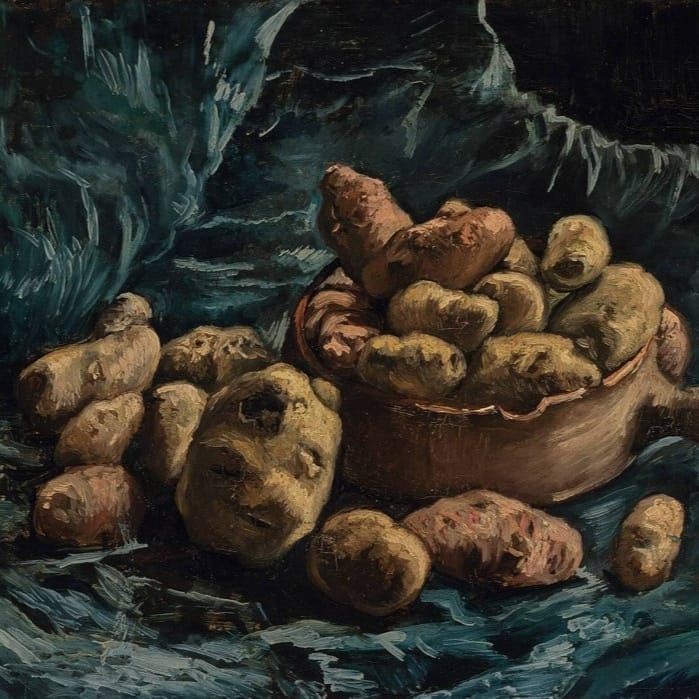

Few foods have had as many cultural lives as the potato. Ancient South Americans gave it spiritual meaning. European painters made it a symbol of rural labour and poverty. Governments turned it into propaganda, and modern society eventually transformed it into Mr Potato Head. Now, researchers have used these changing representations to ask an unusual question: can art reveal how our relationship with food has changed?
Food production systems worldwide sit at the centre of two critical challenges: feeding a growing population and reducing the environmental damage caused by agriculture. Yet changing what people eat is complicated. When people choose what to eat, they may consider nutrition and environmental impacts, but their decisions are also shaped by price, availability, convenience and culture.
Researchers often argue that urbanisation has weakened people’s connection with farming. As more people live far from fields and farms, they may know less about how food is produced and the environmental consequences of producing it. But although this idea seems intuitive, this idea is surprisingly difficult to test. Surveys can measure attitudes today, but there are few historical records showing how earlier societies thought about food and agriculture.
Earlier studies have shown that artworks can reveal the history of crops. Paintings and other objects have been used to trace changes in the appearance of beet and to investigate the geographical origins of saffron. Edward F. Hill-King and colleagues from the Lancaster Environment Centre in the United Kingdom took this idea in a different direction. Rather than using art to study how crops themselves changed, they asked whether art could reveal how people’s attitudes towards farming and food changed.
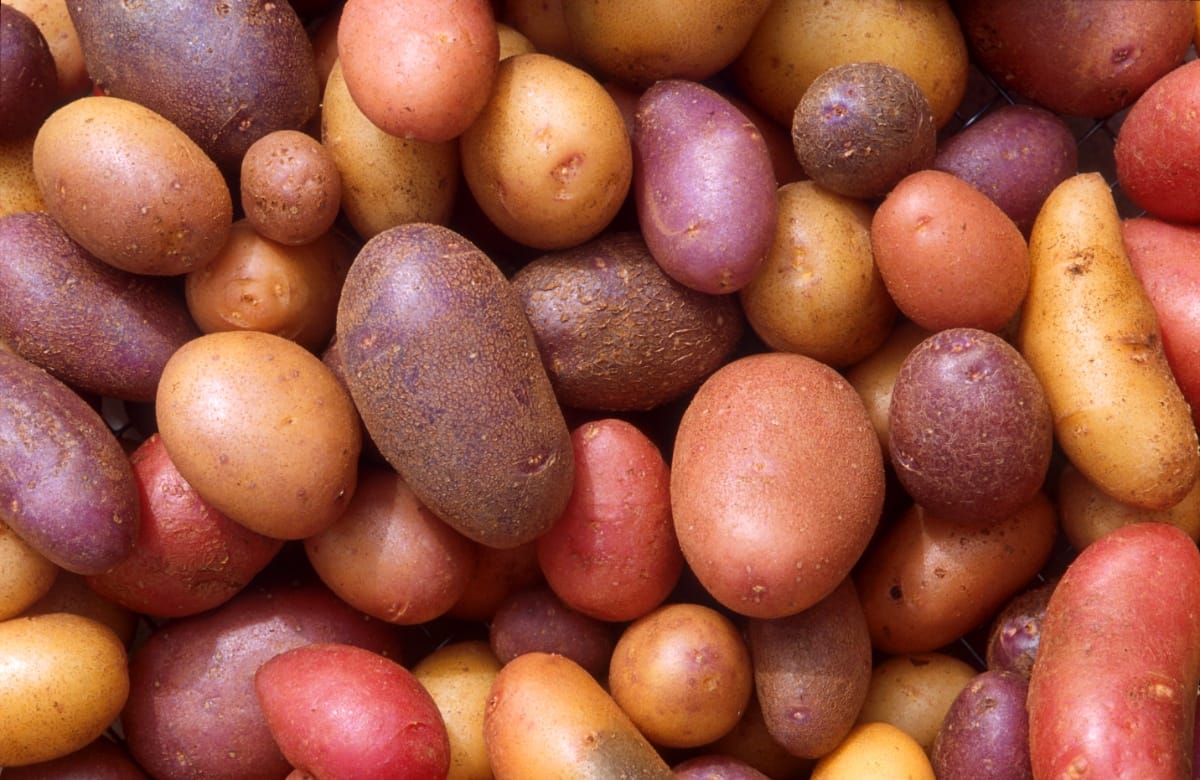
For their research, recently published in Plants, People, Planet, they chose the potato. It is the world’s most cultivated non-grain vegetable crop, and its spread helped shape population growth, industrialisation and urbanisation. Eaten across social classes and depicted in art for nearly two thousand years, the potato also provides an unusually rich record of changing cultural attitudes.
Rather than compiling every artwork featuring potatoes, the researchers selected a varied group of familiar and well-documented examples. These ranged from Moche pottery made in South America between about 200 and 600 CE to European paintings, wartime propaganda posters, North Korean state art and Mr Potato Head.
Using a social art history approach, the team did not judge each work by its artistic style or appeal. Instead, they considered the social, economic and political circumstances in which it was created: who made it, for whom, and what the potato might have represented at that particular time and place.
They also examined how farmers, labourers, political leaders and other groups were portrayed. An image of people harvesting potatoes, for example, might express respect for agricultural work, romanticise rural poverty or reinforce differences in class and power. A government poster, meanwhile, might use the potato to encourage self-sufficiency or promote a political leader. The team checked such interpretations against other historical evidence, including artists’ biographies and correspondence, historical writing and information about the economic and political conditions of each period.
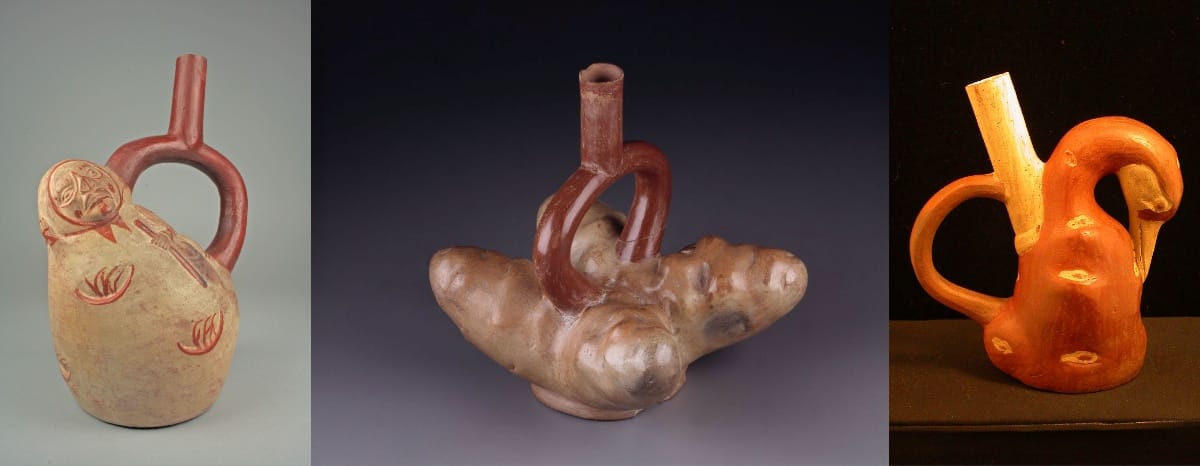
Across two millennia of art, the potato changed from a sacred crop into a curiosity, a staple food, a political symbol and, eventually, an object of humour. In ancient South America, pottery suggests that potatoes carried spiritual meaning. Moche artists created human–potato hybrids, sometimes replacing facial features with the crop’s “eyes” or buds. Although the exact beliefs behind these objects remain uncertain, their ritual associations suggest that potatoes were more than food: they were tied to fertility, sacrifice and the survival of communities.
When potatoes reached Europe, they initially appeared in botanical illustrations as unfamiliar specimens rather than everyday food crops. Suspicion followed, partly because potatoes belong to the nightshade family, which includes poisonous plants. Once rulers and agricultural reformers promoted their cultivation, however, potatoes became symbols of national prosperity and protection against famine.
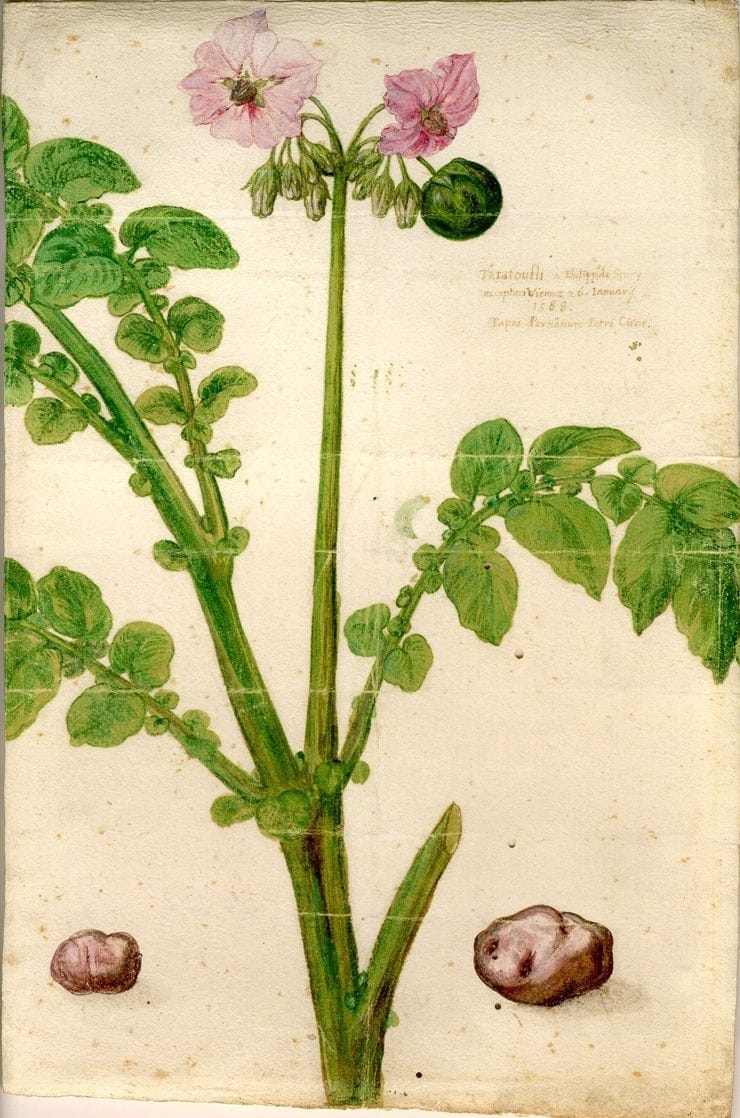
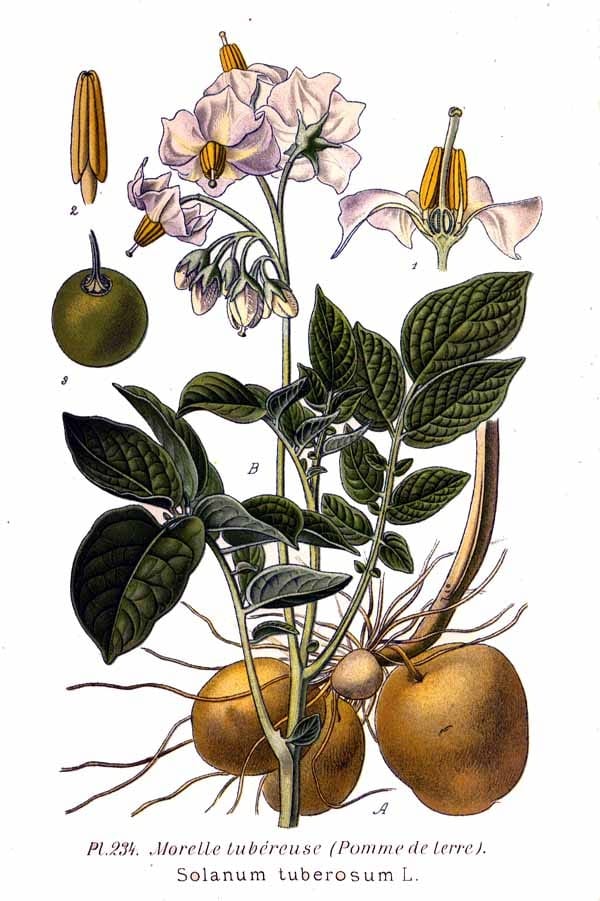
European botanical illustrations of potatoes. Left: Watercolour of potato plant delivered to Phillipe De Sivry (1589). Photo by Samuel Austin (Wikimedia Commons, CC BY-SA 3.0). Right: Illustration from the Atlas des plantes de France (1891) by Amédée Masclef (Wikimedia Commons, Public Domain).
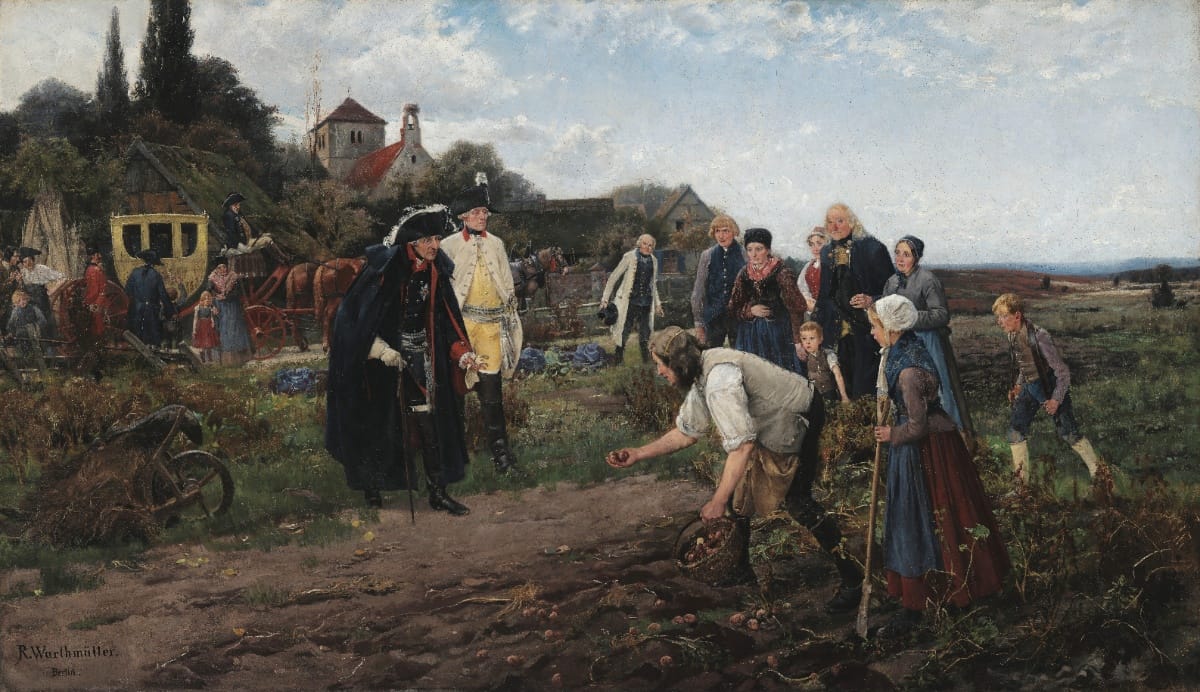
By the nineteenth century, the potato had moved from botanical curiosity to everyday necessity. Painters linked it closely with working-class life. Artists such as Vincent van Gogh portrayed potato growers and eaters as honest people whose survival depended on their own labour. Yet these images could also romanticise poverty from an outsider’s perspective. Artworks depicting the Irish famine revealed the darker side of this dependence: when the crop failed, poverty became catastrophe.
The potato’s meaning shifted again during times of political crisis. During the Second World War, governments transformed the potato into propaganda. Posters presented eating potatoes as patriotic, while post-war campaigns even depicted threats to potato crops as threats to the nation. Decades later, North Korean art used abundant harvests to associate political leaders with national survival.
In wealthy post-war societies, however, Mr Potato Head and Marilyn Monroe’s potato-sack dress signalled another transformation: the crop had become ordinary enough to play with or turn into a joke. Today, its cultural image also extends to crisps, chips and other ultra-processed convenience foods, a striking contrast with societies for which the crop once represented survival itself.
The potato’s journey through art shows that food is never just fuel: it can carry spiritual meaning, express social status, support political power or become an everyday convenience. Hill-King and colleagues do not prove that modern societies have forgotten where food comes from. Instead, they suggest that if a modern disconnection from food exists, it may lie less in knowing where food comes from than in understanding the environmental consequences of producing it.
That distinction matters as climate change and food insecurity force societies to rethink how food is produced and consumed. Although this study examined only one crop and a limited selection of artworks, it demonstrates how social art history could provide historical evidence that surveys and economic data cannot. Larger collections covering more crops, regions and periods could reveal how cultural attitudes have shaped food systems, and perhaps help explain how our relationship with food might need to change again as we try to make those systems more sustainable.
READ THE ARTICLE:
Hill‐King EF, McAinsh MR, Roberts MR. 2026. Using art history to explore society's changing connections with agriculture. Plants, People, Planet. https://doi.org/10.1002/ppp3.70230
Spanish and Portuguese translation by Erika Alejandra Chaves-Diaz.
Cover picture: Vincent van Gogh’s “Still Life with an Earthen Bowl and Potatoes” (Wikimedia Commons, Public Domain).





.jpg?ref=botany.one#/media/File:Aquarelle_de_Clusius_repr%C3%A9sentant_un_plant_de_Taratouffli_(1588).jpg)

.jpg?ref=botany.one#/media/File:Robert_Warthm%C3%BCller_-_Der_K%C3%B6nig_%C3%BCberall_(1886).jpg/2)
