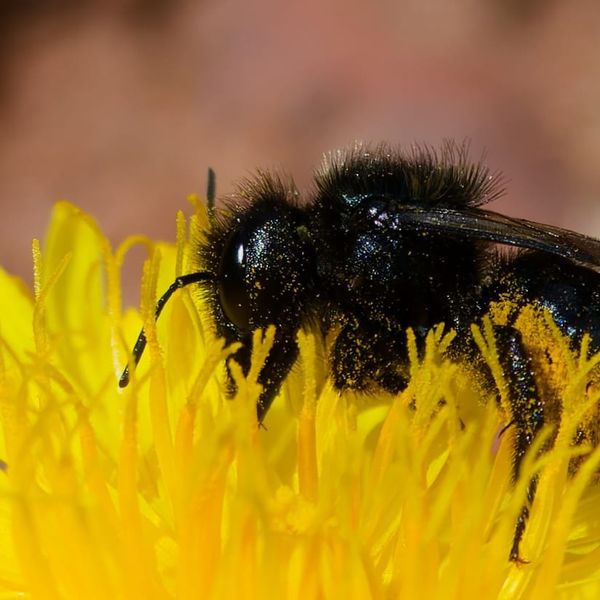
What catches your eye about the flowers in your city? Perhaps it is their vibrant colours, their fragrance, or simply the beauty of a city in bloom. Flowers can brighten the entire urban landscape, bringing a sense of delicacy, wonder, and relief amid the stresses of daily life. For a long time, however, architects and landscape designers chose urban plants mainly for their appearance and how easy they are to maintain. But how do the tiny inhabitants of our cities, such as bees, butterflies, and pollinating flies, so often go unnoticed by our eyes, perceive these urban gardens?
A recent study conducted across seven Italian cities and published in Landscape and Urban Planning revealed that ornamental plants can do far more than merely decorate our streets. Sometimes, they function as thousands of little restaurants scattered throughout the city, serving as vital stepping stones for urban biodiversity.

To understand this, researchers surveyed 43 popular ornamental plant species and monitored thousands of insect visits. But not every pretty flower makes for a good restaurant! That was the researchers’ first major discovery: not all ornamental flowers cater to all pollinators.
Species like Pyracantha koidzumii and Deutzia crenata were the biggest hits, drawing in the most customers by attracting both a massive quantity of insects and a rich diversity of different pollinator species. Other plants, such as Borago officinalis, attracted plenty of customers, but nearly all belonged to the exact same species. Meanwhile, flowers celebrated for their beauty, such as Viola lutea or Tagetes erecta, drew very few pollinator customers.

Following these findings, a question naturally arises: why do insects prefer some plants over others? The answer lies in floral traits, namely the flower’s shape, size, and the type of reward it provides.
Disk-shaped or open flowers are the clear favourites among bees and beetles. Because they are open, accessing food is straightforward for everyone. Moreover, flowers with particularly sweet nectar are far more appealing, providing a rich energy source for these pollinators. In contrast, long or tube-shaped flowers can deter butterflies or certain bee groups if reaching the nectar proves too difficult.
There is no such thing as a single perfect flower or a universal restaurant. Therefore, the secret to a vibrant urban garden full of tiny dwellers, which will bring health and beauty to your flowers, lies not in planting a single pretty species, but in offering a varied menu of diverse shapes and colours. Quite like our own human choices when visiting different eateries across town, isn't it?

The study also compared three types of green spaces: public parks, botanic gardens, and historic villa gardens. Which of these do you reckon attracts the most pollinator customers? Curiously, historic villas, which typically feature symmetrical gardens and immaculate lawns, welcomed the fewest pollinators. The overall architecture of the green space matters to these customers as well. Insects favour heterogeneity: fine-scale mosaics combining flowerbeds with varied surfaces and areas boasting a slightly more “wild” touch.
Ultimately, when designing urban landscaping, we must blend design with ecology. Choosing the right ornamental plants can transform street verges, avenues, and public squares into functional ecological corridors, ensuring that our cities remain beautiful for people and welcoming for nature as well.
READ THE ARTICLE:
Biella P, Brambilla G, Verduci V, et al.. 2026. Pollinator habitat enhancement through ornamental plants, floral traits and urban green area features for planning biodiversity-friendly cities. Landscape and Urban Planning 276: 105757. https://doi.org/10.1016/j.landurbplan.2026.105757
Portuguese translation by Andressa Luna.
Cover Picture by Ciara Ní Riain (Wikimedia Commons, CC BY-SA 4.0)