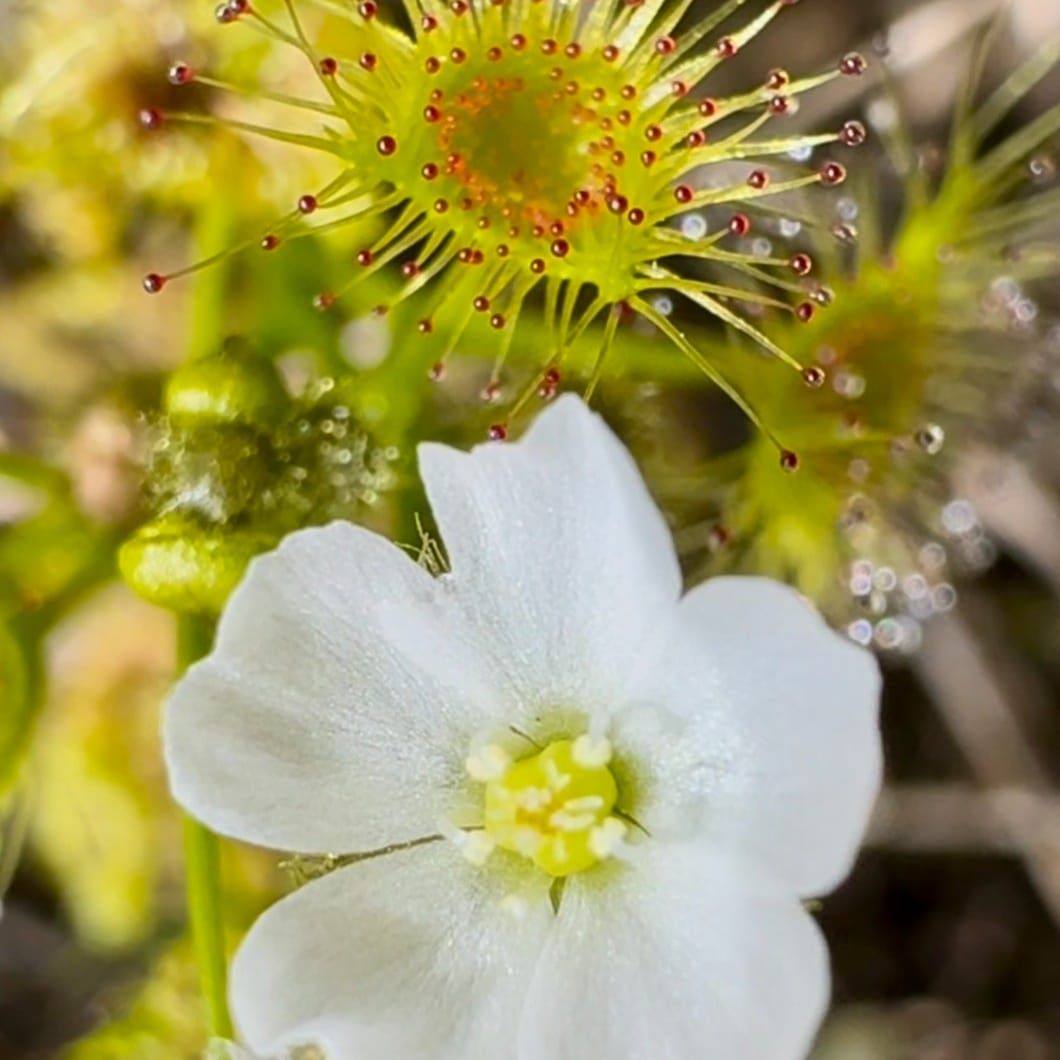

Carnivorous plants often arouse curiosity due to a unique characteristic: their ability to capture small animals and obtain nutrients that are scarce in the environments where they grow. But there is a dilemma: to reproduce, they must attract insects that carry their pollen to other flowers. So, how can this dilemma be resolved without devouring the very creatures that ensure their future?
Most carnivorous plants prevent this problem through an elegant separation tactic. They hold their flowers aloft on very long stalks, well away from the leaves on the ground, or use entirely different colours and scents to attract distinct insects. Thus, pollinators and prey never mix.
However, a study published in Annals of Botany revealed that Drosera hookeri, a carnivorous plant native to the rocky outcrops of eastern Australia, decided to play by riskier rules: it places its flowers mere centimetres away from an arsenal of leaves bearing glandular hairs that secrete droplets of a viscous substance laden with digestive enzymes. Any unsuspecting insect that lands there gets stuck and becomes lunch.
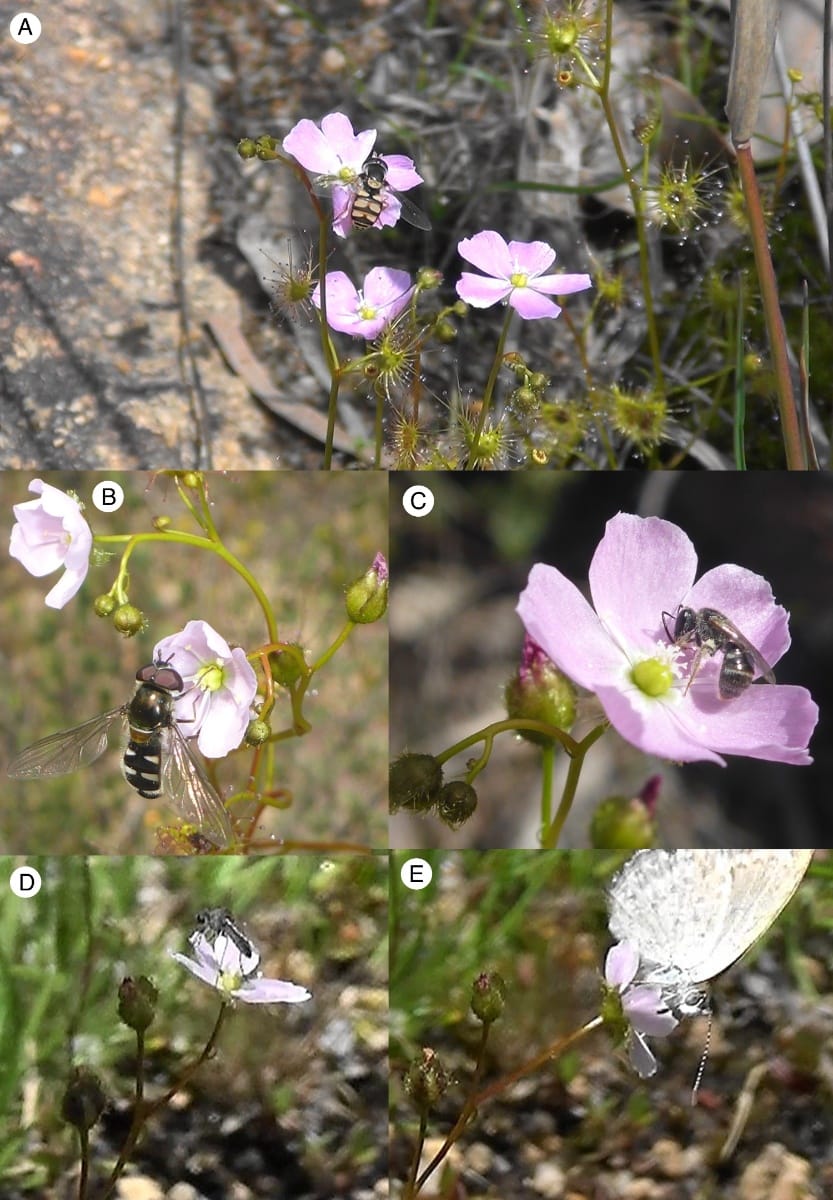
To understand the ecological consequences of this risky architecture, researchers monitored plant populations in the field over several years and carried out glasshouse experiments, making it possible to investigate which animals are caught and how the plant manages to maintain reproduction even when some of its prospective pollinators end up becoming prey.
In total, the researchers gathered 1,246 arthropods from the leaves. Among the identified organisms, flies were the most frequent, followed by insects from other groups such as true bugs, bees, wasps, butterflies, and beetles. Hoverflies and native bees accounted for 57% of the specimens identified on the leaves. These groups include key floral visitors and potential pollinators.
To discover whether the insects were attracted to the sticky leaves or lured by the charm of the flowers, the researchers placed plants with open flowers side by side with plants that had flowered the previous day and plants with only leaves. The carnivorous leaves alone did not attract a single pollinator. Hoverflies and bees completely ignored flowerless plants. When flowers were present, insects landed on the petals, attracted by the pollen. The flower stalks of Drosera hookeri are frail and flexible. As the insect landed and walked towards the edge of the petals in search of fallen grains, the stalk bent under its weight or the visitor lost its footing, being catapulted directly onto the leaves positioned just below.
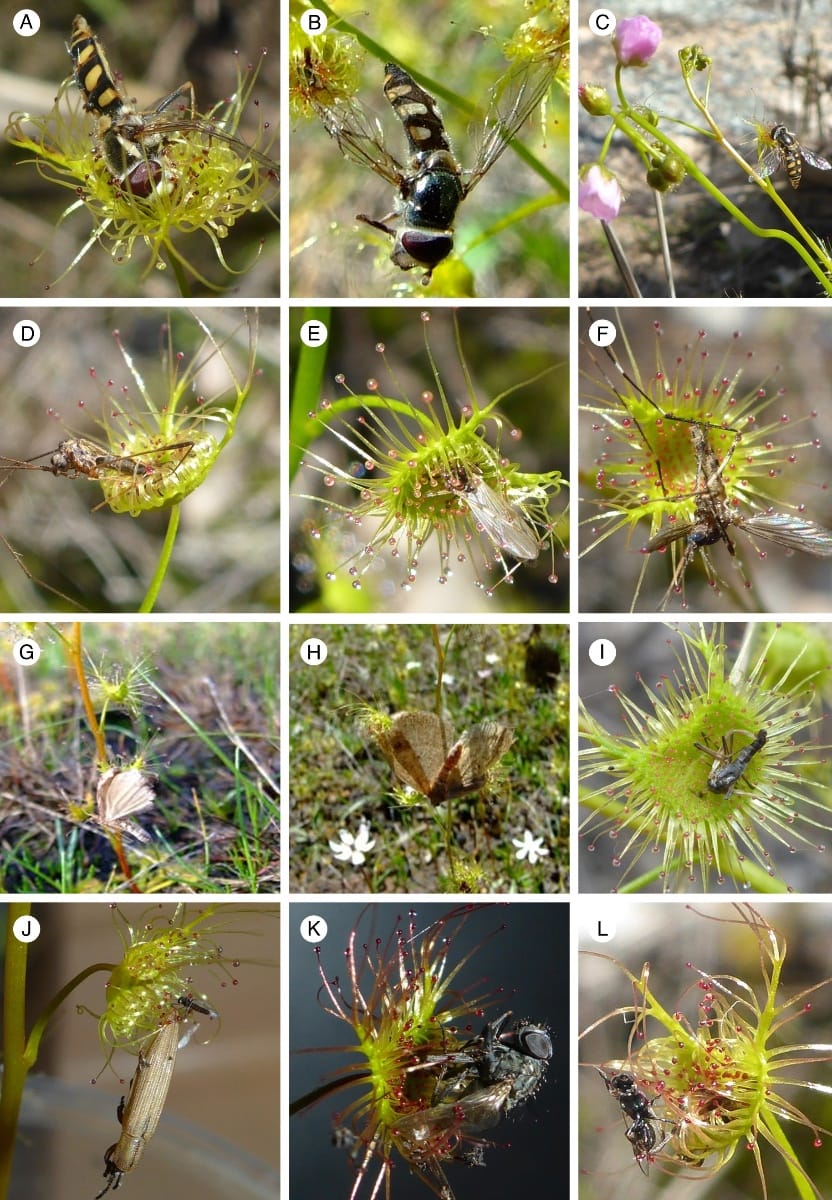
In evolutionary terms, devouring the very creatures that carry your pollen seems like shooting yourself in the foot, doesn’t it? If pollinators perish before carrying pollen to other plants, how does the species continue to produce seeds and leave descendants?
The answer is: Drosera hookeri is not held hostage by pollinators to set seed. Just a few hours after opening, its stamens automatically curve over the centre of the flower, achieving self-pollination. Experiments show that it sets roughly 80% of its seeds even when entirely isolated from insects. Furthermore, living in crevices with nutrient-poor soils and under the constant risk of drought, the phosphorus and nitrogen gained from digesting a pollinator provide fuel for photosynthesis and seed production.
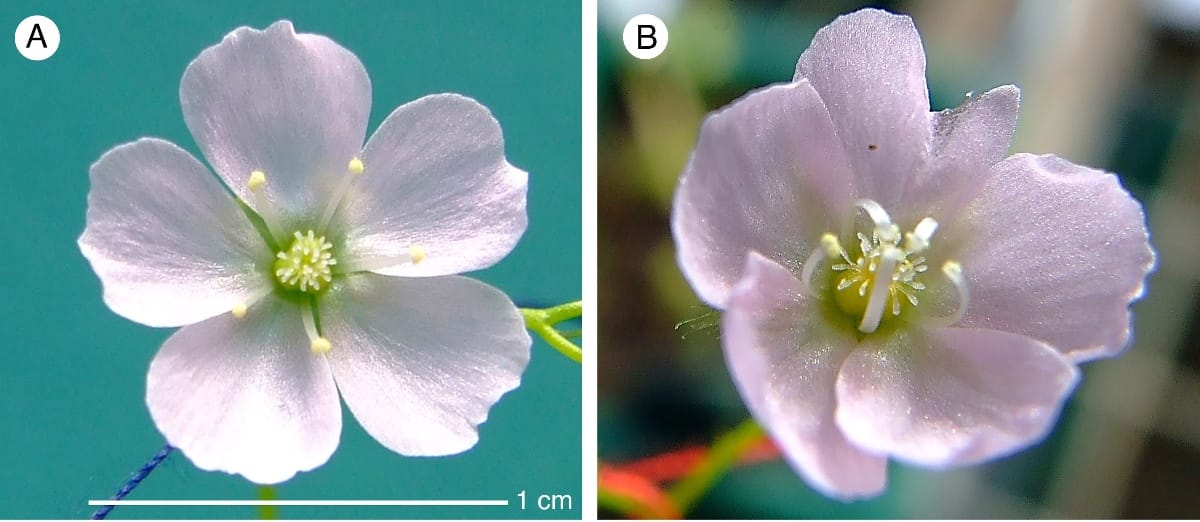
Ultimately, the dilemma between feeding and pollination is cleverly balanced by the biology of the species. By setting its own seeds, reproduction is safeguarded by the plant's ability to self-fertilise.
Far from being an evolutionary flaw, the fatal attraction of Drosera hookeri functions as an ecological pact: the insect is welcomed as a partner, but should it take a misstep... Oops! It instantly turns into a nutritious meal.
READ THE ARTICLE:
Gross CL, Whitehead JD, Waters WA, Mackay KD, Mackay ESG, Souza CS. 2026. Fatal attraction: flowers lure pollinators as prey in the carnivorous Drosera hookeri (Droseraceae). Annals of Botany 138: 1511-1522. https://doi.org/10.1093/aob/mcag170
Portuguese translation by Andressa Luna.
Cover Picture by SBERRY (iNaturalist, CC BY-NC 4.0).