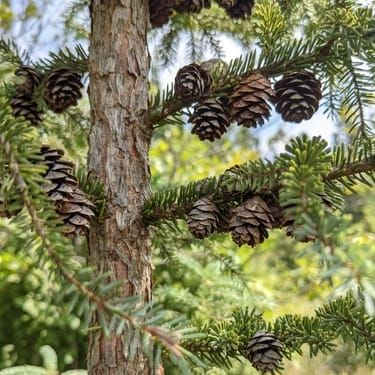

Often overlooked, seeds are an important life stage in the growth of boreal forests. Before a tree is capable of photosynthesis, the germinating seed supports plant growth using stored reserves of carbon, starch, nitrogen, and phosphorus. But higher latitudes are known to adversely affect the deposition of these nutrients within the seed.
This is because higher latitudes have lower nitrogen and phosphorus availability, are colder, have a shorter growing season, and have an increased incidence of fire. And these limitations negatively impact seed production and germination success.
Now, you might think this negative is a negative. But a new study on the reproductive traits of black spruce (Picea mariana) across a latitudinal gradient has shown that smaller seeds and poor germination likely confer special advantages to reproduction in this species.
"In this study, we investigated the variation in cone and seed traits of black spruces growing in five natural sites along a latitudinal gradient from 48°N to 53°N in Quebec, Canada," write Karki and colleagues. Black spruce is a dominant conifer species in North American boreal forests.
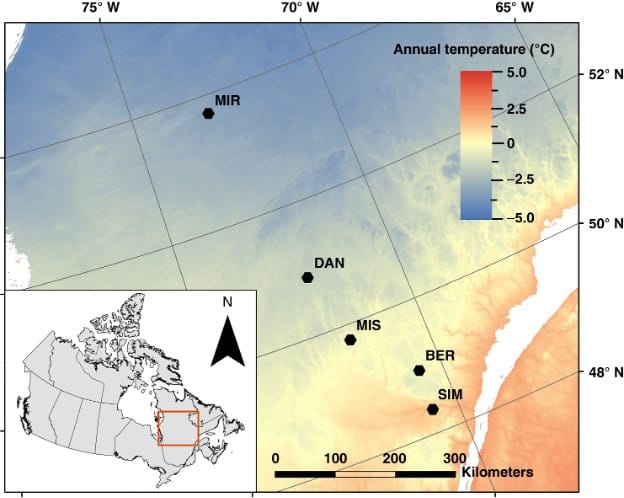
For their study, Karki and colleagues collected 90 fully mature brown cones from each of 10-13 adult black spruce trees growing in the five independent test sites. The researchers then studied cone and seed size, seed number, nutrient composition, and germination rates, comparing the data between latitudes.
They found a clear trend along the latitudinal gradient. Black spruce trees in more southern latitudes have larger seeds, heavier seeds, more seeds per cone, wider cones, and a higher sucrose but lower starch content than more northern populations.
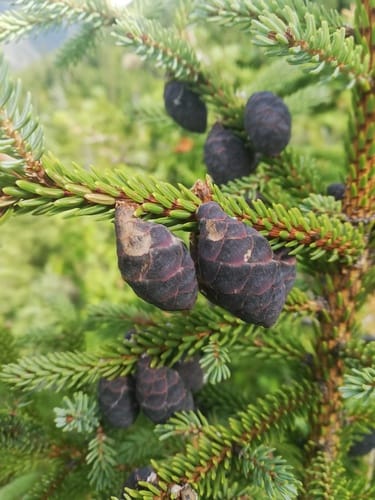
Karki and colleagues concluded from these data that the heavier seeds produced in southern areas are packed with nutrients that allow them to grow well in place, while lighter seeds of northern areas can be dispersed by the wind to new locations. Both confer advantages to the seed.
That's because these differences affect germination. Where its warmer, in the southern latitudes, the seed can drop, full of nutrients, and establish a new tree. But in higher latitudes, fewer nutrients in the seeds leads to lower, and delayed, germination, which may sound bad, but is really an advantage. The delay prevents seeds from germinating when there's still a risk for frost, helping to ensure the survival of the next generation. Fewer nutrients also result in a light seed that can be carried by the wind to new, favourable growing locations.
Northern black spruce cones also appear to be better suited to fire ecology; the cones need more heat to open than their southern relations. This "could reflect an adaptation to the shorter fire intervals occurring at higher latitudes" write Karki and colleagues. This is important because climate change is predicted to shorten the fire intervals in Eastern Canada. And so having cones that can withstand fire and protect their seeds helps mitigate risks to the next generation.
Together, these results paint a hopeful picture. Black spruce may have built-in resiliency along the latitudinal gradient that allows the boreal forest to adapt to changing conditions over time.
READ THE ARTICLE: Karki, D., Silvestro, R., Deslauriers, A., Mslati, M., Périé, C., Boucher, Y., and Rossi, S. (2026) Moving-or-staying dilemma: reproductive traits reveal a latitudinal trade-off in black spruce. Annals of Botany. Available at: https://doi.org/10.1093/aob/mcag288.
Cover Image: Black Spruce (Picea mariana) by Ellie Johnson via iNaturalist CC BY-NC 4.0