

Here's a fact that might surprise you: wheat, the staple food behind your delicious bread, hates hot weather. And this is a growing problem. Scientists have estimated that for every 1°C the planet warms, global wheat production could drop by roughly 6%. So, as global temperatures rise, your morning croissant is increasingly under threat.
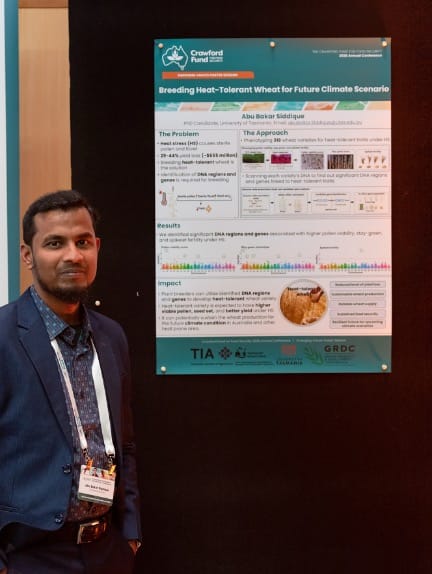
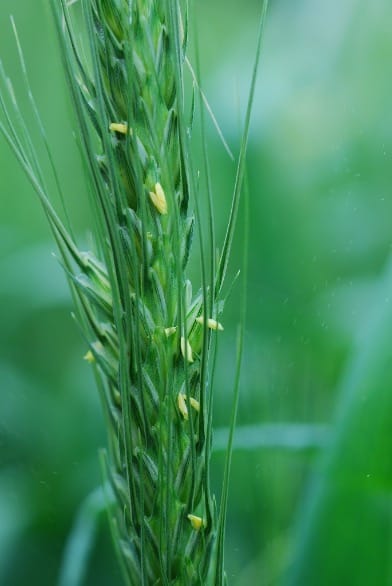
Abu Bakar Siddique, a PhD candidate at the Tasmanian Institute of Agriculture (TIA), University of Tasmania (UTAS), is working to protect wheat from the heat. Wheat is especially heat-sensitive when it flowers and produces pollen, two processes vital to producing the grain that we eat. In his latest publication, Siddique combines large-scale genetic screening with a clever new lab technique to find out exactly which wheat genes help pollen survive the heat and which wheat varieties might hold the secret to climate-resilience.
Botany One sat down with him to learn more.
Why focus on climate-resilient wheat?
Siddique explains that high temperatures, at just the wrong moment, cause a snowball effect that results in reduced wheat grain production. If a heatwave happens during pollen release, then the pollen can become damaged or non-viable, which then: throws off the timing of pollination, severely impacts fertilization, negatively affects grain formation, and ultimately reduces the overall yield. Therefore, developing new, heat-tolerant wheat varieties is essential to mitigating grain yield losses.
“Identifying the genomic regions, genes, physiological mechanisms, and traits linked to heat tolerance will allow breeders to develop resilient varieties capable of coping with a warmer and more unpredictable climate,” says Abu Bakar Siddique.
Siddique and colleagues at TIA, UTAS aim to uncover new insights into the genetics of heat tolerance in wheat at the reproductive stage, providing valuable genetic resources to develop resilient cultivars.
What major challenges did you overcome during this study?
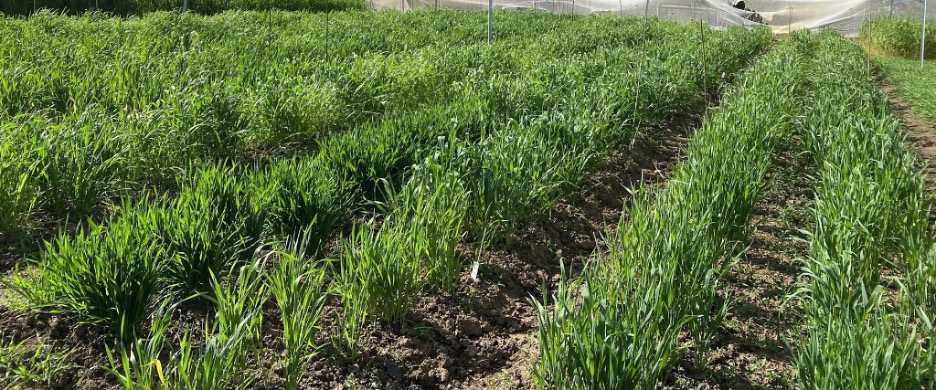
One of the major challenges in wheat breeding is observing the traits of hundreds of genetically diverse lines under field and glasshouse conditions, says Siddique, because it can take years. This is especially difficult for heat stress because its impact depends not only on the temperature and duration of the stress, but on exactly when it occurs during development. Wheat lines grow at different rates, which limits the precision of developmental-stage-specific stress assessment.
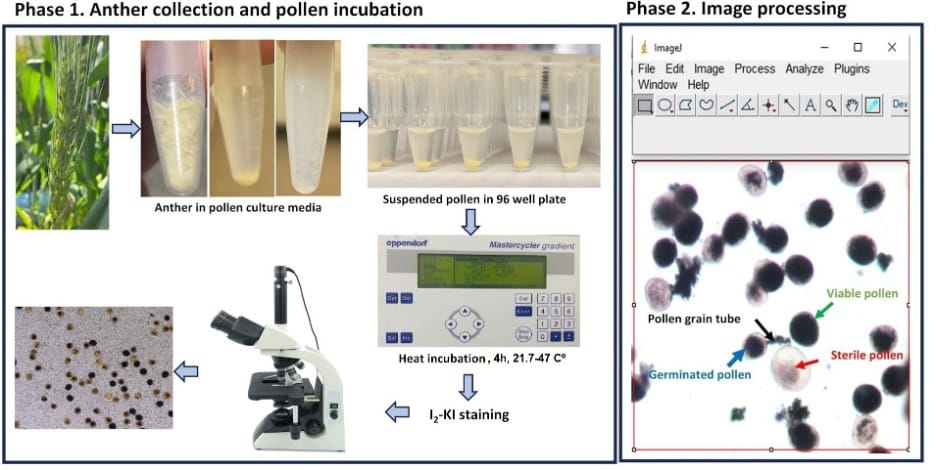
So in the lab, Siddique’s team, led by Dr. Chenchen Zhao and Professor Meixue Zhou at the University of Tasmania, had an idea: instead of heating the whole plant, why not just heat the pollen? In testing this idea, the team created a new method for measuring heat stress in pollen. Using a PCR thermocycler, which can hold 96 samples at once, Siddique and colleagues exposed pollen to twelve temperatures, ranging from 21 to 47°C. The clever use of a thermocycler allowed the team to produce accurate temperatures along a gradient via the normal function of the machine while testing many samples. This in turn allowed for rapid, reliable, and precise analysis of pollen viability using microscopy, so that the pollen’s response to heat stress could be quantified along a thermal gradient.
Siddique and colleagues have now built on that approach with a new 4 hour method that consists of the following steps: collect pollen from each wheat line at exactly the right developmental stage, place the pollen inside a thermocycler at 37°C, and then measure the effects on the pollen. In this way, the team compared almost a hundred different wheat lines simultaneously. Afterwards, the pollen suspensions were stained and examined under a microscope and photographed with a digital camera. The team then analyzed the images taken using ImageJ software to score “pollen viability percentage”, by manually counting the viable and non-viable pollen grains to capture the differences in heat tolerance between the lines.
“The most rewarding part was seeing a practical scaling-up challenge become an opportunity to develop a new way of studying heat tolerance. Because pollen is sampled at the right stage for every line, differences in heat tolerance can be measured without the confounding effect of developmental timing.”
This method is ideal for high-throughput phenotyping, as it allows many samples to be processed under controlled, repeatable conditions while saving greenhouse space, time, and labor. To streamline the process further, the team is integrating machine learning (ML) based image analysis. This will replace manual counting by automatically detecting, classifying, and counting viable and non-viable pollen, enabling rapid and consistent scoring of large image sets.
What was the most exciting part of your research?
“Validating the PCR thermal cycler method on more than 300 wheat lines and using the data in a genome-wide association study, which is one of the very first studies to phenotype pollen heat tolerance in so many varieties, and getting a successful detection of several genomic regions associated with pollen survival that could be bred into more heat-resilient wheat varieties,” Siddique said by interview.
Also exciting, was one finding that genuinely caught Siddique off guard – the heat-tolerant wheat varieties tended to produce noticeably larger pollen grains, which meant that grain size tracked closely with both pollen survival and grain filling rate. In other words, the simple trait of pollen size, visible under a basic microscope, might be a useful early clue to a variety's heat tolerance.
Looking ahead, how do you hope these findings will guide future breeding?
“One of the first applications is identifying, in a quicker and easier way, promising wheat lines that maintain pollen viability, fertility and grain-filling rate under heat stress. Furthermore, by pinpointing the genomic regions and candidate genes related to heat tolerance, we are giving breeders the precise genetic molecular tools they need to select and breed resilient wheat varieties that can maintain reproductive success under rising global temperatures,” explains Siddique.
Siddique also sees potential well beyond wheat: the same PCR-based protocol could be adapted to other crops, opening up new avenues for climate-change adaptation research across agriculture.
As Siddique put it, the long-term goal is for this kind of research to feed into a full pipeline, from lab screening, to genetics, to real field trials, that ultimately helps farmers keep growing wheat in a hotter world. In the future, integrating machine learning and AI-driven image analysis tools could enable automated pollen detection, quantification, and conversion to percentage viability, substantially improving precision and efficiency.
“Ultimately, I hope this research contributes to a breeding pipeline in which high-throughput phenotyping identifies useful genetic variation, [and] genomic analysis tracks the underlying genetic factors, and multi-environment field trials confirm their value for yield and adaptation.”
Wheat is a cool-season crop, and it's undeniable that it is feeling the heat. But it can breathe a little easier now that people like Siddique are asking big questions about the future of agriculture by studying one of the smallest things, pollen.
READ THE ARTICLES:
Siddique, A., Sharmita, O., Sun, M., Wei, Q., Li, C., Varshney, R., Shabala, S., Chen, Z., Lu, M., Zhao, C., and Zhou, M.(2026) Genome-wide association study reveals major SNPs associated with pollen viability and spikelet fertility in wheat under heat stress. Plant Growth Regulation, 106(1). Available at: https://doi.org/10.1007/s10725-026-01467-y.
Zhao, C., Siddique, A., Guo, C., Shabala, S., Li, C., Chen, Z., Varshney, R., and Zhou, M.(2025) A high-throughput protocol for testing heat-stress tolerance in pollen. aBIOTECH, 6(1), pp. 63-71. Available at: https://doi.org/10.1007/s42994-024-00183-3.
Cover photo: Abu Bakar Siddique journeyed from Bangladesh to Australia to conduct groundbreaking research on wheat pollen heat tolerance. Photo credit: Onusha Sharmita.