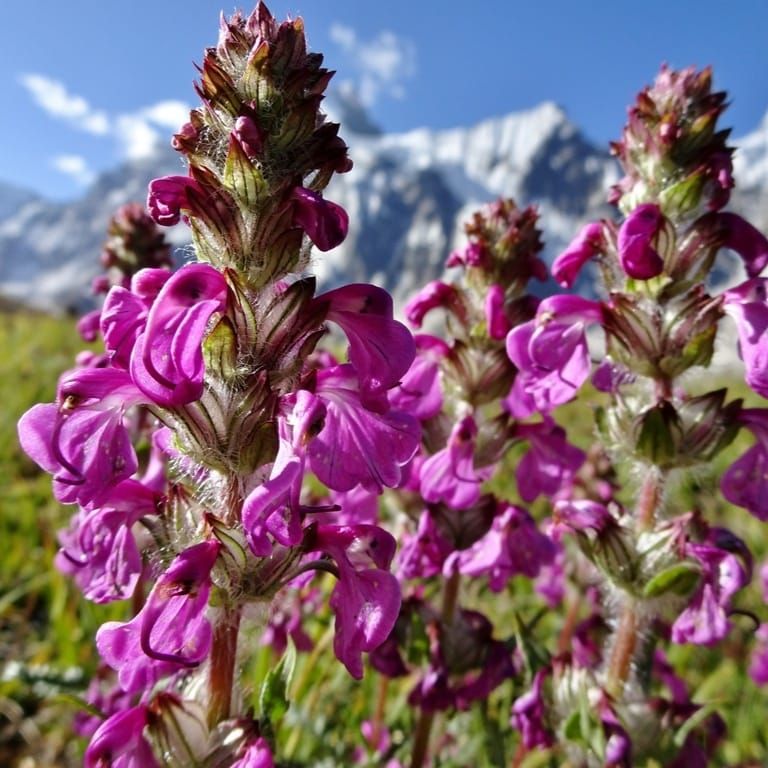

Flowers come in all sorts of colours, sizes, and shapes. They can look like anything from tiny trumpets or bells to nectar-filled cups and straws. Some even resemble delicate fairy slippers or eerie alien eggs, while others bear intricate petals that imitate fungi and bugs. As for louseworts, several species have their petals partly fused into a long, curving trunk, making their flowers look like a miniature elephant’s head. But what for?
Although unusual flower designs often play a role when engaging with pollinators, the function of such a weird-looking appendage had never been properly demonstrated. Until now. An article published this year in Annals of Botany reveals that the snout-like petals of certain lousewort flowers serve as a finely tuned mechanism to regulate pollen delivery to animal visitors.
Led by Dr Ze-Yu Tong, a group of researchers from China and the United States compared pollinator behaviours and pollen dispensing strategies across three sister lousewort species that grow side by side in the Hengduan Mountains, right next to the Himalayas. One of them, Pedicularis densispica, lacks the peculiar elephant trunk. In this species, the upper petals of the flowers simply merge into a short hood that covers the pollen-producing anthers from above. In the other two species, Pedicularis cephalantha and Pedicularis rhinanthoides, that basic hood extends into slender funnels of different lengths that fully enclose the anthers. Thus, their pollen grains can only be released through a small pore at the tip of the trunk, following the buzzing of a suitable bee guest.

Despite their different floral architecture, all three species were pollinated by the same mountain-dwelling bumblebee. But the way this furry lover handled different types of flowers was not quite the same. Indeed, snoutless plants were visited far more often than the others. As the food treats they offer are way easier to reach, bumblebees moved on more quickly between snoutless flowers, while taking much longer on the elephant-looking ones. Even so, the researchers found that each visit to the longest-trunked flowers released a much smaller slice of their hidden pollen stores. In other words, the intriguing appendage seemed to restrict pollen expenditure.
To reinforce their field observations, Tong and his team further designed an elegant set of lab experiments. They turned plastic pipettes into different models of lousewort floral trunks, varying in length and curvature. After filling them with artificial powders of a pollen-like particle size, the models were put through mechanical vibrations at the average frequency of a buzzing bumblebee. The results backed up what the real flowers had suggested: as the plastic trunks got longer and more twisted, a smaller proportion of fake pollen was released with each vibration.
By dispensing pollen in small doses, the authors say, a flower with an elephant’s trunk might get more bumblebees and have its pollen spread to a greater number of compatible plants, enhancing reproduction. Rationing pollen could also ease the conflict of interest between louseworts and their pollinators over its limited supply. While plants want their pollen to make it to other suitable flowers, bees feed it to their larvae as their main protein source. Perhaps these big-nosed flowers evolved to cut the chances of all their pollen ending up as baby bee food.

Beyond providing answers, this study also raises a whole new set of questions. For instance, the researchers went on to count the number of foreign, compatible pollen grains received by each flower during a single bumblebee visit. Paradoxically, they found that the short-snout species achieved the most favourable balance of pollen losses and gains. Does this mean that a longer trunk is not actually a better bet? Is there something like an optimal snout length for pollination success? Could trunk size and curvature influence how often pollen makes it to the right destination? There’s still much to uncover about the winding paths of evolution in these and many other flowers.
READ THE ARTICLE
Tong, Z. Y., Wu, L. Y., Armbruster, W. S., Huang, S. Q. (2026). Ecological function of the ‘elephant trunk’ upper corolla in Pedicularis species. Annals of Botany, 137: 703-711. https://doi.org/10.1093/aob/mcaf278
Spanish translation by Andrés Pereira-Guaquetá.
Cover picture: Pedicularis rhinanthoides, the study species with the longest floral trunk. Photo modified from Jasmine Star.