Surviving in nature sometimes means free-riding on the hard work of others. Carnivorous plants expend an enormous amount of energy producing mucilage and digestive enzymes to capture their food. Yet, nature always finds an opening, like sundew bugs of the Australian genus Setocoris, which have made their homes on the lethal leaves of Drosera and feed on the prey the plant captures with so much effort. But stealing in broad daylight requires a master strategy: knowing exactly when the plant has its traps set.
A new study conducted in the national parks of New South Wales shows that these bugs strategically hatch right when different Drosera species reach their peak lethal capacity, ensuring they never run out of free meals.

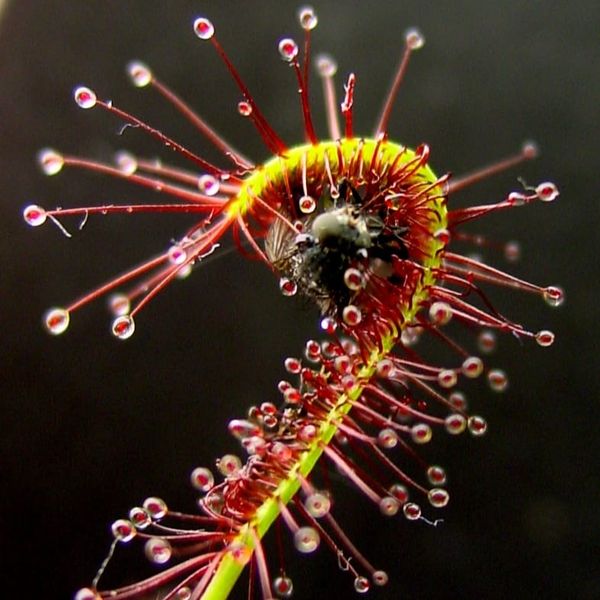
In the nutrient-poor soils of Australia, these plants, commonly known as sundews, evolved to become clever hunters. Their leaves function as active flypaper traps, covered with mobile tentacles that secrete drops of sticky mucilage to catch and digest small invertebrates. However, while almost any other insect suffers an agonising death, Setocoris bugs are the exception to the rule. These small insects move with impunity across the sticky traps at all stages of their life cycle and engage in what ecologists call "kleptobiosis": the direct theft of prey captured by their host.
Although this curious association has been known since the bug genus was described in 1951, a mystery remained: the synchronisation of their life cycles. Australian sundews are not lethal year-round due to seasonal periods of dormancy, meaning the window during which they actively catch prey can last only a few weeks.
To understand how the thief survives when the "restaurant" is closed, a team led by researcher Zoe Bloesch examined this phenomenon in a study published in Austral Ecology. The team closely observed the behaviour of an undescribed Setocoris species in Royal National Park. This insect frequents two host species with very different growth forms: Drosera peltata, with small rounded leaves, and Drosera binata, with large, linear lobed leaves.


The two host species studied: Drosera peltata (left), featuring small, rounded leaves with a captured insect, and Drosera binata (right), with its characteristic bifurcated leaves. Each displays distinct morphology and peak sticky periods. Photos by Lee Barber (CC BY-SA 4.0 via Wikimedia Commons) and Krzysztof Ziarnek, Kenraiz (CC BY-SA 4.0 via Wikimedia Commons).
The main finding of the study by Bloesch and her team, based on field observations over three months in spring, revealed an astonishing synchrony. The scientists discovered that the bugs do not appear at random; instead, their nymphs are present on the plants precisely when their hosts reach peak leaf stickiness, the period of maximum prey capture capacity. Because Drosera peltata reaches its peak number of sticky leaves earlier in the season (September and October), it was there that the bugs were observed first. Conversely, Drosera binata reaches its peak trap activity slightly later (October and November), perfectly matching the subsequent emergence of bugs on that species. The insect's biological clock seems to meticulously track its host’s menu.
To explain how they achieve such perfect timing, the study's authors propose two scenarios. The first suggests that the bug's eggs share an "environmental clock" with the plant: the same moisture or temperature cues that trigger the Drosera to emerge and produce sticky mucilage also trigger the bug's eclosion. The second scenario points to a clever nomadism. Because the study sites were in proximity, sometimes just 100 meters apart, the bugs might hatch first on the early Drosera peltata and, as that host senesces, move on foot or via short flights to Drosera binata, capitalising on two consecutive windows of continuous prey availability.

These observations open new avenues to investigate a highly specialised interaction. Although we have yet to discover exactly where these bugs oviposit their eggs or what precise cues trigger their emergence, one thing is clear: while the carnivorous plant works tirelessly perfecting its deadly trap, the ingenious Setocoris has mastered the enviable art of arriving just in time for dinner.
READ THE ARTICLE
Bloesch Z, Bourke G, Hochuli D, Murphy DJ, Cassis G. 2026. Phenology of Kleptobiotic Sundew Bugs Tracks Peak Stickiness of Their Carnivorous Host Plants. Austral Ecology 51. https://doi.org/10.1111/aec.70187
Spanish and Portuguese translation by Erika Alejandra Chaves-Diaz.
Cover picture by Jean and Fred Hort (CC BY 2.0, Wikimedia Commons).