
This is the second part of the State of the World’s Plants and Fungi Symposium reflections. The first article followed Days 1 and 2, where digitisation appeared through herbarium specimens, microbial collections, pollen slides, AI georeferencing, spectral data, fungi and silent herbaria. By the time we reached Day 3, it was clear that the article had become far too long for one piece. Too much had been discussed, and the final day deserved its own space.
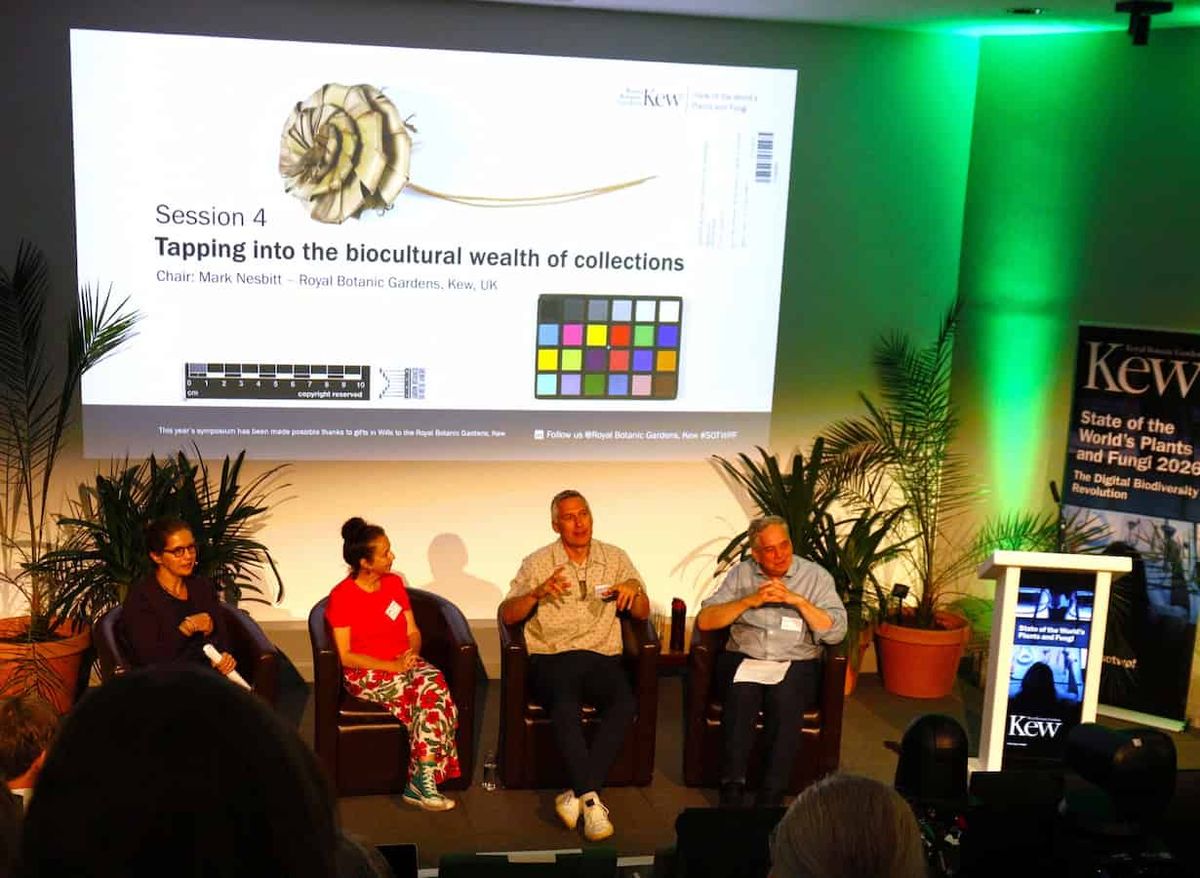
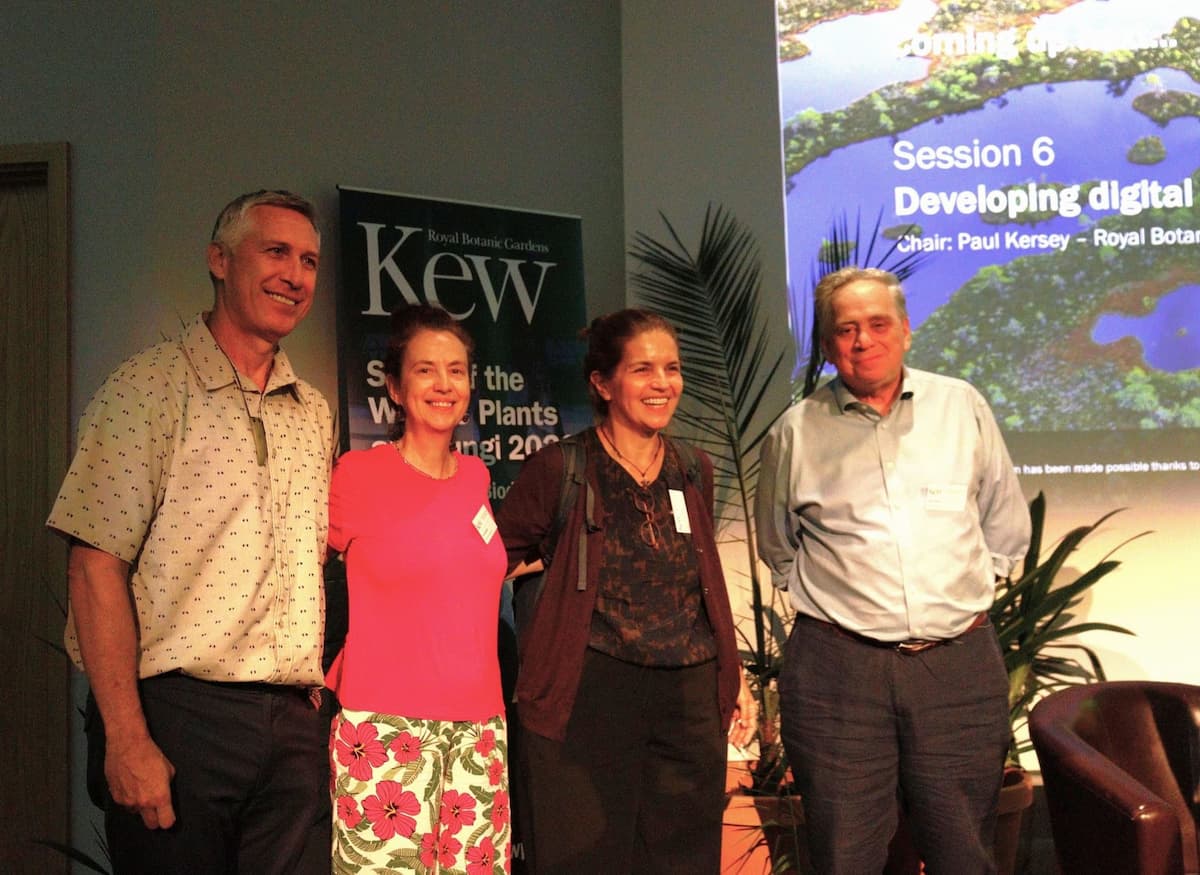
The most memorable session for me came on the last day of the symposium, titled “Tapping into the biocultural wealth of collections”, chaired by Mark Nesbitt. It was a much-needed sanity check. It is easy to get excited by new data, new tools and new platforms. Ina Vandebroek, Māui Hudson and Viviane Stern da Fonseca-Kruel shifted the discussion from access to authority. The question was no longer only how to put collections online. It was whether the language of “unlocking” and “tapping into” collections hides harder questions about who benefits.
Collections as living cultural heritage
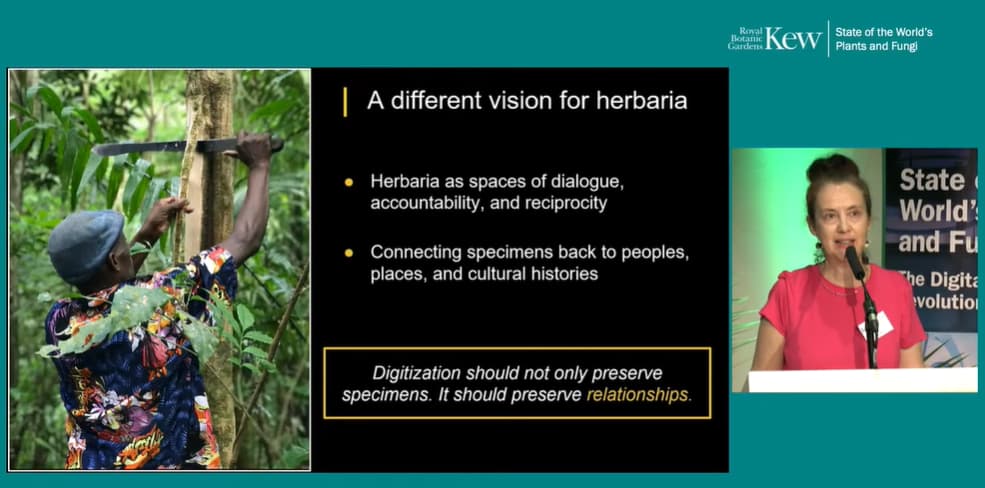
Firstly, Vandebroek framed ethnobotany as a bridge between communities and herbaria. She and her colleagues estimated in a recent article in Plants, People, Planet that more than one million herbarium specimens may contain ethnobotanical or biocultural information. Her examples showed why openness cannot follow a one-size-fits-all model. A widespread species with important cultural uses may need community review before data are shared. An endemic cactus being sold in New York may raise legal risks for diaspora communities. A culturally important wild-harvested Jamaican spice tree may face additional pressure if its locations are made openly available.
Highly recommend watching the entire "Tapping into the biocultural wealth of collections" session.
In the SOTWPF report, Vandebroek says:
“Collections are not just scientific resources. They are repositories of living cultural heritage, and the communities whose traditional knowledge they hold must have a voice in how the associated data are kept and used.”
Botany One also asked Vandebroek what stayed with her after the symposium. Her answer returned to the same tension between speed and responsibility:
“We are racing with the Biodiversity Data Revolution, but we have to make sure we do not leave communities behind so that they do not get the short end of the stick. How will communities be part of these conversations? If we are ambitious about this revolution, we need to be equally ambitious about our commitment to source communities. It is not optional or an afterthought.”
That line should sit at the centre of any conversation about digitisation. A specimen label may contain a plant name, a place, a use, a collector, a language, a knowledge-holder, or a sacred relationship. Those details can be valuable scientifically. They can also be sensitive, extractable, decontextualised or harmful if treated as ordinary open data.
Vandebroek’s conclusion was a different vision of herbaria: spaces of dialogue, reciprocity and accountability, reconnecting specimens to people, places and traditional knowledge systems. Digitisation, she argued, should not only preserve specimens as biological records or data points. It should preserve relationships between people and plants, between knowledge and place, and between communities and institutions.
Labels, Notices and the work of responsibility
Next, Māui Hudson’s talk was one of the sharpest reflections of the symposium and asked what digitisation does to relationships.
He began by taking apart the session title itself: “Tapping into the biocultural wealth of collections.” The phrase sounds positive, but it carries assumptions: that something is waiting to be uncovered, that the “wealth” is unrealised, and that someone has the right to tap into it.
Hudson put the questions plainly: “But who’s doing the tapping? Who does the wealth belong to? And who benefits from the collections?” He then made the balance clear: “Digitisation is good.” It improves access, supports decision-making, and creates opportunities for education and capacity-building. But the same systems can also worsen equity issues, allowing researchers and companies to bypass direct engagement with Indigenous peoples and local communities, and facilitating appropriation of genetic resources and traditional knowledge.
The access pathway is easy to describe: archives become digitisation projects, then AI “unlocks” knowledge. The benefit-sharing pathway is harder: data governance, Indigenous metadata, relational infrastructure, capacity-building and long-term relationships.
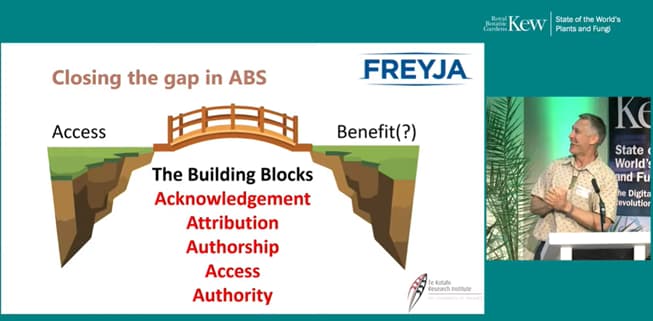
That is where Local Contexts becomes practical. Its Notices are assigned by institutions or researchers to disclose Indigenous rights and interests, while Traditional Knowledge and Biocultural Labels are assigned by communities to carry provenance, protocols, permissions and expectations for use. This links directly to the CARE Principles for Indigenous Data Governance: collective benefit, authority to control, responsibility and ethics. Hudson’s “building blocks” were deliberately concrete: acknowledgement, attribution, authorship, access and authority.
His examples showed how technical this work really is. The New York Botanical Garden pilot on reconnecting Indigenous data to Country mapped Australian specimens against Aboriginal and Torres Strait Islander geographies. A Smithsonian example linked 50,000 samples from Moorea to Local Contexts Notices and a community stewarding the lands and waters where those samples originated. GBIF’s Indigenous data governance task group is now testing how Labels and CARE principles can move through open biodiversity data systems, rather than disappearing when records are aggregated.
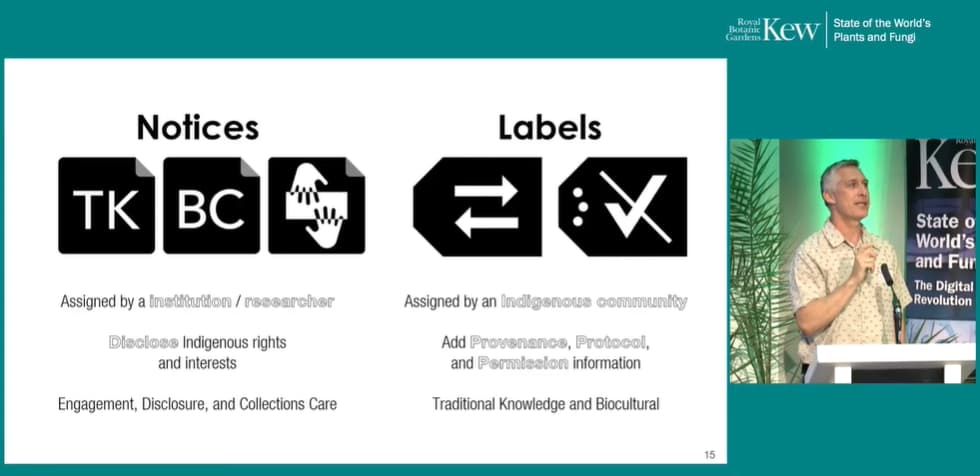
Hudson’s most practical answer came in the Q&A. Asked what a large historical colonial collection could do to begin implementing CARE principles, he replied: “I would say implement the labels.” But he did not present Labels as the endpoint. They are “a starting point” for conversations about fields, traditional knowledge, engagement and the wider challenges around collections data. That is a serious answer because it moves the discussion from good intentions to workflow.
Hudson also shared a practical resource trail during his talk: the comic Local Contexts: Restorying Sovereignty with Plant Relatives, the films They Returned Home and The Connection Remains, Local Contexts working groups, and the Benefit Sharing Compass game.
Not numbers, but stories
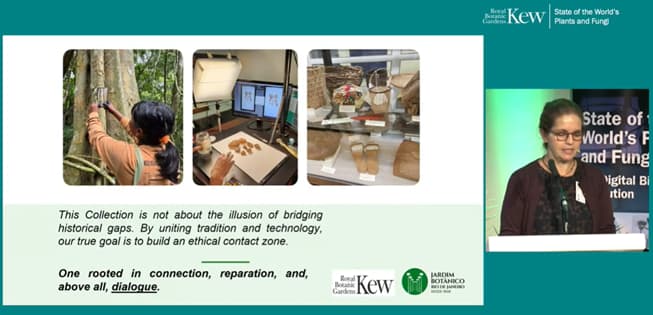
The last speaker in this session was Viviane Stern da Fonseca-Kruel, about her work at the Rio de Janeiro Botanical Garden, which can be summarised with her one-liner: “At JBRJ, we don’t collect numbers, we collect stories”.
The digitisation of the Garden’s Ethnobotanical Collection, of which we blogged about for our Digital Botany Issue, reveals biocultural details on how Indigenous Peoples and local communities refer to, use and manage plants and fungi. The collection includes raw and processed plant products such as fibres, ornaments, instruments, necklaces, baskets, construction materials and household utensils. Brazil’s JABOT platform is being used to connect these records with curation and intercultural understanding, but they have not openly published their digitised database yet, as they are still reviewing and deciding on how it would be best.
Fonseca-Kruel is quoted in the report saying that digitising biocultural collections is important for “associating, recognising and valuing the holders of knowledge linked to the belongings of Indigenous Peoples and traditional communities.” The next sentence is just as important: by recognising communities as “true guardians of biocultural diversity”, digitisation can support intercultural dialogue, traceability and protection of traditional knowledge.
DiSSCO UK: Open data, commercial reuse and alarm bells
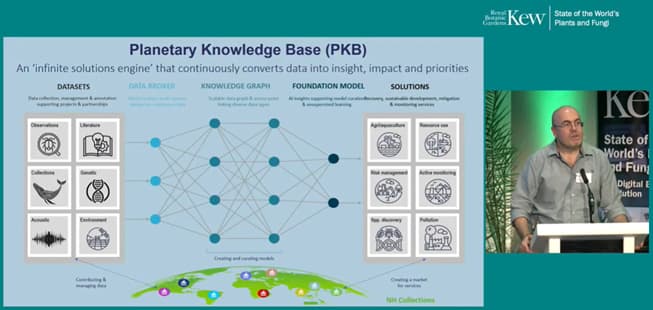
DiSSCo UK’s talk brought the infrastructure and money question into focus. The presentation described a £155.6 million, ten-year national digitisation infrastructure for UK natural science collections, aiming to unlock around half of the UK’s 141 million specimens. This will lead to an estimated £2 billion value in return. The programme involves more than 90 organisations, with hub-and-node digitisation, infrastructure, services, financial sustainability and a planetary knowledge base all part of the architecture.
And. The public DiSSCo UK digitisation guidance says that all data produced is expected to be openly published, with CC0 for data and CC BY 4.0 for images. CC0 enables free use for any purpose, with no permission requests required, no attribution required and unrestricted copying, modification and redistribution. CC BY 4.0 allows sharing and adaptation for any purpose, even commercially, with attribution.
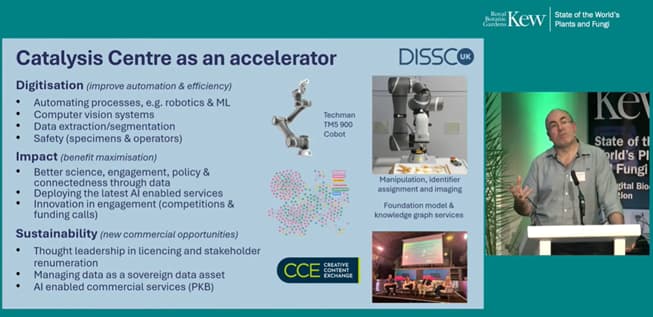
That means digitised collection data, much of it entangled with imperial collecting histories, can be available for commercialisation without restriction. They can be used by generative and commercial AI systems. They can also be used in pharmaceutical discovery, agriculture, mining, environmental risk assessment and other industries. Sitting in the room, this landed as a red flag.
Open access can democratise knowledge. Many researchers, educators, conservationists and students depend on it. But openness alone does not guarantee fairness. It does not automatically return value to the source communities. It does not build local infrastructure. It does not repair colonial collecting histories. It does not decide which sensitive records should remain closed.
Digitising collections is cheaper than building long-term partnerships. It is easier than repatriating specimens. It is faster than training people, sharing power, changing funding models or asking difficult questions about colonial histories. But if we want this revolution to be worthy of the collections it depends on, those slower tasks cannot remain optional.
Final session: AI, Pl@ntNet and the human loop
The final AI session pushed these questions into the future. AI can help identify plants, process labels, extract traits, detect patterns, support monitoring, and widen access to expertise. But “AI” is not one thing. Commercial generative AI, research AI, computer vision, citizen-science tools and biodiversity-monitoring systems carry different risks and benefits. The discussion made that distinction clear: focus only on commercial generative AI and you miss the positives; treat all AI as benign, and you miss the harm.
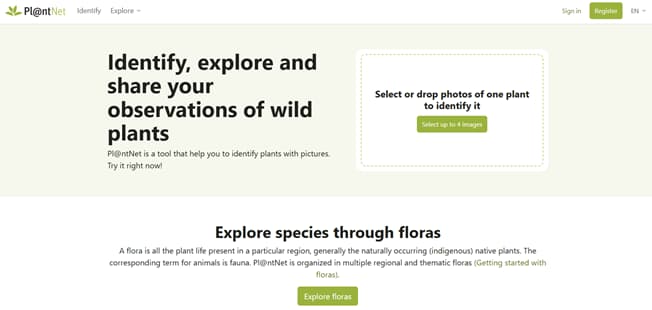
Pl@ntNet is a great example of a human-AI loop, the final session kept circling back to. It is not just a plant-identification app and browser. It is a long-running citizen-science and computer-vision system that links images, users, taxonomic knowledge, model improvement and biodiversity observations. The project now sits across identification, open data, APIs, GBIF publishing and research infrastructure, with the Pl@ntNet site listing more than 84,000 species, 1.47 billion images and 77 floras. Citizen-science AI can move beyond “what is this plant?” towards biodiversity monitoring and research-ready data.
Botany One asked Pierre Bonnet for his takeaways from the final AI session. He pointed to Pl@ntNet as a human-AI collaboration rather than an expert-replacement tool:
“At the final special session, Supercharging biodiversity conservation: The powers and pitfalls of AI, Pl@ntNet highlighted how artificial intelligence can broaden access to botanical knowledge while strengthening scientific expertise. By providing a free, large-scale plant identification service used by millions of people worldwide, Pl@ntNet helps extend the reach of botanists and taxonomists, making their knowledge accessible far beyond traditional academic circles. This human-AI collaboration not only empowers the public to engage with plant diversity but also contributes valuable biodiversity observations that support research, conservation, and our collective understanding of life on Earth.”
That is the version of AI worth paying attention to. It does not remove people from biodiversity science. It changes where people enter the system: as observers, identifiers, validators, taxonomists, data curators, model builders and users. It also links back to one of the best lines from the image discussion. The machines are not going to make our data meaningful for us. We have to do that work.
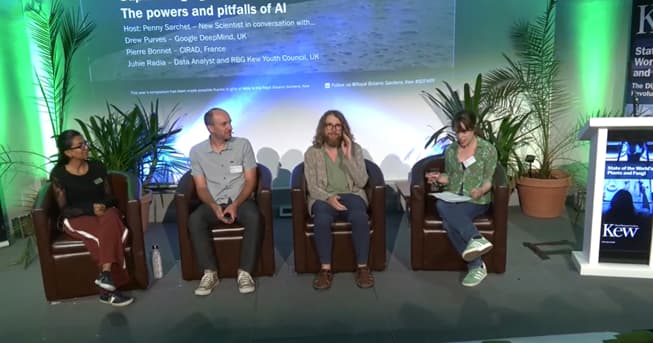
The Google DeepMind contribution in the final session sat in a wider discussion about whether AI will upskill people and free them to spend more time in the field. That is an appealing promise. It also needs testing against the old story of the fisherman and the businessman. The businessman teaches the fisherman how to scale up, work harder, grow the enterprise and eventually retire to enjoy the simple life he already had. The question is not only whether AI saves time. It is who gets that time back.
Next up: how to keep up whilst slowing down?
By the end of the symposium, it was clear that digitisation is powerful, but digitising a specimen is faster than building a partnership. Scanning a label is easier than understanding the world that produced it. It is cheaper to digitise collected knowledge than to fund local collections, repatriate specimens, train people long term, or share power.
But cheaper is not the same as better.
The future of digital botany should be open, yes. It should also be careful, reciprocal and reflective.
Otherwise, the digital biodiversity revolution risks becoming just recolonisation with fancy cameras.
Read more
• Part 1: The Digital Biodiversity Revolution Needs More Than Data
• State of the World’s Plants and Fungi 2026 report - the report behind the symposium
• Local Contexts Labels - Traditional Knowledge and Biocultural Labels
• Local Contexts Notices - institutional disclosure and collections-care tools
• Local Contexts films - including They Returned Home and The Connection Remains
• Local Contexts: Restorying Sovereignty with Plant Relatives - comic shared in Maui Hudson’s talk
• CARE Principles for Indigenous Data Governance - collective benefit, authority, responsibility and ethics
• GBIF Indigenous data governance task group - open data for people and purpose
• DiSSCo UK digitisation guidance - licensing and digitisation guidance
• Pl@ntNet - human-AI plant identification and biodiversity observations
• Hart, R., Fonseca‐Kruel, V., Dalcin, E., da Silva Luís Alexandre, E., Pace, M., Schmull, M., Beltran‐Rodríguez, L., Murguía‐Romero, M., Flores‐Camargo, D., Mapes‐Sánchez, C., Nesbitt, M., Romero, C., Townesmith, A., Salick, J., McAlvay, A., Otero‐Walker, K., Balick, M., Golan, J., Hoffman, B., Leonard, K., Mattalia, G., Odonne, G., Prehn, A., and Vandebroek, I. (2025) Repositories of biocultural diversity: Toward best practices for empowering ethnobotany in digital herbaria. PLANTS, PEOPLE, PLANET, 8(4), pp. 1095-1103. Available at: https://doi.org/10.1002/ppp3.70052.
• Fonseca‐Kruel, V., Coimbra, C., Estevão da Silva, L., Oliveira, F., Vasconcelos Mesquita, M., Taniguchi, M., and Forzza, R. (2025) Connecting tradition and technology: The digitization of the ethnobotanical collection at the Rio de Janeiro Botanical Garden. PLANTS, PEOPLE, PLANET, 8(4), pp. 1104-1115. Available at: https://doi.org/10.1002/ppp3.70105.