
The destination is Mars – and a resilient crop is needed for future space agriculture. Scientists are testing out sweet potato using a ‘Mars regolith stimulant’ (MRS) – a terrestrial growth substrate specially designed to mimic the chemical, mineral and physical properties of Martian soil.
“Understanding how organisms adapt to extraterrestrial environments is essential for supporting human life beyond Earth,” write Chinreddy and colleagues in their paper published in the Journal of Advanced Research. “Sweet potato (Ipomoea batatas) stands out among potential crops for space agriculture due to its robust yield, drought tolerance, high nutritional value, and ability to regenerate from vine cuttings.”
Martian soil poses significant challenges to agriculture. It contains high salt (perchlorates and sulfates), excessive iron and manganese, and has poor water retention because it lacks organic matter. Scientists therefore use MRS to test out how plants like sweet potato might grow on Mars and to study their stress response.
“Exploring plant adaptability in extraterrestrial soils is crucial for Mars missions aiming to grow food for astronauts,” write Chinreddy and colleagues.
To find out how sweet potato might tolerate Martian soil, the scientists grew sweet potato in pots containing either a control mix of potting soil or the simulated Martian mix at the Bioplex facility at West Virginia State University in the United States. Chinreddy and colleagues isolated the plants’ genetic material (total RNA) from leaves, shoots and storage roots and compared gene expression between the plants grown in Earth-soil to those in MRS. Next generation sequencing on leaves, shoots and storage roots was performed.
The scientists found that core stress response genes were consistently more highly expressed in Martian-soil grown plants.
While previous research had shown that sweet potato can grow in Martian regolith supplemented with nutrients, this study by Chinreddy and colleagues goes further by identifying genes potentially involved in how sweet potato respond to the stress of Martian soil. They show that genes for cell wall modification, secondary metabolites, reactive oxygen species management and metabolic detoxification are affected, in a tissue-specific manner (e.g. in leaves or roots).
A group of defense-related genes in the cytochrome P450 family were also activated by plants grown in Martian soil. Additionally, changes in gene expression for genes known to be involved in drought and heavy metal stress were observed.
These primary insights from a Martian-like soil mixed with Earth-based nutrients are a good first-step for mankind to build a resilient space agriculture.
"Future work will focus on functional validation in genetically tractable model crop systems," write Chinreddy and colleagues. "Insights gained from these models can subsequently inform targeted breeding and genetic improvement strategies in sweet potato, thereby supporting the development of stress-resilient crops for space agriculture."
READ THE ARTICLE: Chinreddy, S., Chinnannan, K., Natarajan, P., Patel, V., Lee, G., Chakrabarti, M., Nimmakayala, P., and Reddy, U. (2026) Molecular adaptation of sweet potato to Martian soil simulant: insights from mRNA and long non-coding RNA analyses. Journal of Advanced Research. Available at: https://doi.org/10.1016/j.jare.2026.04.050.
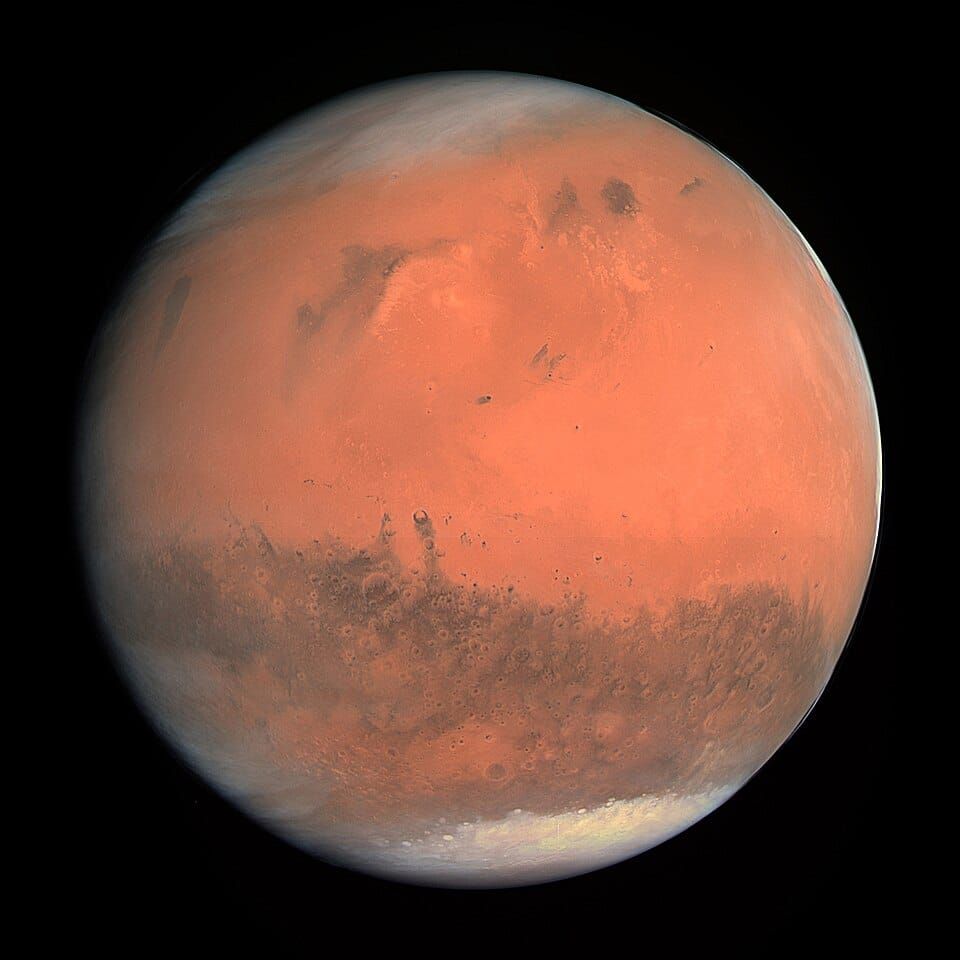
Cover Image: True color image of Mars taken by the OSIRIS instrument on the ESA Rosetta spacecraft during its February 2007 flyby of the planet. The image was generated using the OSIRIS orange (red), green, and blue filters. ©ESA Courtesy of ESA & MPS for OSIRIS Team MPS/UPD/LAM/IAA/RSSD/INTA/UPM/DASP/IDA, CC BY-SA 3.0 IGO