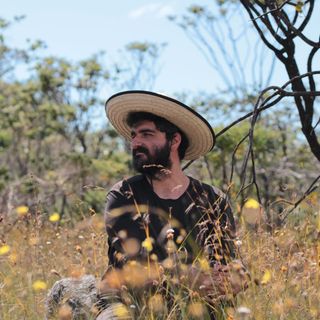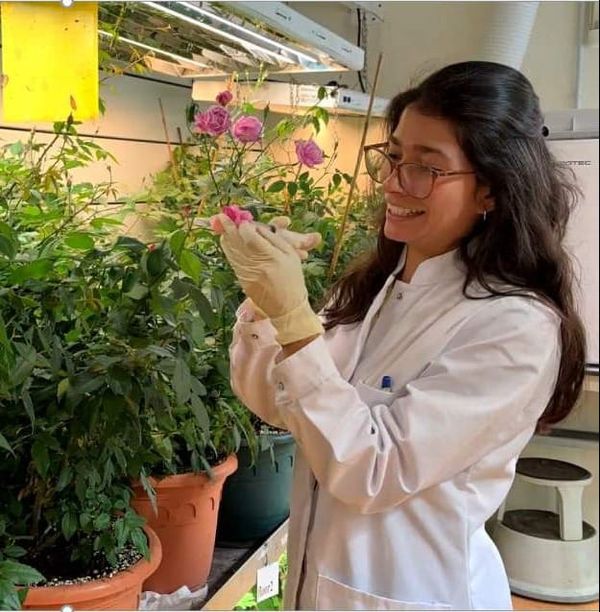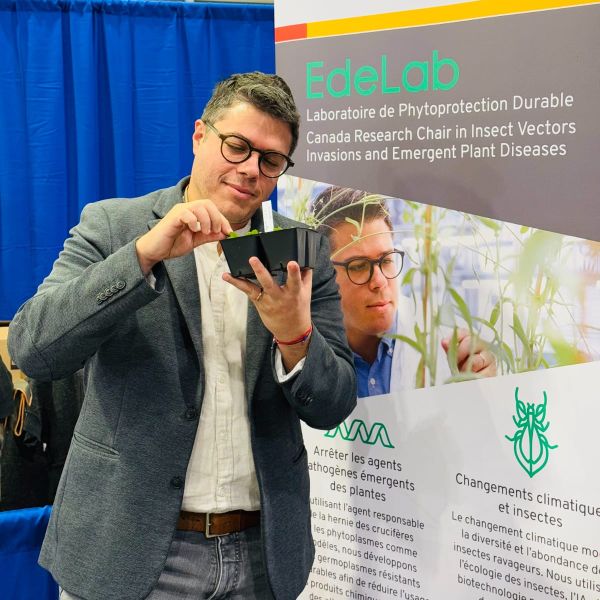

Plants are incredibly diverse, and so are botanists! In its mission to spread fascinating stories about the plant world, Botany One also introduces you to the scientists behind these great stories.
Today, we have Dr Sreetama Bhadra, the head of the Plant Evolutionary Ecology group at the Institute of Botany, Czech Academy of Sciences, Průhonice, Czech Republic. She is an evolutionary biologist and cytogeneticist pursuing a fundamental question: why do some plant groups rapidly evolve into hundreds of species while their close relatives remain species-poor?
Bhadra studies genome size—the total amount of DNA in a cell nucleus—and polyploidy, the presence of multiple sets of chromosomes. She investigates how these genomic features shape what plant lineages can become: how their traits evolve, where they can grow, how widely they spread, and how readily they diversify into new species. In doing so, her research connects processes occurring within individual cells to evolutionary patterns visible across continents.
Bhadra began her scientific career in India and continued pursuing these questions through postdoctoral research in China and Germany before establishing her own group in the Czech Republic. Her team studies flowering plants using a wide range of approaches, from microscopy and molecular techniques to plant collections and statistical modelling. Their work also has practical implications: understanding which lineages can adapt rapidly and which may be more constrained could help identify plants particularly vulnerable to climate change. Alongside her research, Bhadra is also involved in promoting gender equality in academia.
You can learn more about her work on her personal webpage and follow her on LinkedIn.
What made you become interested in plants?
My father is a botanist, so plants were part of my childhood, which, if anything, made them easy to take for granted. Evolution, though, was the part of school biology that held my attention. Everything alive descends from a single origin in the Tree of Life, so that a plant and a mammal are cousins, more than a billion years removed, and you can work backwards along the branches to find out what happened. By the time I finished school, that interest had narrowed to plants.
My undergraduate degree settled it. Botany was my main subject, alongside Zoology. So, I was learning the two in parallel, and the contrast was hard to miss. Animals seemed beautifully engineered and rather fragile. Take away their food, their water or their temperature range and they die. Plants seemed stubborn. They grow out of walls. They come back from a burnt stump. They survive being cut in half, and they endure conditions that would finish most animals within a day, without anywhere to run to.
Something about the way plants are built lets them do that. I wanted to know what it was. I still do.
What motivated you to pursue your current area of research?
My PhD was on the chromosomal, genomic and genetic variability of Indian gingers, and it left me with a suspicion I could not shake. I was looking at real variation in real cells, and chromosome numbers, ploidy, genome sizes shifted between close relatives. It seemed obvious that this ought to matter for how those lineages evolved. But cytogenetics and macroevolution rarely meet at the scale I am interested in. Genomes are described in exquisite detail, a few species at a time, while diversification is explained across whole phylogenies, without asking whether the size and structure of genomes mattered.
Where the two do meet, the line runs straight from genome size or ploidy to diversification or distribution. The step in between is missing. A genome does not produce new species by itself. Instead, it changes the traits a plant can evolve, and those traits determine where a lineage can live and whether it splits. Leaving them out means testing the ends of a chain without its middle.
Closing that gap is what I spent my postdocs on, and what my group continues to work on. You cannot do it with cytogenetics alone, and you cannot do it with modelling alone.
What is your favourite part of your work related to plants?
My favourite part is when large, messy datasets begin to reveal a story and the puzzle I have been trying to solve starts falling into place. What makes it satisfying is that the puzzles are not new. People have been describing and classifying plants for as long as we have written records. Cytogeneticists have been recording chromosome numbers and genome sizes for over a century. But it was not possible to test what any of it meant across thousands of species at once. I get to work with data assembled by hundreds of people over centuries, and sometimes an answer appears that none of them could have reached alone.
The other part is the students. Academic leadership in Europe still looks fairly uniform, and I am aware of being an exception to it. Students notice too, and representation matters. It is easier to imagine a path when someone who shares your background has already walked it. So I mentor, formally and informally, and not only women. Much of it is telling people that hard things are hard for everyone, failed experiments, unsuccessful grants and rejected papers vastly outnumber the successful ones, and uncertainty is not a sign they have chosen wrong.

Are any specific plants or species that have intrigued or inspired your research? If so, what are they and why?
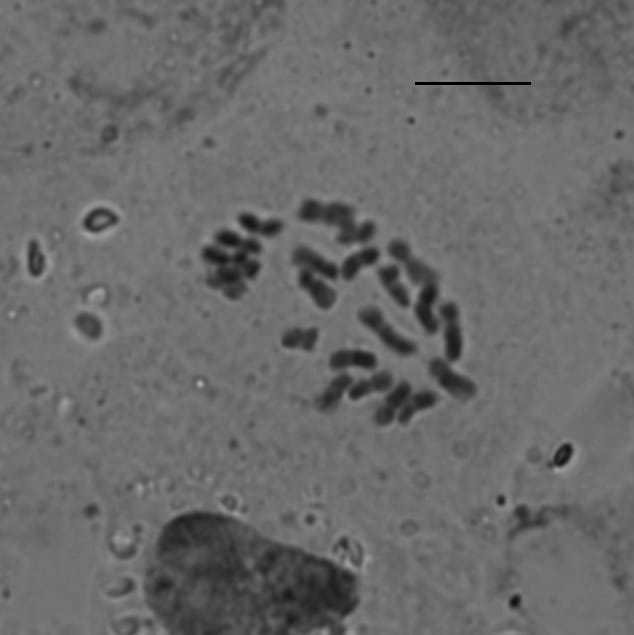
Two, at opposite ends of my career. I started with the ginger family, Zingiberaceae, and they taught me not to trust tidy expectations. Their chromosomes are minute, and flattening out a single cell clearly enough to count the chromosomes and see their structure can take days or even weeks. And once you have one, the numbers refuse to behave: close relatives turn out to have different counts. That disorder is what sent me looking for an explanation, and gingers have never entirely stopped surprising me.
Palms came later, for almost the opposite reason. They are a large, ancient, tropical family whose traits, distributions and phylogeny are documented unusually well. This makes them one of the few groups where you can ask a genome-scale question across an entire family and expect a real answer. They are also plants people think they already know, familiar from every tropical postcard, and it is satisfying to find that the familiar ones still have unanswered questions in them.
Could you share an experience or anecdote from your work that has marked your career and reaffirmed your fascination with plants?
During my PhD, I spent a great deal of time counting chromosomes in gingers. Squashing root tips, staining, then sitting at the microscope for hours until a cell cooperates is slow, unglamorous work. In Curcuma especially, plants would turn up with odd numbers, extra sets, or sets that were plainly incomplete.
Turmeric itself is a sterile triploid with three sets of chromosomes instead of two, 63 in total. That would be lethal in an animal. But gingers spread by rhizome, so sexual reproduction was never essential to them in the first place, and a disorderly genome costs almost nothing. This is not peculiar to clonal plants. Every flowering plant alive today descends from at least one whole genome duplication somewhere in its past.
That tolerance is not a curiosity. It is, I think, one of the reasons plants have come through disturbances that erased many animal lineages. Plants are fixed where they germinate, so they have to be flexible instead, and duplicating or rearranging the genome is one of the ways they manage it. What I want to know now is whether that flexibility has a speed limit, and whether the pace of current climate change is pushing plants against it.
What advice would you give young scientists considering a career in plant biology?
Don't worry if your path doesn't look like anyone else's. Mine has moved between countries, institutes and methods more often than I would have predicted at the start, from microscope to greenhouse to command line. What stayed constant was the question: what does a genome permit a plant to become?
Plant biology is broad enough to absorb almost any interest you bring to it. There is taxonomy, genomics, ecology, evolution, conservation, agriculture, invasion biology, and plenty more. Try fieldwork, try lab work, try modelling, or try all three. But find the question that actually holds your attention rather than the one that sounds impressive to others, because that is what will carry you across the moves and method changes.
And you don't need to know everything at the start. I learnt modelling long after my PhD, and it was uncomfortable for a while. Most careers here are built out of unexpected questions, chance collaborations and a fair amount of stubbornness. So, keep asking what genuinely interests you, learn whatever tools that question demands next, and don't be afraid to ask for advice. People who have worked in a field for decades usually want to pass it on.
What do people usually get wrong about plants?
People treat plants as background scenery, and once you stop really seeing something, you stop asking what it is doing.
One consequence is that we mistake stillness for inactivity. Plants live in communities, competing, cooperating and shifting in composition over time, like us. The restlessness goes all the way down. Plants duplicate entire genomes, gain and lose chromosomes, and hybridise in ways most animals could not survive. And the community is never only plants: it runs down into the soil and the microbes they trade with, and out into the animals they support. None of this is visible from outside, which is precisely why it goes unnoticed.
The other is that we read green as healthy. A mown lawn, a row of clipped ornamental shrubs, or a field of a single crop are green, tidy and satisfying to look at, but most of them support far less life than they appear to. We have trained ourselves to take plant cover as a sign of environmental health, when often what we are looking at is an arrangement of plants that suits human aesthetics and very little else.