
We’re coming round to our annual assessment here at AoBBlog. Spurred by JSTOR Plants and their blog post on Social Media we’re sharing our thoughts. And if you have better thoughts we’d welcome them as a comment on this post.
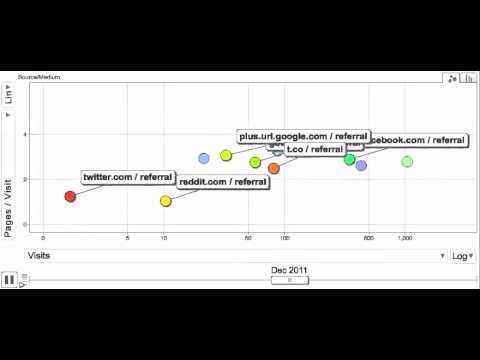
In our case we have three social networks we target: Facebook, Twitter and Google+. Facebook and Twitter are easy to populate, we have auto-posting from the weblog to Facebook and Twitter so you don’t have to keep visiting here to see what’s new. Google+ has to be posted to manually. We’ve also played with Reddit, Stumbleupon and Pinterest over the past year. If you’d like to see what referrals we’ve had to this site from social media, here’s an animation of the past year:
broken video
Note that it’s a logarithmic scale horizontal scale for the number of visitors. This is because there was such a spike from Reddit that, if we had a linear scale, everything would appear to be stuck on the zero visitors axis, except for a quick flurry from Reddit in March. In fact you can see our year on Reddit below:
another broken video
So what is happening here? It’s simply that without effort from us, one of posts briefly went viral on Reddit. This happened after I’d given up on Reddit. If you’re not familiar Reddit is a site where people submit links and people vote them up, down or ignore them. I’d been submitting some sites, not all AoB Blog posts, to Reddit. Because it’s an interest-based community I’d only picked links that I thought were interesting and I think they all pretty much sank without trace. I’d been also voting up other stories I’d found interesting, but not many. My conclusion here is that Reddit is a good source of traffic, but it needs special attention and it works best when you’re fully participating in Reddit. I don’t have the time to devote to that. In particular I think it’s best to focus on a good quality sub-reddit, a page that covers a specific subject. The quality of sub-reddits vary. Some are notorious for being stuffed with cranks, but I think that on the whole the Biological Sciences sub-reddits, including Botany are pretty sane. They’re also unpredictable. The spike you see happens in March. The post that got picked up was our Valentine’s Day post on Rainbow Roses. If we had someone who could contribute to Botany as a whole, and not just our posts, this could be a network worth investing time in.
The most favoured network for people who don’t do social media is Facebook. People have heard of Facebook, even if they don’t use it. We’re on Facebook at http://www.facebook.com/AnnalsOfBotany and you’re welcome to join us there.
I think everyone in the office now has a Facebook account of some sort, but I don’t know how many of us see it as a network for discussing professional matters. This is why we need a multiple network strategy. It’s not that one network is better than the others, it’s they they get used differently. For example for friends I use Facebook, for interests I use Google+, for following what new in blog posts I use Twitter and when I don’t want to be social in any way I use LinkedIn. But this is how I use networks, because that’s how they work best for me. For other people it works differently and we shouldn’t be in the business of telling people how they should use their networks. For Facebook we see some variation in use over the course of the year. In all the graphs below the visitor scale is linear, so the further right a dot goes the more visitors the blog is getting from a site. The vertical axis is pages viewed per visit, so the higher it goes the more of the site a visitor is browsing. Each dot on the trail marks the end of a month and we start on June 1:
yet another broken video
What we see here is that there’s a very different use in September to November, February and March. In September what we had was a relatively high number of page views per visitor. Initially I thought this was high interest/engagement in the site but that might be a bad assumption. What we seem to see is people at the start of term looking around to see what the site offers and then hitting the site in numbers during term time. Now is this higher viewing, but lower pages per view signal with the spikes to the low right really a case of more visits and less engagement? Another possibility isn’t that people are less engaged, but are more familiar with the site, so they’re hitting what they want and moving on to the journal rather than wandering around trying to find something relevant. But it also might not be. What the graph doesn’t show is that we had a massive uptake in likes during October. A lot of the visitors for this period must be people who weren’t familiarising themselves with the blog in September. Taking this into account, it looks like the Facebook visitor is someone who has a specific target they’re interested in when they visit.
We probably see a similar pattern for Twitter. In the graph below the dots are all sites starting with 'T'. This was the only way to get referrals from Twitter.com and t.co on to the same graph. During the past year Twitter phased out twitter.com and made t.co it’s referral service with short links. In the next year t.co should account for all Twitter referrals:
and yet another broken video
Posting to Twitter is a zero-effort task. Autoposting plugins mean that blog posts are tweeted when they’re published. The relatively low number of visits from Twitter is probably partly a reflection of this lack of effort. We did innovate with Twitter by covering tweets at IBC18 from a distance, which was a high-effort undertaking. There was positive feedback for this, and tweeting from other conferences through the annbot account would increase interest in the twitter feed, if not clicks-through. This does require people at conferences who are willing to tweet what is happening.
The new launch over the past year has been Google+. Take-up of Google+ has been patchy and user’s opinions have been mixed. A common complaint is that Google+ is a ghost town and no one posts there. This isn’t _entirely_ accurate. Google+ has privacy settings and commonly people only share with other people in their circles. A new member of Google+ isn’t likely to be in anyone’s circles and so won’t see much of the conversation that’s happening. All AoB editorial staff on Google+ regularly post items with Public visibility, so new members can see what is being posted. The Annals of Botany page on Google+ also routinely posts publicly. We have discussed setting up specific circles to post extra content to for followers, but so far have preferred to leave everything as public as possible. Tracking Google+ visits is difficult. plus.google.com and plus.url.google.com are obvious referrers. Is google.com/ referral also a referral from Google+, or does this cover Gmail and Google and not Google+? All three make an appearance in the graph below: