
Life is all about trade-offs.
At least, that’s the idea behind the growth-defense tradeoff hypothesis. This premise posits that the metabolic costs of defense and growth are inherently at odds with one another, essentially driving plants to “choose” between investing in either defense preparedness or biomass accumulation, depending on environmental conditions.
Recently, however, researchers at the Swedish University of Agricultural Sciences showed that there’s another factor influencing this decision: neighborhood gossip.
One of the ways plants “talk” to each other is through the emission of a unique combination of gaseous chemicals known as Volatile Organic Compounds (VOCs). Historically, scientists learned about plant defense by analyzing the VOCs emitted when a plant is under attack. These stress-induced VOC emissions can chemically alter the emitting plant’s palatability while also “warning” neighboring plants of the attack, improving plant health outcomes.
But VOCs don’t have to be stress-induced to be worth listening to. Baseline VOCs, emitted constantly by an undamaged plant, can transmit a wealth of information about the emitter's growth status. These signals are picked up by nearby plants of the same species, also known as receivers.
This sparked a hypothesis for André Åbonde and his colleagues at the Swedish University of Agricultural Sciences: Perhaps the VOCs of young, undamaged plants can shape how neighboring plants perceive threats and make energy investments.
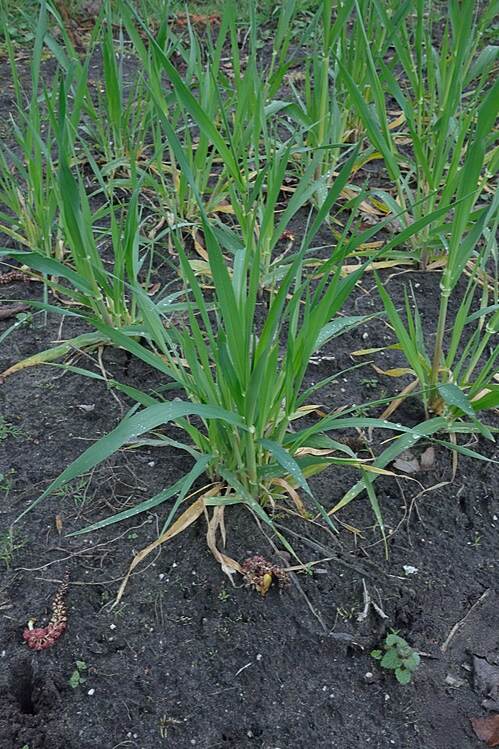
To test this, they designed an experiment focusing on the effects of VOCs emitted by three unique cultivars of barley: Fairytale, a slow-growing cultivar; Luhkas, a cultivar characterized by a typical growth rate; and Salomas, a fast-growing cultivar.
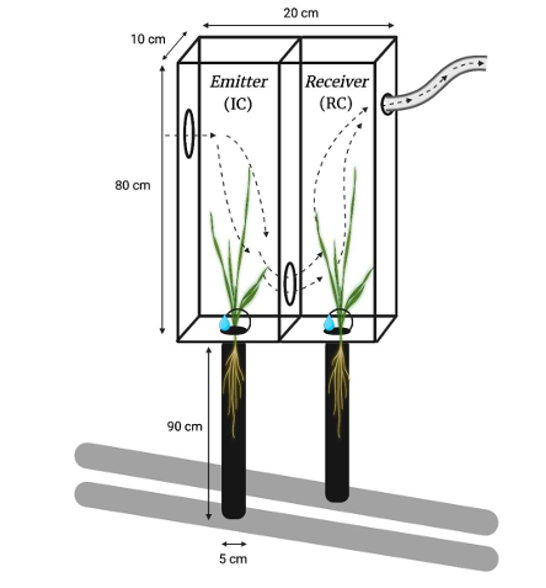
The crux of their experimental design relied on a dual-celled chamber, which allowed the VOCs from one plant to reach the other plant via one-directional airflow. In this setup, the “emitting” plant gave off VOCs, which were then picked up in the air current and deposited into the chamber of the “receiving” plant.
In their experimental setup, a plant of either the Fairytale (slowest-growing) or Salome (fastest-growing) cultivar was placed in the receiving chamber, where it was exposed to the VOC emissions produced by the cultivar in the emitting chamber. They hypothesized that the VOC emissions of a comparatively fast grower, like the Salome cultivar, would influence the typically slower-growing receiver plants like Fairytale to grow faster, investing in less defense preparedness as a result. Similarly, they hypothesized that the VOC emissions of a comparatively slow-grower, like the Fairytale cultivar, would influence the typically faster-growing receiver plants like Salome to grow slower, investing in more defense preparedness as a result.
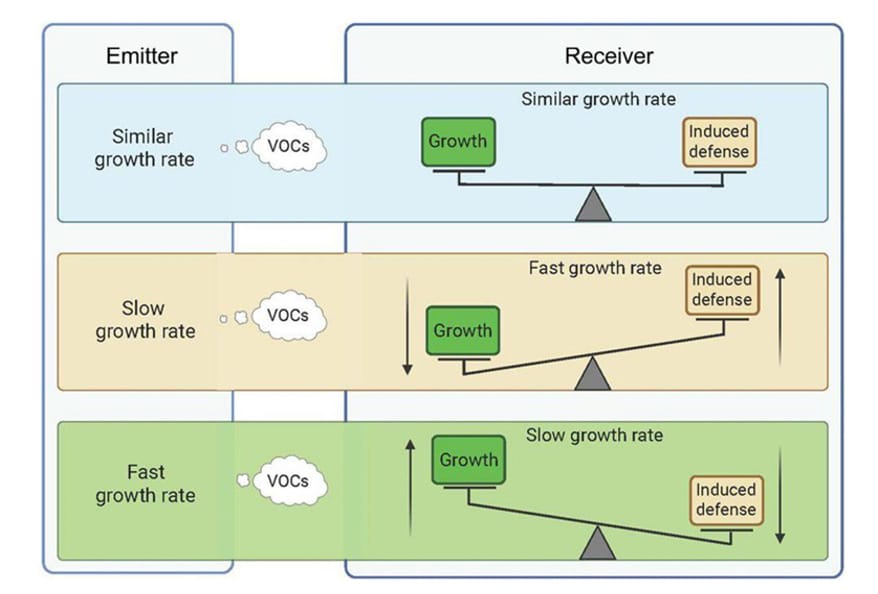
By measuring the biomass and genetic trends of each receiver plant in the study before and after 20 days of exposure to the emitter plant, the authors gained support for their hypotheses: Fairytale (slow-growing) showed increased biomass accumulation and reduced stress response when exposed to the VOCs of Salome (fast-growing), and Salome showed decreased biomass accumulation and increased stress response when exposed to the VOCs of Fairytale.
These results suggest robust support for the growth-defense tradeoff hypothesis as well as potential future applications for VOCs.
“Our results are consistent with a trade-off,” wrote corresponding author Dr. Velemir Ninkovic in an email exchange. “A practical next step would be to compare candidate mixtures with their component cultivars grown separately, measuring harvested yield, pest damage and performance across growing conditions.”
The future of plant science has never looked chattier.
READ THE ARTICLE: Åbonde, A., Rensing, M., Gallinger, J., Juárez-González, V. T., Dahlin, I., Markovic, D., Martinez, G., and Ninkovic, V.(2026) Volatiles released by undamaged plants mediate the adaptive growth strategies in neighbors. Journal of Experimental Botany, 77(16), pp. 5124-5139. Available at: https://doi.org/10.1093/jxb/erag252.
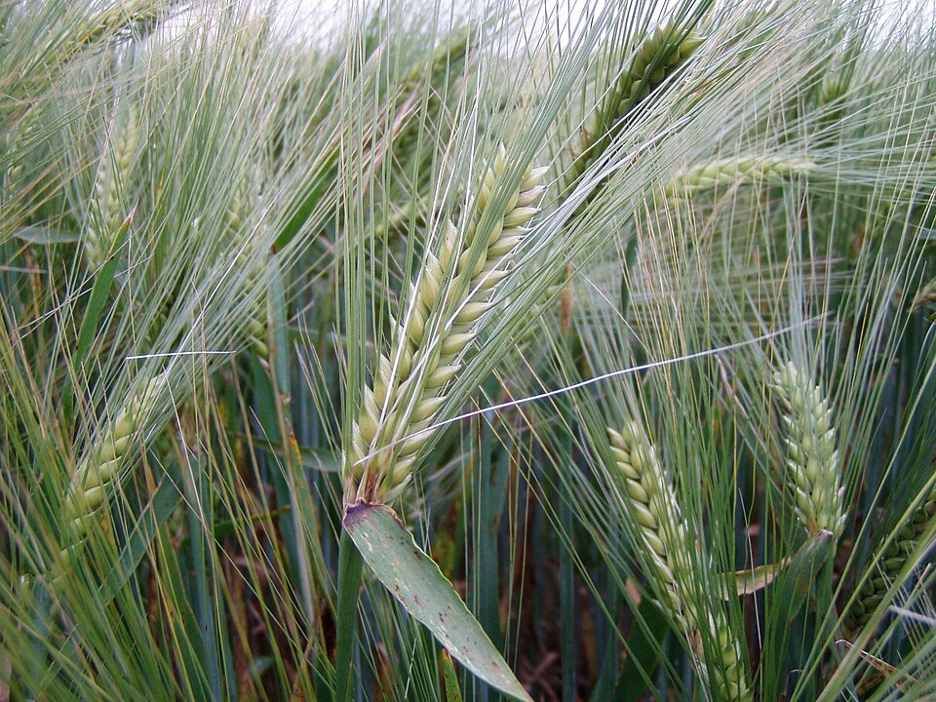
Cover Image: Barley, Hordeum vulgare subsp. vulgare. Image by raul.dupagne, Public domain, via Wikimedia Commons.


.jpg?ref=botany.one#:~:text=Description,English%3A%20six%2Drow%20winter%20barley)
