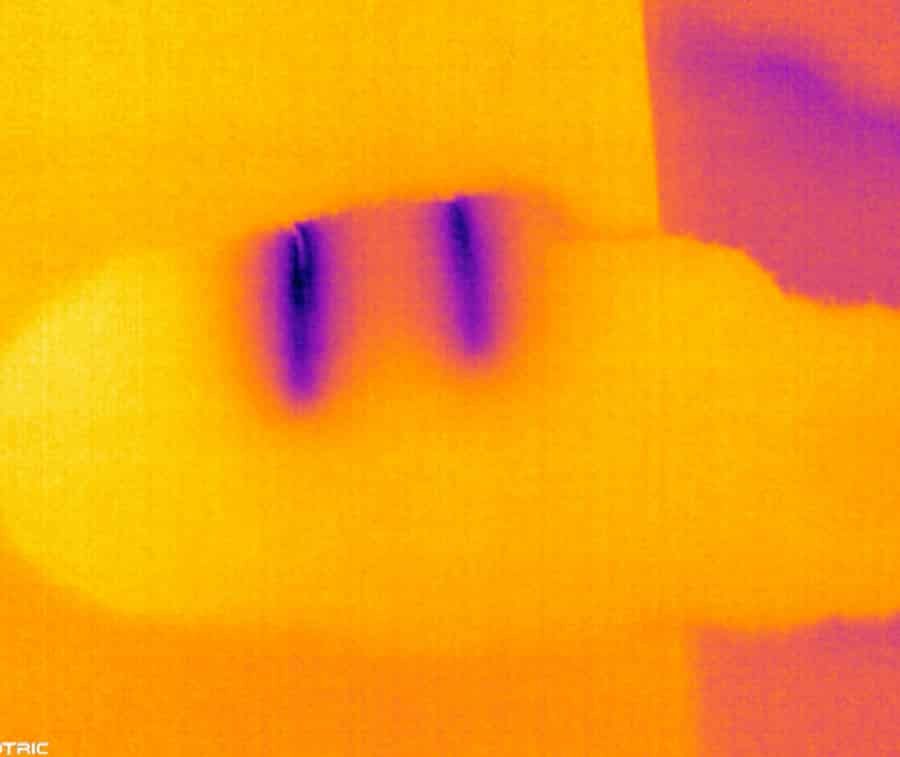

A plant has no nerves. So when something takes a bite out of a leaf, what tells it? Part of the answer is temperature. Balem and colleagues have a paper in New Phytologist, where they cut Arabidopsis leaves and film what happens with a thermal camera.
Cut a leaf and cells are broken. This has a few effects, but one that might be important is water evaporates, cooling the wound. In a few seconds, the temperature drops by one and a half degrees celsius.
Image from Balem et al. 2026 CC BY-NC.
This drop in temperature switches on cold-response genes, the same genes that get turned on by a frost. It also triggers a salicylic acid response, which leads to lignin and callose deposition, sealing the wound.
It's not certain that water evaporation is the exact mechanism to kick off the response, but they did three experiments that strongly point to it. They smeared lanolin wax over the half the wound, preventing water from evaporating from one half, and leaving the other open as a control. They found the waxed side, that didn't allow evaporation didn't switch on the cold response. They cut a seedling underwater, and found no cold response, which is what you might expect if evaporation was causing the cooling. They also put a water droplet on an unwounded leaf, and found the evaporation from the droplet triggered a cold response.
So it seems that a plant isn't sensing an injury as such. What it's sensing is a localised winter, caused by evaporation. This works with other signals, like jasmonate signalling to sealing of the wound.
Uploaded as social media posts to Bluesky, Mastodon & YouTube.
Balem, J., Tan, C., Dias, N., Arnold, M., Tran, S., Severns, P., Teixeira, P., Li, C., and Yang, L. (2026) A C‐repeat binding factor–salicylic acid (CBF<–SA) module links wound‐induced evaporative cooling to tissue repair in plants. New Phytologist. Available at: https://doi.org/10.1111/nph.71535.