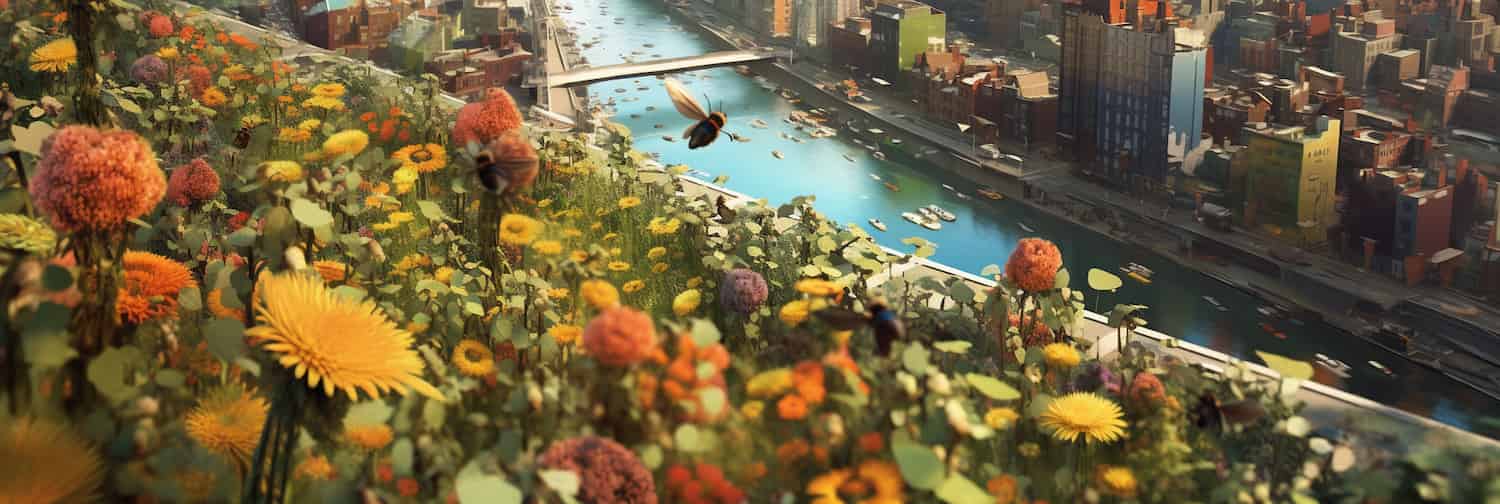



Roguz and colleagues have unearthed the vital role of urban meadows in sustaining diverse pollinator communities, offering fresh insights into improving the quality of wildlife in cities. Published in Urban Forestry and Urban Greening, their investigation sheds light on how the urban environment influences plant-pollinator interactions and underscores the significance of biodiversity in our urban landscapes.
Pollination, a crucial ecological service involving the transfer of pollen from male to female parts of a plant, underpins the reproduction of most flowering plants and plays a pivotal role in human food security. However, expanding urbanization and changing land use can disrupt these intricate interactions. Roguz’s team examined how urban factors, like floral resource richness, green area proximity, air pollution, and temperature, influenced these interactions in 14 Warsaw meadows.
Their findings reveal a complex dynamic; different pollinator groups, such as bumblebees and Syrphidae flies, responded differently to urban factors. For instance, bumblebees were negatively affected by high air pollution, while Syrphidae flies were more frequent visitors in greener areas. Moreover, the researchers found plants in these urban meadows to be frequently visited and effectively pollinated, suggesting urban pollinator communities can provide sufficient pollination services to city plants.
The team discovered that species-rich meadows were not detrimental to pollination, with mostly conspecific pollen grains – grains originating from the same plant species – found on the stigmas of studied plants. These findings highlight the significant contribution of species-rich communities to pollinator conservation.
Contrary to popular belief, the higher temperature did not deter pollinators. Surprisingly, beetles were observed visiting flowers more frequently at higher temperatures. Also, the floral resource richness in the studied communities, typical of urban environments, did not threaten pollination.
Interestingly, the study found that certain city-related factors had varied impacts on different pollinator groups. Both the green area proportion and air pollution had both positive and negative effects on the recorded frequency of visits.
Through their investigation, the team confirms that the richness of resources in these meadows was not the primary influence on the frequency of pollinator visits, suggesting other factors, such as nesting sites, may be more pivotal. In their article, Roguz and colleagues write:
The results of our study suggest that city meadows, species-rich habitats with variable flowering species offering food reward for the whole season, are attractive for urban pollinators. The conservation activities, however, should be tailored to specific group of pollinators, as different flower visitors respond differently to studied city-related factors. For instance, the green areas itself are not necessarily influencing wild pollinators positively and we need to take care also of the quality of urban greenery.
Roguz et al. 2023
This research underscores the importance of green spaces within cities for the survival and thriving of pollinator communities. The richness and diversity of these spaces directly contribute to the functioning of ecosystems, even in urban environments, playing a critical role in food security. Urban meadows are not just patches of beauty in our cities; they are vital lifelines supporting ecological balance and biodiversity.
READ THE ARTICLE
Roguz, K., Chiliński, M., Roguz, A. and Zych, M. (2023) “Pollination of urban meadows – Plant reproductive success and urban-related factors influencing frequency of pollinators visits,” Urban Forestry & Urban Greening, 84(127944), p. 127944. Available at: https://doi.org/10.1016/j.ufug.2023.127944.