
The FIFA World Cup 2026 has officially begun – which means turfgrass is making the news (again).
What makes this turfgrass special?
"The perfect football pitch at the 2026 World Cup is not simply grass. It is a combination of agriculture, temperature control, engineering and logistics," according to Reuters News.
It needs to drain properly. It needs to withstand studs. And this year, it must feel the same across 16 stadiums in three different countries and climates. Not a small task, and not a task for natural grass. Professional turf breeders were needed.
As a result, FIFA collaborated with turf breeders at Michigan State University and the University of Tennessee to research and produce the right grass for each location. The cool season turfgrass was bred by Rutgers scientists.
"Researchers testing World Cup turf at Michigan State University found that roofed stadiums with limited sunlight performed better with ryegrass-bluegrass blends, while hotter open-air venues were better suited to bermudagrass," according to Reuters News.
Ryegrass (Lolium perenne) is a perennial native to Europe, Asia and northern Africa. It's commonly used in lawns and golf courses and is also the official turfgrass of the All England Lawn Tennis Club in Wimbledon. Bluegrass, also known as Kentucky bluegrass (Poa pratensis), has a similar native distribution. It is popular in lawns and parks, and is commonly seen in North American baseball stadiums. Bermudagrass (Cynodon dactylon) is native to Europe, Asia, Africa and Australia. It is known for its deep root system and is widely cultivated in warm climates. It is often found on golf course putting greens and baseball fields. It grows well in hot, dry and saline conditions, providing a dense cover that can withstand heavy foot traffic.
After researchers determined the best turfgrass mix for each venue, the logistics of getting the turf to the field began.
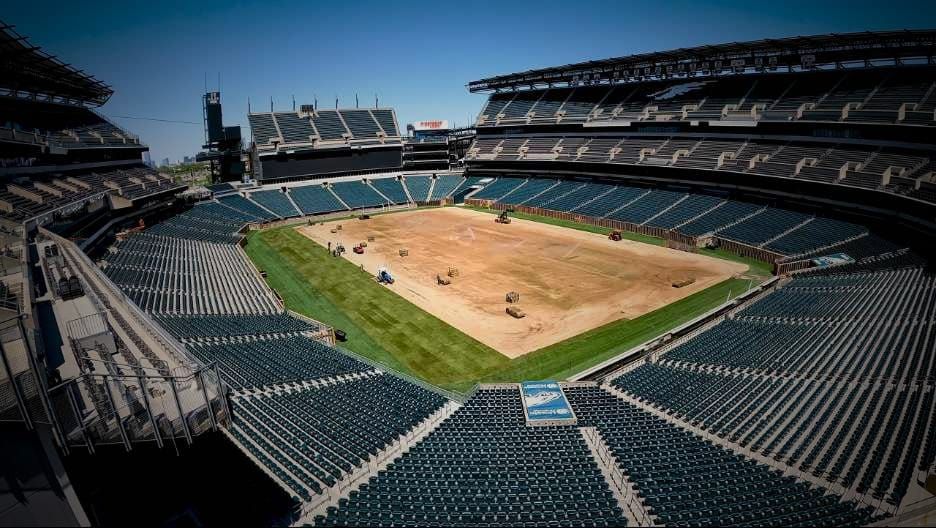
The mature grass was harvested in strips, rolled and transported to each stadium – often in refrigerated trucks (lorries) to keep it fresh. Installation was performed by rolling out the strips and heavily watering and fertilizing. Then, synthetic fibres were stitched into the grass to anchor the turf and reduce tearing during play.
"After the turf is rolled out, a specialised machine stitches millions of fibres vertically into the rootzone, sometimes as deep as 18 centimetres. As the grass grows, its roots wrap around them, creating a hybrid surface that remains predominantly natural grass," reports Reuters News.
The grass then needs regular maintenance to keep ball speed consistent and any divots will need to be repaired. Watering is important too. It's a Goldilocks situation – too much water and the field feels heavy to players, but too little water and the turf will slow the ball down. The perfect amount of water will let the ball skim quickly without these problems.
Another challenge – light. Keeping the turf alive and in peak condition requires special LED growlights to be moved over the field between games.
But the biggest challenge? The pressure for perfection. Most scientists don't have billions of people watching their research in action. But if all goes well, then no one will notice but the players.
Let the tournament begin!
Cover Image: A still image from Rutgers University's video on FIFA World Cup 2026 turfgrass production showing installation at a stadium.