
Here's this week's most shared papers on Bluesky. It's one of those weeks where I understand relatively few of the top shared papers so I can't really sum up the top papers in a friendly way. I suppose I could use Chat-GPT to write a cheery summary, but a couple of papers I read this week show that would be a bad idea. One makes the list this week, and I'll comment on the other later. As usual, papers behind a paywall are marked 💰otherwise they're free to access at time of checking.
How this works
We scan posts by people on the Botany Auto list and pull out the entries with links to papers. Every time a paper gets a post written about it it gets 4 points. It gets 3 points for a repost and 1 point for a like.
We try to add people to the Botany Auto post, if they post about Botany (doesn't have to be links to papers) around 20% of the time or more. The belief is that because the list as a whole shares an interest in plants, it's this material that tends to rise to the top.
If you think you should be on the Botany Auto list, but aren't, please drop a message to @botany.one on Bluesky.
1. Progressive oxygenation of developing leaves directs morphogenesis
Panicucci, G. et al. · Science Advances · 2 posts · 84 likes · 41 reposts on Bluesky
Here, we show that developing leaves form a spatiotemporal oxygen gradient that is sensed through the oxygen-sensing machinery. This pathway integrates local oxygen availability to regulate leaf morphogenesis: Early hypoxia restricts cell expansion, whereas subsequent distal-to-proximal oxygenation depletes group VII ethylene response factors enabling specialized cell-fate acquisition and controlling proliferation.
International Society for Plant Low Oxygen Research @isplore.bsky.social · on Bluesky
Progressive oxygenation of developing leaves directs morphogenesis
Exciting #plantscience work by @daanweits.bsky.social @panicuccigabriele.bsky.social @syno2xis.bsky.social out now in Science Advances
www.science.org/doi/10.1126/...
2. Recent high-severity wildfires in a dry-conifer landscape are unprecedented over five centuries and foretell future forest loss
Wion, A. P. et al. · Proceedings of the National Academy of Sciences · 1 post · 55 likes · 23 reposts on Bluesky
To what extent do modern high-severity fires depart from pre-1900 fire regimes, and how do these departures affect the future persistence of dry-conifer forests? We address these questions using a multiscalar approach that combines the largest landscape-scale tree-ring fire-scar network in North America with neutral landscape model simulations in the Jemez Mountains of northern New Mexico.
Discussed on Bluesky by @grumpyunclesean.bsky.social.
3. A genomic catalog of Earth’s bacterial and archaeal symbionts
Villada, J. C. et al. · Nature Biotechnology · 1 post · 31 likes · 17 reposts on Bluesky
This study used machine learning (ML) to predict symbiotic lifestyles in more than a hundred thousand microbial genomes from diverse environmental metagenome samples and reference genomes. Predictions were performed using symclatron, an ML framework developed to identify genomic signatures of symbionts.
Axel Visel @axelvisel.bsky.social · on Bluesky
A Global Catalog of Microbial Symbionts 🌍🦠🧬🫨
New resource from @jgi.doe.gov, led by @astrogenomics.bsky.social and @fmschu.bsky.social with contributions by @emileyeloe-fadrosh.bsky.social @miferg.bsky.social and many more
🔓 www.nature.com/articles/s41...
@biosci.lbl.gov @berkeleylab.lbl.gov
4. GPT detectors are biased against non-native English writers
Liang et al. · Patterns · 1 post · 27 likes · 13 reposts on Bluesky
GPT detectors frequently misclassify non-native English writing as AI generated, raising concerns about fairness and robustness. Addressing the biases in these detectors is crucial to prevent the marginalization of non-native English speakers in evaluative and educational settings and to create a more equitable digital landscape.
Thiago Carvalho @cyrilpedia.bsky.social · on Bluesky
The study
"GPT detectors are biased against non-native English writers"
www.cell.com/patterns/ful...
5. How Do Filamentous Pathogens Deliver Effector Proteins into Plant Cells?
Petre, B., Kamoun, S. · PLoS Biology · 1 post · 28 likes · 11 reposts on Bluesky
In this article, we examine recent conflicting findings that have generated discussion in the field. We also highlight promising approaches based on studies of both parasite and host during infection.
Sophien Kamoun @kamounlab.bsky.social · on Bluesky
An important question in plant pathology still lacks a coherent model—a striking example of how bad science can bring an entire field to a standstill:
How do filamentous pathogens deliver effector proteins into plant cells?
dx.doi.org/10.1371/jour...
 View on Bluesky →
6. An embryo-derived peptide signal directs endosperm polarity in
Arabidopsis 💰
Creff, A. et al. · Science · 2 posts · 49 likes · 22 reposts on Bluesky
Angiosperm seed formation requires the coordinated development of the products of double fertilization—the embryo and the endosperm. The endosperm mediates efficient nutrient transfer from surrounding maternal tissues to the developing embryo. This function requires a polarized tissue organization, which manifests as early polar gene expression and polar cellularization dynamics. We show that the receptor kinase HAIKU2 (IKU2) acts in coordination with the transcription factor WRKY10/MINISEED3 (MINI3) to ensure robust endosperm polarity establishment through the activity of the homeodomain transcription factors WUSCHEL-RELATED HOMEOBOX 8 (WOX8) and WOX9.
Tatsuya Nobori @tatsuyanobori.bsky.social · on Bluesky
Great work by Ingram & Zipfel labs. Congratulations, everyone!
An embryo-derived peptide signal directs endosperm polarity in Arabidopsis
www.science.org/doi/10.1126/...
7. An evaluation of the UK distribution of Eleocharis palustris subspecies palustris (Cyperaceae) using herbarium material
Biddle, A. · British & Irish Botany · 1 post · 32 likes · 8 reposts on Bluesky
Eleocharis palustris (Common Spike-rush) occurs at two ploidy levels, represented in Britain by subsp. palustris (2n = 16) and subsp. waltersii (2n ≈ 38). Although the species is widespread and considered of low conservation concern, the distribution of the lower-ploidy subsp. palustris has remained poorly understood because material has rarely been identified or verified at subspecies level. As a result, its status, habitat associations, and potential vulnerability in the UK have been unclear. Herbarium vouchers from major UK collections were examined using a non-destructive method that allowed stomatal size to be measured directly from dried specimens. Stomatal size differs consistently between the two ploidy-defined subspecies, being smaller in subsp. palustris and larger in subsp. waltersii, allowing subspecies assignment from herbarium material.
Dr Astrid Biddle @astridbiddle.bsky.social · on Bluesky
Pleased to announce my new paper:
Herbarium specimens spanning nearly two centuries revealed striking ecological & geographical differences between two ploidy-defined subspecies of Eleocharis palustris in Britain.
Ploidy & genome size could help explain them. doi.org/10.33928/bib...
 View on Bluesky →
8. A manifesto for plant science education
Alvey, E. et al. · PLANTS, PEOPLE, PLANET · 1 post · 22 likes · 11 reposts on Bluesky
Plants provide oxygen, food, shelter, medicines and environmental services, without which human society could not exist. Tackling pressing and global challenges requires well‐trained plant scientists and plant‐aware individuals. This manifesto provides a practical evidence‐based vision to strengthen plant science education, focused on five strategic priorities.
Mary Williams @PlantTeaching @plantteaching.bsky.social · on Bluesky
We're still working on the website, but please save the date if you are interested in Plant Education.
Following on from the successful 2025 event (See nph.onlinelibrary.wiley.com/doi/10.1002/...), we are planning "Plant Education 2" next April in Cambridge, UK.
www.aab.org.uk/event/plant-...
9. Nature-based solutions in open ecosystems must support biodiversity and people 💰
Lehmann, C. E. R. et al. · Nature Geoscience · 1 post · 27 likes · 9 reposts on Bluesky
Nature-based solutions in savannas and grasslands that seek to maximize tree cover and carbon uptake can erode biodiversity, create fragile carbon stocks and disrupt the livelihoods of people who depend on these landscapes, all for uncertain climate benefits.
James Bullock @jmbecologist.bsky.social · on Bluesky
Nature-based solutions in savannas & grasslands that seek to maximize tree cover & carbon uptake can erode biodiversity, create fragile carbon stocks & disrupt livelihoods
Our new paper on how the obsession with trees & forests undermines open ecosystem conservation
www.nature.com/articles/s41...
 View on Bluesky →
10. Exodermal suberin contributes to ion homeostasis and growth in potato 💰
Company-Arumí, D. et al. · Journal of Experimental Botany · 1 post · 18 likes · 8 reposts on Bluesky
Here, we studied root apoplastic barrier formation in potato (Solanum tuberosum). Using histochemical staining, we mapped the spatiotemporal deposition of lignin/poly(phenolic) material and suberin in the endodermis and the exodermis. The exodermis develops an outer polar lignin/poly(phenolic) cap and rapidly establishes a continuous suberized layer close to the root tip, whereas endodermal cells form Casparian strips first and suberize later and discontinuously.
Journal of Experimental Botany @jxbotany.bsky.social · on Bluesky
🥔 RESEARCH 🥔
In potato roots, the endodermis and exodermis define anatomical compartments for mineral nutrients. Exodermal suberin accumulates early, and its reduction is associated with altered ion homeostasis and reduced growth- Company-Arumí et al.
🔗 doi.org/10.1093/jxb/...
#PlantScience 🧪
 View on Bluesky →
11. Decoding BIG: how one protein influences multiple pathways
Theodoulou, F. L. et al. · Journal of Experimental Botany · 1 post · 14 likes · 9 reposts on Bluesky
A major strength of forward genetic screens is their unbiased nature: the plant reveals which genes underlie a physiological process. Yet this strength often presents a new challenge: determining the biochemical basis of the mutant phenotype. BIG/DARK OVEREXPRESSION OF CAB1/TRANSPORT INHIBITOR RESPONSE3 encodes an exceptionally large (∼0.5 MDa) protein identified in diverse genetic screens. big mutants have smaller stature, reduced elongation growth and apical dominance, and defects in lateral root formation, phenotypes consistent with disrupted auxin gradients. However, they also display altered stomatal behaviour, circadian regulation, pathogen responses, and changes in other hormone pathways. This broad pleiotropy points to wide-ranging roles in signalling and development, yet the biochemical function of BIG remained unresolved for more than three decades.
12. In the same cell, the proteome defines cellular state and the transcriptome marks transitions
Thielert, M. et al. · bioRxiv · 1 post · 21 likes · 6 reposts on Bluesky
Here we introduce a scalable technology that quantifies thousands of proteins and transcripts in the same cell, separating RNA from protein by tip-based C18 capture and pairing full-length RNA sequencing with latest-generation mass spectrometry.
13. Maintenance work ahead: cellulose links cell wall construction and sucrose transport
Alonso Baez, L. · Journal of Experimental Botany · 1 post · 15 likes · 7 reposts on Bluesky
This article comments on: McCubbin TJ, Mertz RA, Baker RF, Leach KA, Barron B, Bhimidine S, Rueda S, Basu A, Chomet P, Wagner R, Grote K, Peevers J, McCann MC, Carpita NC, Slewinski TL, Braun DM. 2026. A maize GT14 family glycosyltransferase affects cell wall composition and carbohydrate export from source leaves. Journal of Experimental Botany 77, 5033–5050. https://doi.org/10.1093/jxb/erag194
14. A new tool for fitting C4 gas exchange response curves
Smith et al. · Journal of Experimental Botany · 2 posts · 11 likes · 7 reposts on Bluesky
This article comments on: Woodford R, Ermakova M, Furbank RT, von Caemmerer S. 2026. Fitting photosynthetic carbon dioxide and irradiance response curves for C4 leaves. Journal of Experimental Botany 77, 4987–4999. https://doi.org/10.1093/jxb/erag223
15. Still standing: persistence traits capture belowground plant functions beyond resource exploration and acquisition
Tumber‐Dávila, S. J. et al. · New Phytologist · 2 posts · 11 likes · 7 reposts on Bluesky
Belowground plant trait research has predominantly focused on trade‐offs in fine‐root traits via the root economics space (RES). Yet, this fine‐root framework captures only a fraction of the functional strategies plants employ beneath the soil surface. Here, we broaden the perspective on belowground plant functioning by integrating traits related to root system extent, clonality, and bud banks, using data from the new UNDERPLOT dataset.
16. Leaf habit of Late Permian Glossopteristrees from high-palaeolatitude forests
Gulbranson, E. L. et al. · Journal of the Geological Society · 1 post · 17 likes · 6 reposts on Bluesky
We show, through an integration of palaeobotanical techniques and isotope geochemistry of trees in one of the earliest polar forests (Late Permian, c. 260 Ma, Antarctica), that the arborescent glossopterid taxa were both deciduous and evergreen, with a greater abundance of evergreen trees occurring in the studied forests.
17. VRN2-PRC2 facilitates light-triggered repression of PIF signaling to coordinate growth in Arabidopsis
Osborne et al. · Developmental Cell · 1 post · 14 likes · 7 reposts on Bluesky
Here, we show that VRN2 is enriched in the hypoxic shoot apex and emerging leaves of Arabidopsis, where it negatively regulates growth by establishing a stable and conditionally repressed chromatin state in key PHYTOCHROME INTERACTING FACTOR (PIF)-regulated genes that promote cell expansion.
18. A phage communication peptide alters Bacillus subtilis colony development and promotes sporulation
Hagbi-Lazar, B. E. et al. · bioRxiv · 1 post · 15 likes · 6 reposts on Bluesky
Temperate Bacillus phages use arbitrium peptides to coordinate lysis–lysogeny decisions, but whether the mature communication peptide can be sensed directly by Bacillus subtilis and affect its physiology and behavior is unknown. Here we show that the φ3T arbitrium peptide SAIRGA elicits a sequence– and stereochemistry-dependent response in Bacillus subtilis that is strongly expressed in surface-grown colony biofilms but is not accompanied by comparable changes in planktonic growth or static-liquid pellicle morphology.
19. Plant bioacoustics: decoding ultrasonic emissions 💰
Font Bordera, P. et al. · Journal of Experimental Botany · 3 posts · 7 likes · 6 reposts on Bluesky
For decades, plant-environment interactions were understood to be primarily mediated by chemical and visual stimuli. However, recent evidence has unveiled an underexplored dimension of plant physiology: airborne ultrasonic emissions. This review evaluates current research in plant bioacoustics, focusing on ultrasound generation, characteristic features, and specificity across different stress conditions.
20. Salicylic acid-triggered apoplastic proteolysis releases cryptic phytocytokines with distinct immunogenic functions
Katzy, P. et al. · bioRxiv · 2 posts · 11 likes · 6 reposts on Bluesky
Here, we show that salicylic acid (SA) rapidly remodels the maize apoplastic peptidome through an early, transient proteolytic program driven by apoplastic serine hydrolases. Time course peptidomics identified fourteen candidate phytocytokines, including two cryptic peptides, PC13 and PC14, released from the stress-associated zinc-finger protein ZmSAP7 and the migration inhibitory factor-like protein ZmMDL1, respectively.
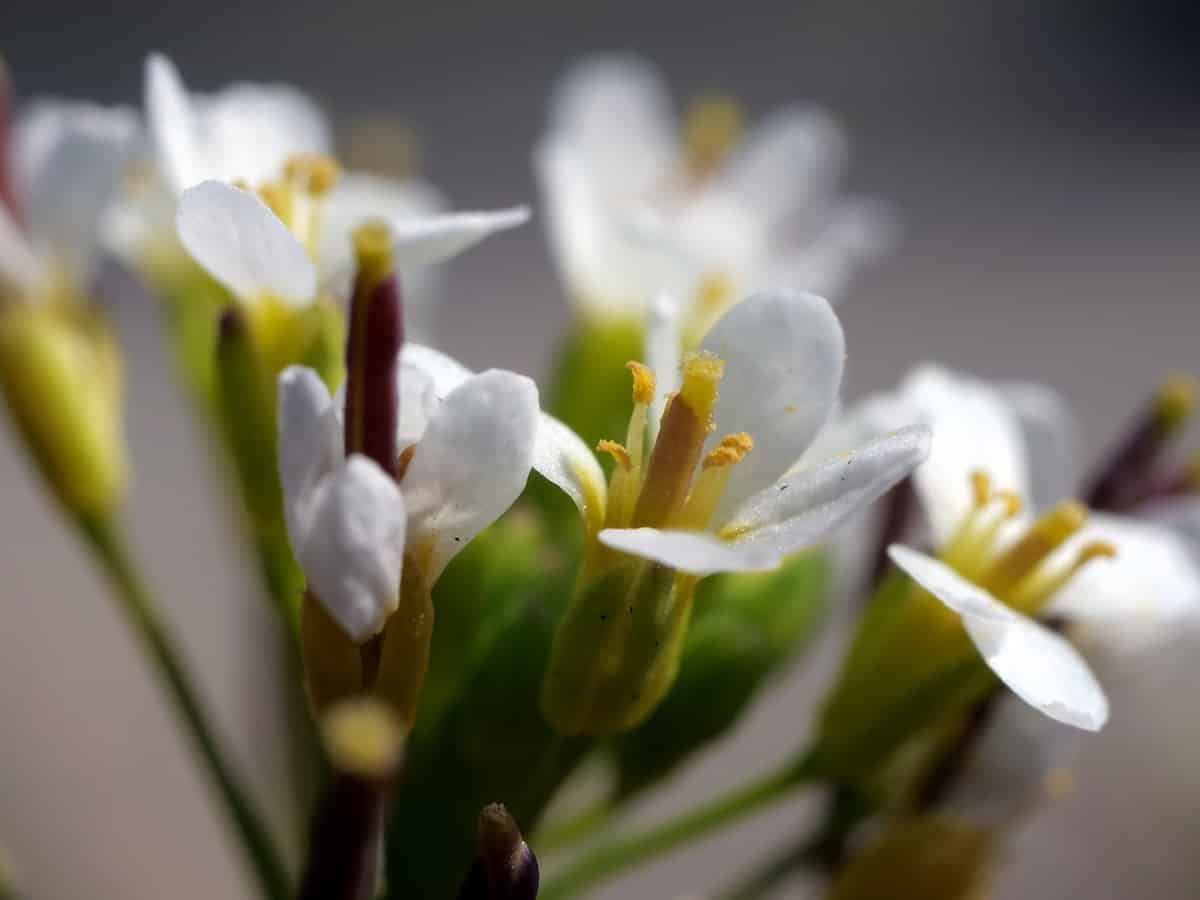
Cover image: Arabidopsis thaliana by Wolfgang Jauch CC BY