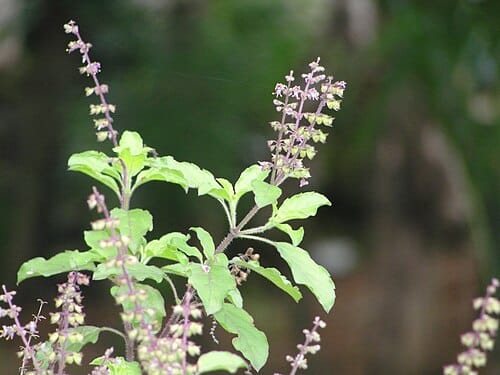
Holy basil, also known by its Sanskrit name tulasi/tulsi, is a species of the Lamiaceae, a family which houses mints, sages, and deadnettles. It is an aromatic perennial native to tropical and subtropical Asia. This herbaceous subshrub grows rapidly to 30-60 cm tall and has fragrant green or purple leaves. Its tubular flowers can be pale pink, lavender, or white. Holy basil has traditional religious, medicinal, and culinary uses. Indeed, the English name of 'holy basil' is derived from its holiness in Hinduism.
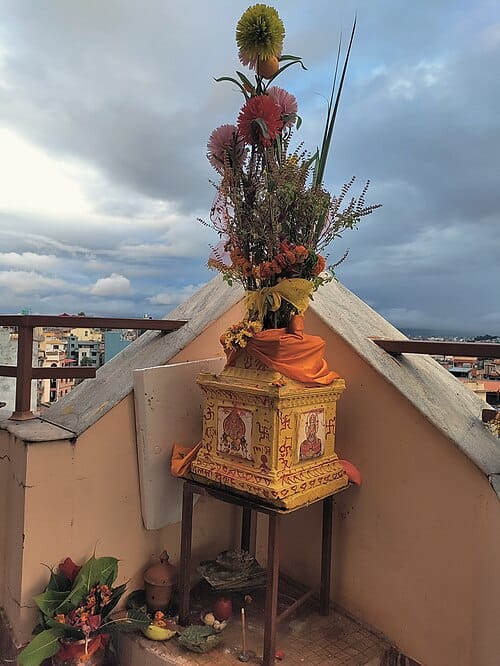
In Hindu tradition, holy basil is the most sacred of all plant species. It is considered the manifestation of god in the plant kingdom and is also regarded as the threshold point between heaven and earth. The species is commonly found in Hindu homes and temples. Household devotional rituals, traditionally performed by women, are centred around the herb. Worship rituals include watering the plant, cleaning its surroundings, making offerings, and lighting a candle near the plant. Additionally, holy basil is regarded as the manifestation of Lakshmi, the consort of Vishnu and Goddess of wealth and prosperity. In ceremonies, leaves are offered in the worship of Vishnu and his avatars.
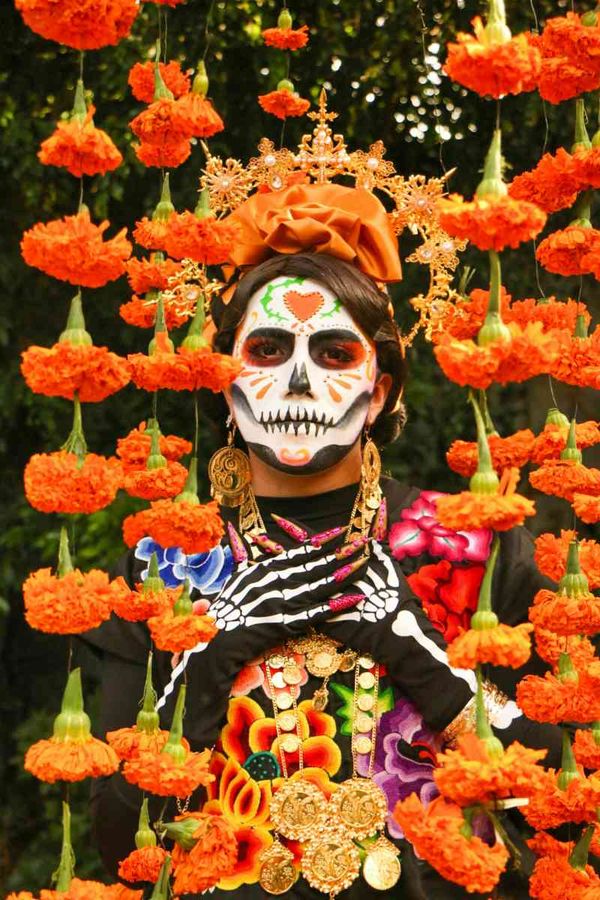
During Diwali, which this year is 8 November (today, if you're reading this on its publication date), "prayers and offerings are made to these plants, reflecting gratitude for nature’s role in providing prosperity and well-being. This reverence for plants reinforces Hinduism's message of living in harmony with nature," writes Priya Popat at The Wildlife Trusts.
Holy basil also has deep historical roots in Ayurveda medicine. The plant is used to treat a broad spectrum of ailments and is consumed as a tea produced from its leaves. "Within Ayurveda, tulsi is known as “The Incomparable One,” “Mother Medicine of Nature” and “The Queen of Herbs,” and is revered as an “elixir of life” that is without equal for both its medicinal and spiritual properties," writes Dr. Marc Cohen in a review of its uses. Scientific studies have shown benefits to immune response, possibility because of a polyphenol it produces called eugenol, but have not yet determined a dosing regimen and no regulation exists yet in the supplemental market.
Finally, holy basil like its relative sweet basil (Ocimum basilicum) is used in cooking, but they have different flavour profiles. Holy basil is peppery with hints of clove and spice, while sweet (Thai) basil is milder and sweeter in taste. Holy basil is used in both Thai and Minangkabau cuisine. In Thai, the species is known as kaphrao, and it is commonly used in curries and stir fries. In Minangkabau, it is known as ruku-ruku and used to spice fish stews.
LEARN MORE:
Cohen, M. (2014) Tulsi - Ocimum sanctum: A herb for all reasons. Journal of Ayurveda and Integrative Medicine, 5(4), pp. 251. Available at: https://doi.org/10.4103/0975-9476.146554.
Cover Image: Ocimum tenuiflorum inflorescence. Image by Abhishek Jacob via Wikimedia CC BY-SA 2.0