


I was a bit fed up after hearing the UK government announce further cutbacks to the science budget today, so I thought I’d delve into the recent Free Access issue of Annals of Botany from Sept 2009 to see what’s been released. Obviously the rest of this post will be a shameless plug for a paper I found – but it’s a shameless plug for a really clever paper.
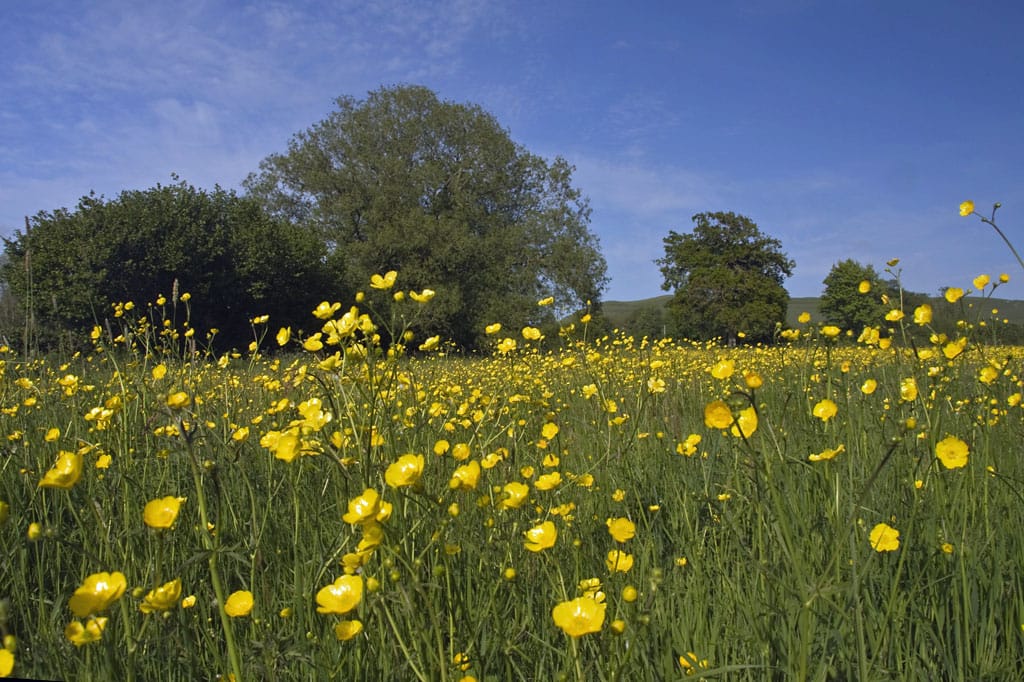
Extra petals in the buttercup (Ranunculus repens) provide a quick method to estimate the age of meadows by John Warren isn’t just clever, it’s also simple and useful. Dating hedgerows for conservation is well-known and the methods of counting the species in the hedge seems nice and obvious. In contrast it’s easy to mistake meadows as bug gaps of emptiness between the hedges. As Marilyn Peddle’s photo shows above that’s not the case.
Warren’s work takes a closer look at the buttercups in a meadow. The method is amazingly simple. You examine a hundred buttercups. For each buttercup with more than the usual five petals, the meadow is seven years old. Variability being what it is, you’d need to count more than one sample to a reasonably reliable estimate, but as a rough rule its good for a couple of centuries. Warren sees a use for this in conservation surveys. I think it could also be a very useful tool for archaeology too.
There is a branch of archaeology called Garden Archaeology. It’s specialised but it can also be really interesting because the intentional reshaping of nature can reveal all sorts of ideas about power relations on an estate. A lot of this kind of work is on sites dating within the last few hundred years, so it fits the range covered by the method. The dating isn’t exact, but it may be enough to usefully distinguish between phases on landscaping. Most importantly it’s very cheap, and very simple. It’s also very replicable, which is unusual for archaeology where your typical excavation examines a site by systematically destroying it.
I tend to like any paper where I can think “I could do that.” For this paper I’m not the only person who could. There was a public appeal for people to visit meadows of known age and sample the buttercups there. It’s a neat example of citizen science.