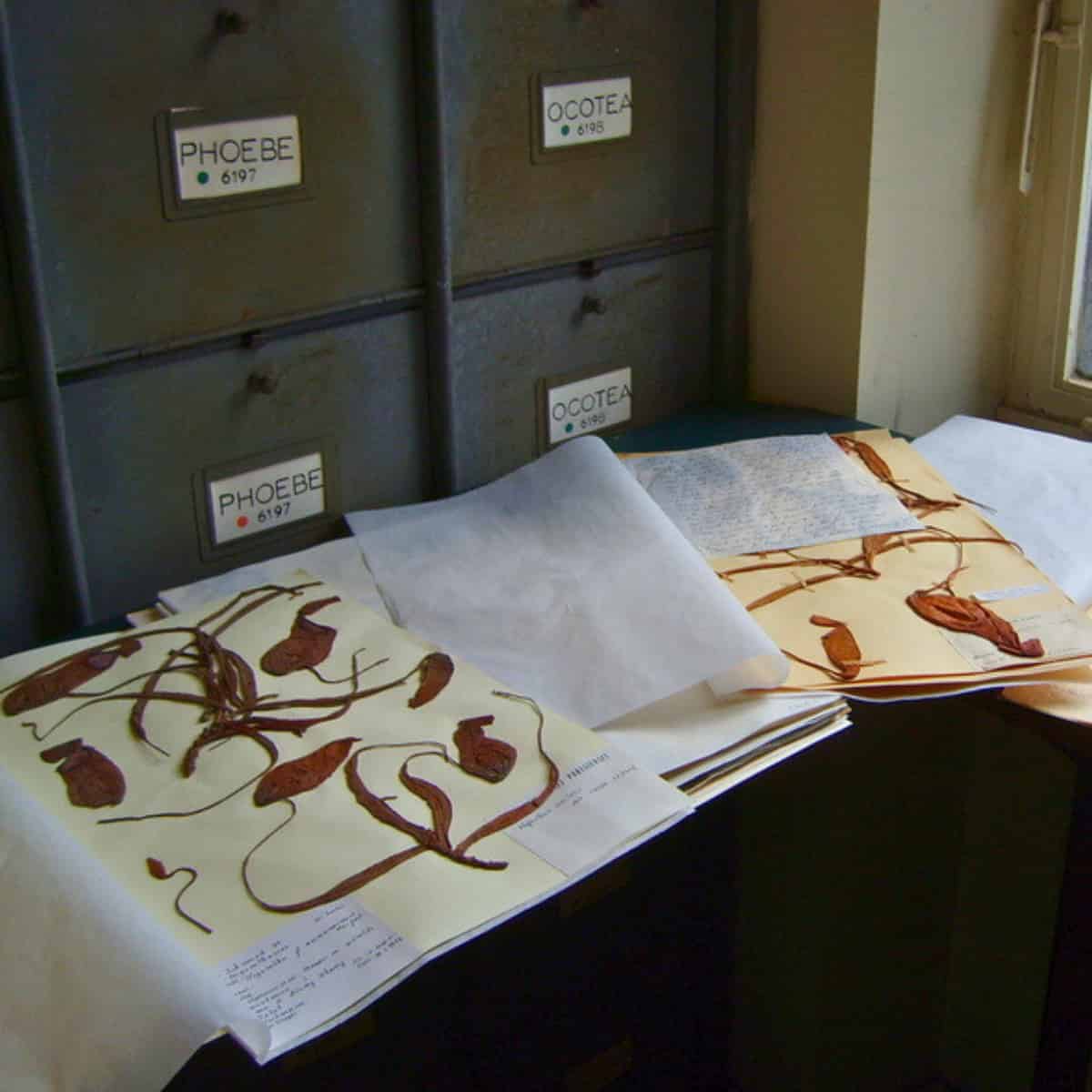



What is the purpose of a herbarium? An article by Hannah Jacobs and Andrew Griebeler shows that it’s not necessarily an easy question to answer. A botanist might have mounted a specimen on a herbarium sheet in the 1920s as a reference, but when they did so, they unwittingly added more data that we’re only just starting to appreciate.
Herbaria being underappreciated is a key element of the paper, because it’s written in the context of the closure of Duke University’s Herbarium. The authors write in the introduction: “Duke University has put forward multiple justifications for its decision. Principal among them is the argument that the herbarium does not engage enough researchers at the university and that it is too niche of a collection to be of service to anyone outside of the botanical sciences.” The rest of the article systematically dismantles this argument as Jacobs & Griebeler show how, as well as being a scientific repository, herbaria include a wealth of historical data.
At the most basic level, there’s the historical material deposited at the time. An example they give is a herbarium specimen mounted on the back of a government poster. But they make an argument that there’s more than that. They state: “...the herbarium sheet and label accrue inscriptions over time, such as locality notes, descriptions of morphology, names of collectors, and identifications, bearing witness to the communal, gradual, and accretive nature of scientific knowledge production.”
These accidental records can expose history that would otherwise be erased. In a slightly frustrating sentence they write: “For example, Ashanti Shih has shown how the botanist Otto Degener struck out the name of his Kanaka Maoli (native Hawaiian) collaborator Henry Wiebke from his specimen labels (Shih 2025), after a falling out between the two.” The frustrating bit being that Shih reference is forthcoming, and I can’t find it yet.
The records are valuable in themselves, but the organisation of the collection as a whole adds value in making implicit connections or disconnections between records. In this way there is value in herbaria as collections source material for the plant humanities. While digitisation can improve accessibility, those physical relationships can only be captured in the actual herbarium. It’s clear that shuttering the Duke Herbarium is therefore an action that will damage research.
In Duke’s defence, they need $1.2 billion to renew university buildings. The cost of preserving the Herbarium is 2% of this figure. This may not seem much but, if you’re the kind of place who spends $8 million on a quarterback who leaves after just one season, you might need every dollar you can grab.
It’s an odd way for Duke to celebrate a centenary, by removing a large part of the university’s legacy and its future capacity for research. Jacobs & Griebeler’s work seems an emphatic demonstration that these collections can only accrue in value due to new and unexpected demands. But Duke’s gamble that in another hundred years universities will be celebrated for their accountancy rather than their research seems to be pushing that faith in the unexpected to an extreme.
READ THE ARTICLE
Jacobs, H., and Griebeler, A. (2025) Herbarium data and herbaria as extended archives for humanities research. Botany, 103, pp. 1-21. Available at: https://doi.org/10.1139/cjb-2025-0074.
Cover image: Herbarium by François MEY, CC BY 3.0, via Wikimedia Commons