*Caladenia crebra*
Plant of the Week

*Caladenia crebra*

An orchid that offers a wasp everything and delivers nothing.

https://www.botany.one/caladenia-crebra/

Know someone who'd like this?

We’ve passed the darkest part of winter and the first orchids of spring are blooming in Australia. This week we have Caladenia crebra, the Arrowsmith Spider Orchid. You’ll find it flowering in August and September, in Western Australia, north of Perth.

Caladenia crebra — GBIF occurrences

Data: GBIF · Map: © OpenStreetMap contributors

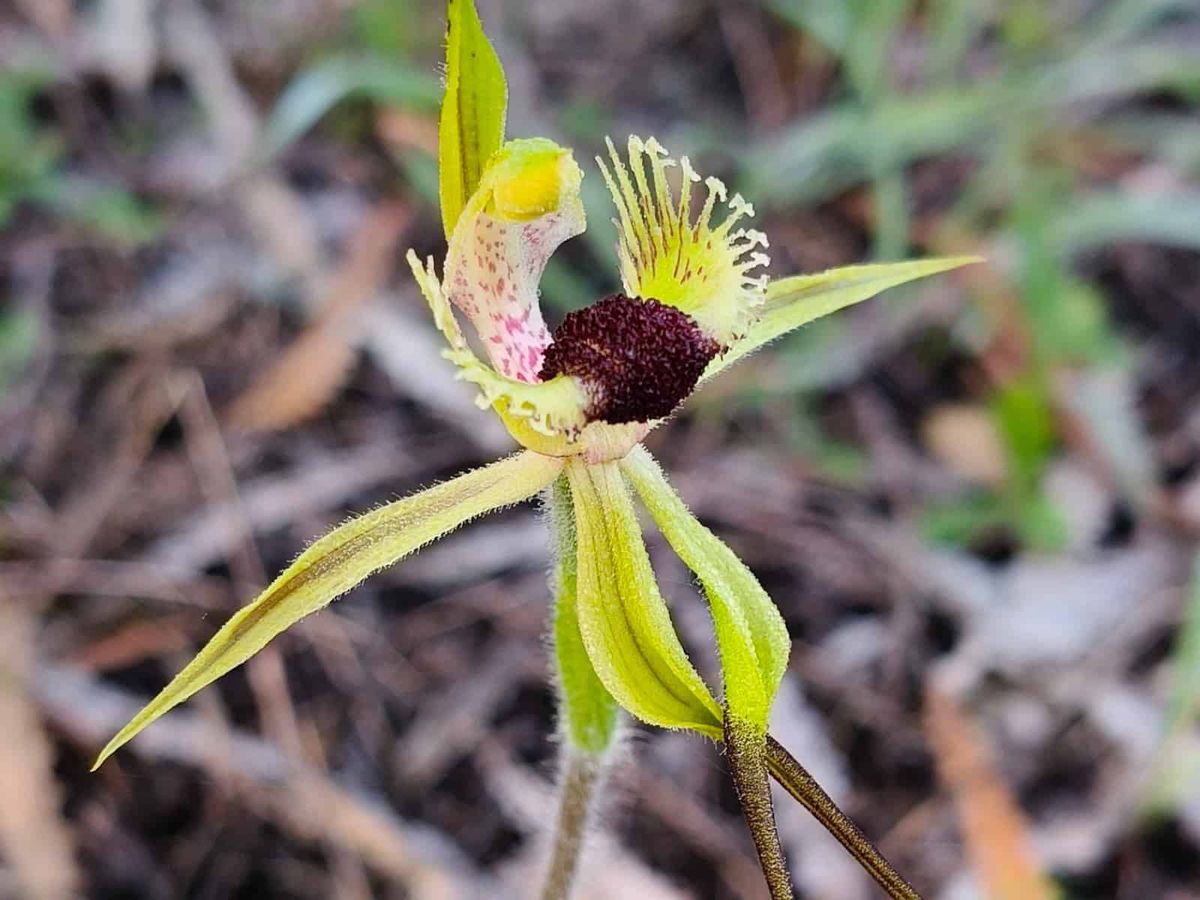
It’s the long thin petals and sepals that give a spider orchid its name, in English, because they are said to look like spider legs. The Latin Caladenia comes from the ancient Greek, kalos, beautiful and aden, gland for the labellum, the colourful lower petal. The labellum in spider orchids has calli. These are small projections on the labellum, and some of the photos on iNaturalist really show these off. The calli in the photos here are the maroon growths on the green labellum. The crebra part means crowded, and refers to how many calli there are on the labellum of this plant, which makes it so distinctive.
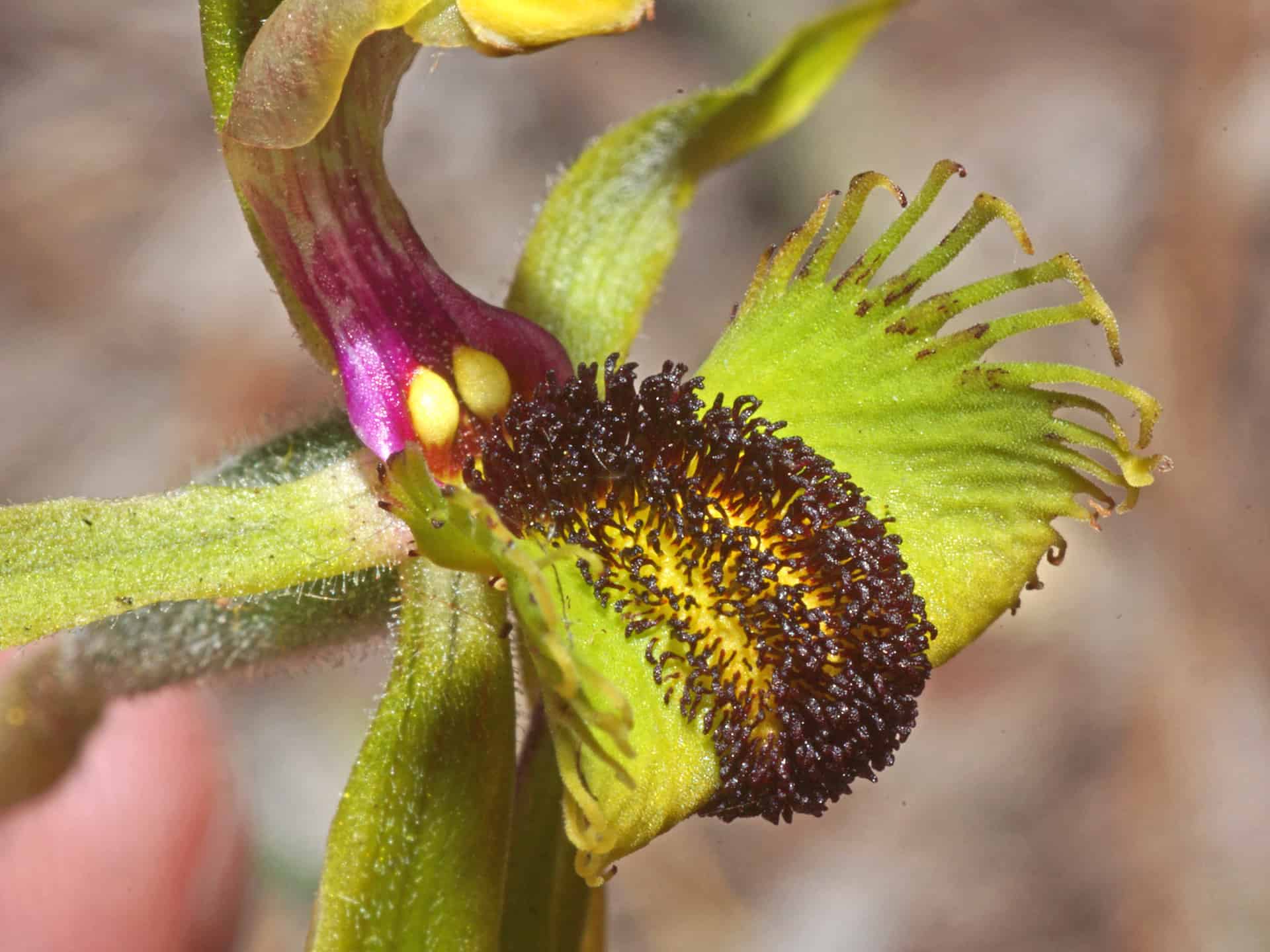
Close-up of a spider orchid labellum, broad and yellow-green, its outer edge fringed with curved comb-like teeth. Across the centre sit rows of densely crowded, club-shaped calli — near-black at the margins, grading to orange and yellow along the middle. Behind the labellum the column arches away, its underside bright magenta, with two small yellow bodies at its base. Narrow green sepals and petals radiate outwards; a fingertip is just visible at the lower left, steadying the flower.
Caladenia crebra by Felix Riegel / iNaturalist CC BY-NC

These calli are part of a lure for the orchid’s pollinator. Caladenia crebra attracts the wasp Campylothynnus flavopictus specifically male wasps. The female wasps are flightless so not really of use to the orchids as a pollinator. But they are useful to mimic because the flower isn’t offering food, it’s offering sex. A female wasp crawls to a prominent place, and waits while she releases pheromones. The labellum is enough to look like a female wasp. It helps that the orchid also copies key elements of the smell.
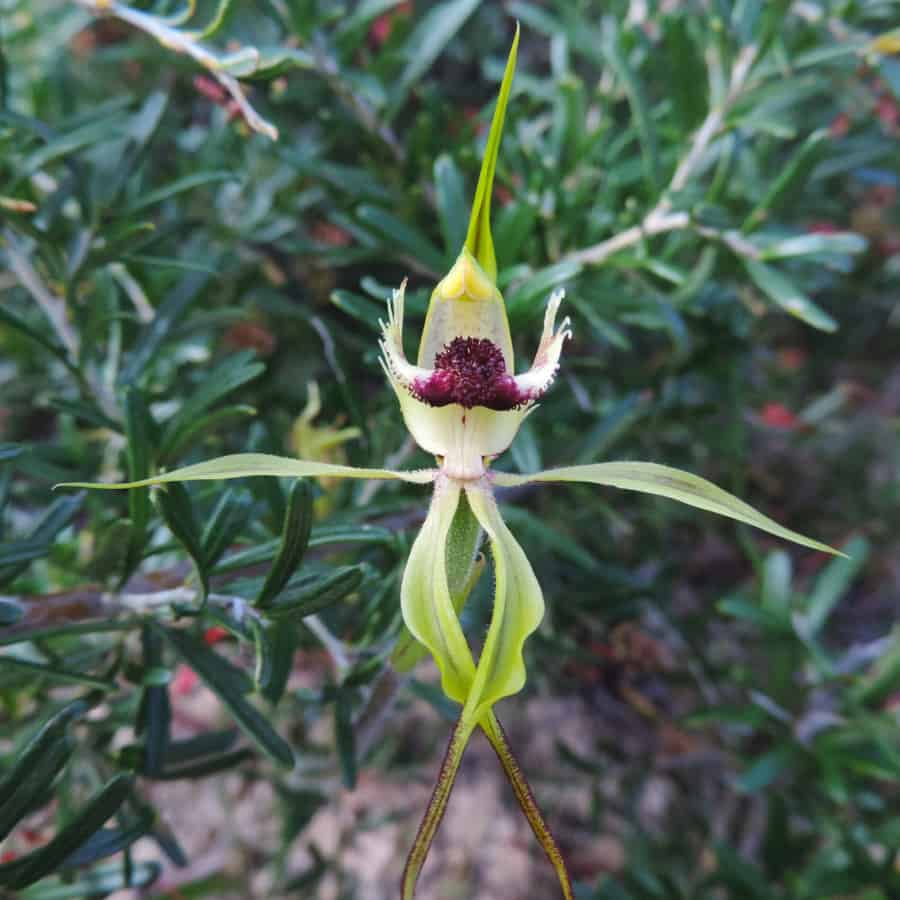
A pale yellow-green spider orchid flower seen face-on, its narrow sepals and petals spreading in six directions like legs — two held out sideways, two curving downwards and forwards, two trailing away below and tapering to dark reddish tips. At the centre a dense dark maroon mass of calli sits on the pale labellum, whose margins are fringed with fine white teeth. The dorsal sepal rises behind, hooding the yellow-tipped column. Behind the flower is a shrub with narrow dark green leaves.
Caladenia crebra by Mike and Cathy Beamish / iNaturalist CC BY-NC

Caladenia crebra produces an irresistible scent from its sepal tips. A study found that the attraction was down to four chemicals, (methylthio)phenols, that the authors described as “extraordinary strong pollinator attractants”. Around a third of the wasps that approach the flowerattempt to mate with it. As the wasp wrestles with the labellum, it can get slapped with pollen to take to another plant.
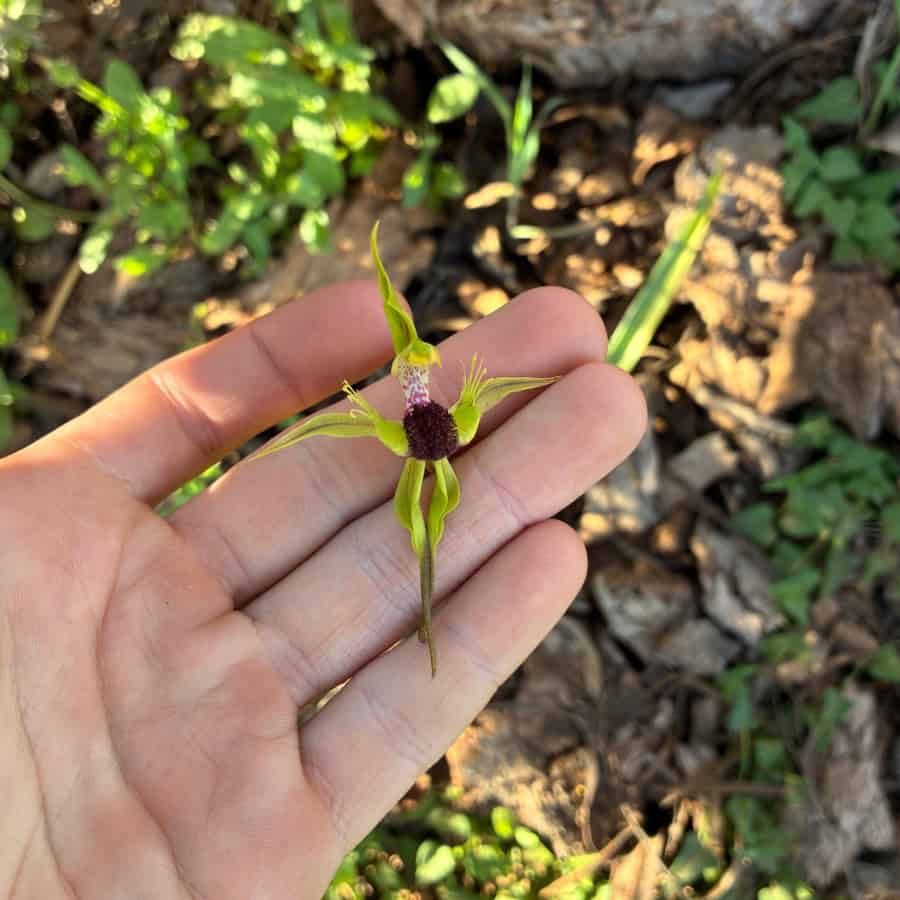
An open hand cupping a small yellow-green spider orchid flower, which spans roughly the width of two fingers. Its narrow sepals and petals radiate outwards and trail downwards across the palm, tapering to fine points. At the centre a dense dark maroon patch of calli sits on the pale labellum, the column rising behind it flecked with red. Beyond the hand, dappled sunlight falls on leaf litter and low green foliage.
Caladenia crebra by monshroom CC BY-NC

It was discovered in sandy soil and scrub south of Dongara but it’s not clear for how much longer it will be there. Typically, distributions of Caladenia are expected to be broadly stable over the next 50 years, but Caladenia crebra, along with C. harringtoniae and C. infundibularis may face a contraction. However, with Caladenia crebra relying on a specific pollinator, it’s not just the orchid’s ability to cope with increasing heat that’s in question.
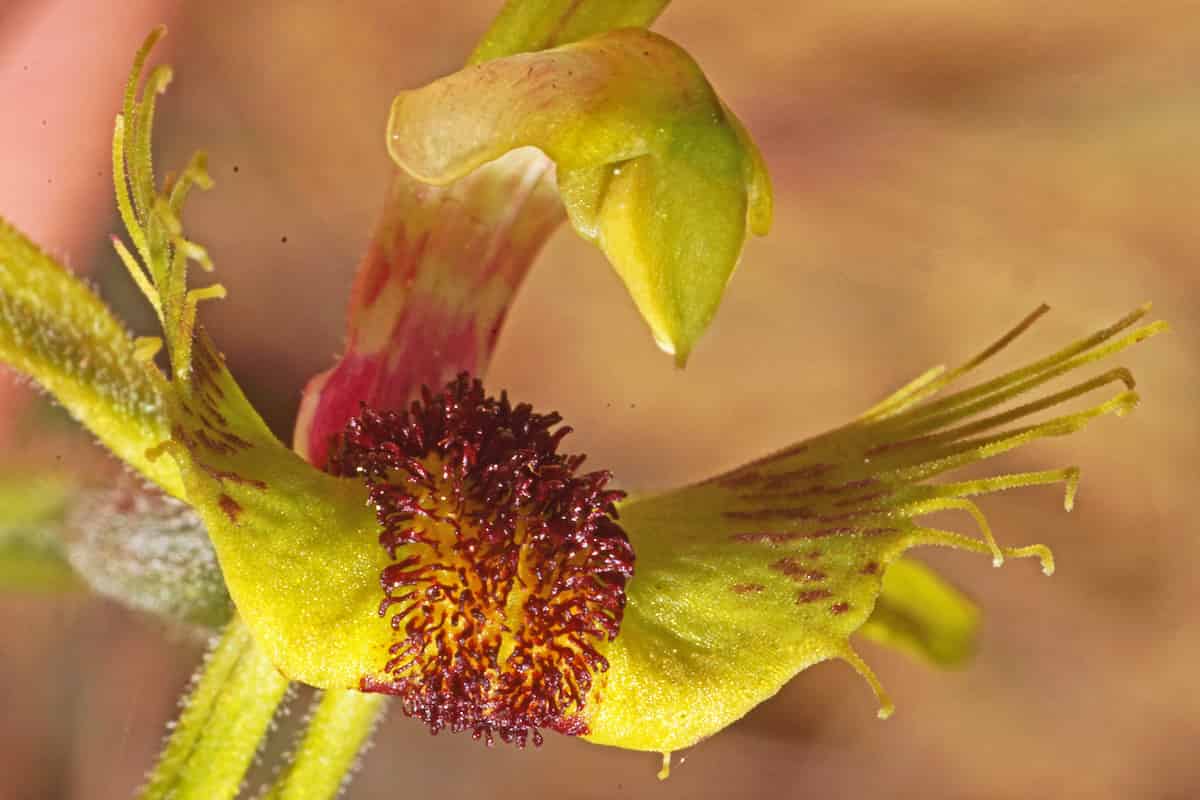
Close-up of a spider orchid labellum, broad and bright yellow-green with fine red streaks, its margins fringed with slender curved teeth. Rows of crowded club-shaped calli cover the centre, dark maroon at the edges and grading to orange-yellow along the middle. Behind, the column arches over in a hood, red-striped at its base and yellow-green towards the tip. A hairy stem and narrow segments cross the lower left of the frame.
Caladenia crebra by Felix Riegel CC BY-NC

If you want to see it in the wild, now is the time, but you’ll have to be in Western Australia, as it’s found nowhere else.

Cover image: Caladenia crebra by Jason CC BY-NC

Liked this article?

Written by

Alun Salt

Alun (he/him) is the Producer for Botany One. It's his job to keep the server running.

More from this writer

The nonprofit plant magazine

Lab science. Citizen science. Your source for plant science.