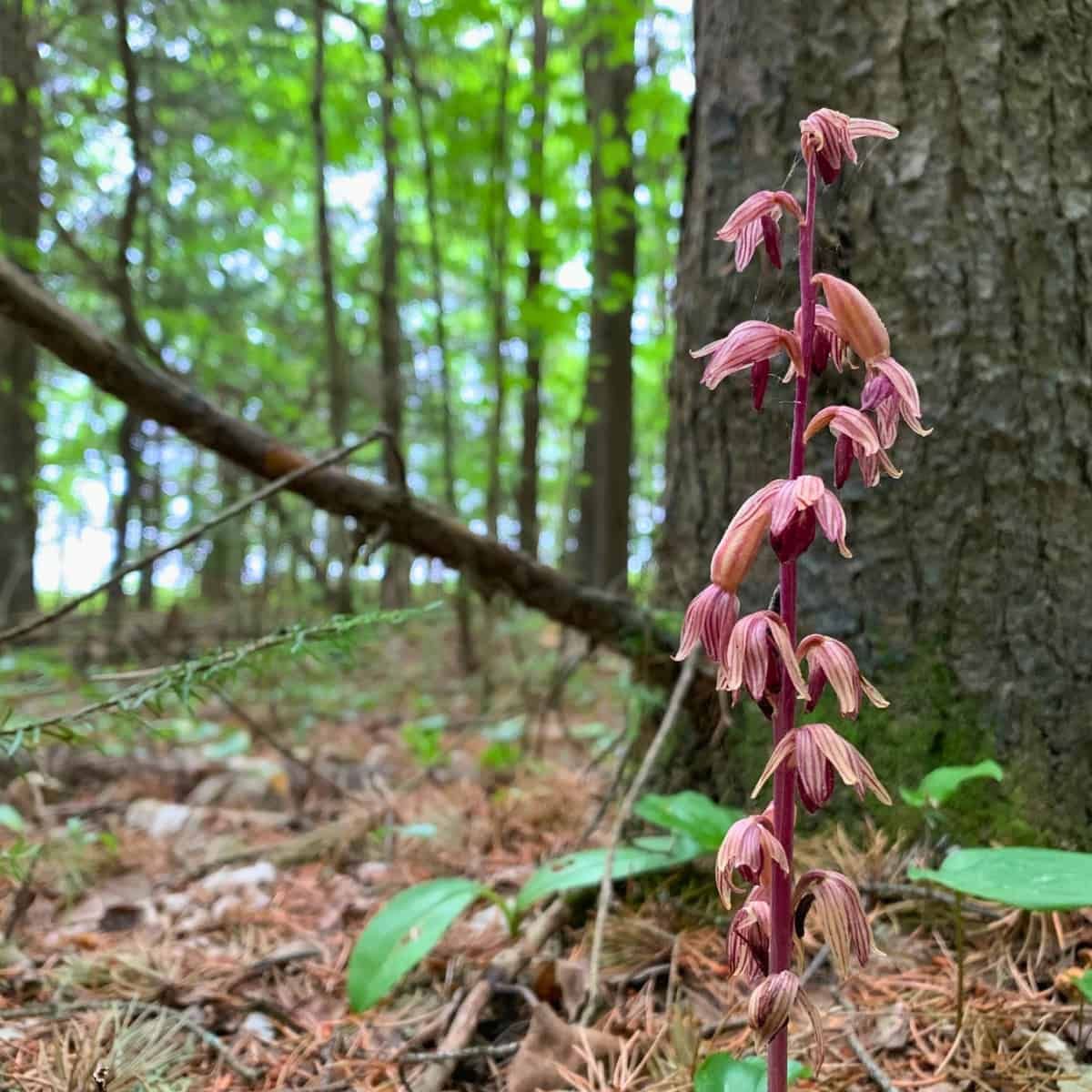

Corallorhiza striata, striped coralroot, is an orchid found in North America, and it hates paying for anything. A paper by Freudenstein and Barrett examines how it steals food from fungi and pollination from wasps.
All orchids need a little help from fungi to begin with. Orchid seeds are tiny, with no stored energy so they connect to the fungal network to start them off, until they photosynthesise their own food. Usually. Striped Coralroot never stops taking, even as an adult. It taps into Tomentella fungi. These fungi swap nutrients for sugars with trees. This orchid gets into the network and takes without giving anything back.
Video from Freudenstein & Barrett 2026 under a CC BY licence.
It also needs pollinators. Male Pimpla pedalis wasps are looking for a female, or rather smelling for one. Striped Coralroot pumps out its own scent to get attention, so a male wasp looking for love finds an orchid and lands on it. While that’s happening the orchid slaps it with pollen. The male leaves disappointed and looks elsewhere for a female. It might find her, but the orchid is betting that it’ll find a few other orchids first, and deposit the pollen on another flower.
Both these approaches rely on the partner not being able to resist the orchid. If they could, they would. That makes any exploitative strategy a bit of a risk. Also a biologist, Bidartondo writing back in 2005 said you shouldn’t expect a plant to be cheating two partners at the same time, because it means relying on getting things right for two very different partners at the same time, else you fail.
What Freudenstein and Barrett have is evidence this kind of freeloading isn’t impossible. The two approaches are both rare, but combine them and the maths says it should be possible, but very improbable around 2000 to 1. And when you look at observations it seems to be in the same ball park, around 4000 to 1. They only know of four other species of plant that are fully parasitic for food and also deceive their pollinators, and discuss whether you can call the plant a double parasite.
Uploaded as social media posts to Bluesky, Mastodon & YouTube.
READ THE ARTICLE
Freudenstein, J., and Barrett, C. (2026) Corallorhiza striata is the first example of a pseudocopulatory orchid in North America and an instance of “double deception” in fully mycoheterotrophic plants. American Journal of Botany, 113(4). Available at: https://doi.org/10.1002/ajb2.70185.
Cover image: Corallorhiza striata striata by Brandon Corder / iNaturalist CC BY