


For many plants, flowers play a vital role in reproduction. Natural selection hones them in competition against other plants to get pollinated most efficiently. Plants that have similar pollinators have similar problems to solve, and so develop similar solutions. So you would expect that plants pollinated by birds, or specifically hummingbirds, would share characteristics. So plants seeking to attract hummingbirds will often have red flowers. They produce larger quantities of dilute nectar, and long tubular flowers to draw in the birds close with their long beaks and tongues. They also have flexible pedicels, which are a puzzle.
A pedicel is the short stalk that holds the flower away from the rest of the plant. If it were rigid, then it would hold the flower up. But in columbines, the pedicel is flexible so it droops downward. This feature evolved not just once, but many times in plants attracting hummingbirds as pollinators. This is odd, because the hummingbirds don’t like it. Dr Eric LoPresti said he noticed this while working on another project. “I worked on a mutualistic relationship between Aquilegia eximia and several predatory bugs during my dissertation and as such, I spent a huge amount of time across several field seasons sitting in patches of this columbine and because of this time spent, I was able to make so many observations of animals interacting with the columbines. ”
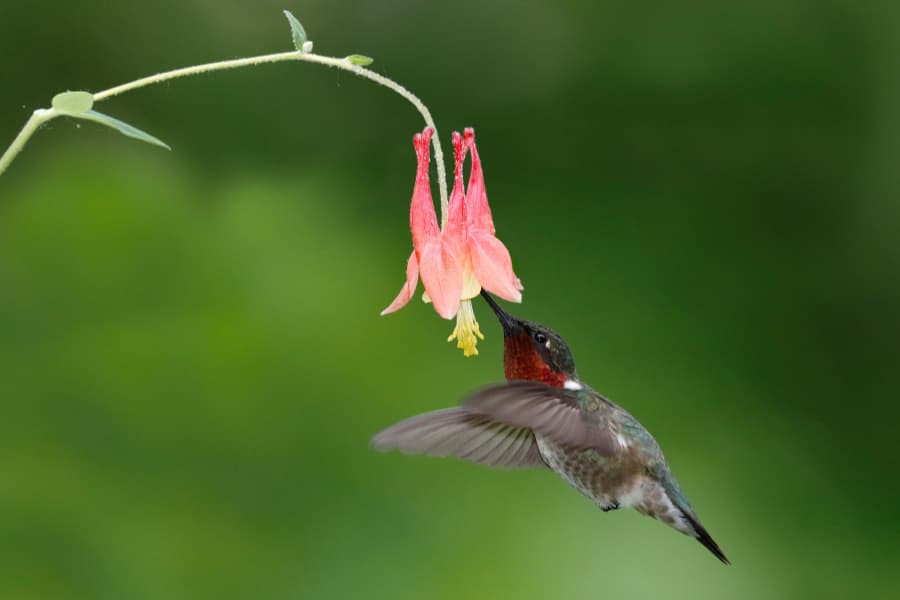
“While I was sitting in patches of columbine, mostly counting dead insects for days on end, hummingbirds would be buzzing around, feeding and chasing each other out of the patch. They usually quite nonplussed that I was around and I was often able to observe them at very close range as they nectared. I noticed that they had this very consistent behavior where they levered the flower up during feeding.”
This behaviour is because it uses more energy to feed from underneath, so when they feed they lift the flowers up with their beaks. They prefer to visit horizontal flowers, given the choice, so why haven't the columbine flowers evolved to offer better feeding?
LoPresti thought that the flowers must be gaining something from being awkward. "I don't recall exactly when I realized that flexible pedicels themselves were interesting, but eventually I found the literature on flexible pedicels and hummingbird pollination and their preferences against downward flowers and realized that I had some interesting insight into how columbine pollination worked that was possibly novel. With that knowledge, I was able to sell this project to a number of pollination biologists I knew (coauthors Maureen, John, Clara, Neal) and the project began!"
The experiment was beautifully simple. The team wired some A. eximia to prevent them from moving when the hummingbirds fed. They then compared the wired flowers against the unwired flowers to see which plants did better. The wired flowers had a 30% reduction in seed set. They also set up video to watch the birds and see how they interacted with the flowers. LoPresti admitted setting up the video cameras was not a simple task. "I'm still not good at it! While we were able to capture dozens of visits clearly enough to get data from them, flexible pedicels also mean that the flowers shake a lot in wind, so very few of the times the camera tripped due to motion were actual visits. Fortunately, Jake had the patience to watch and score all these videos! Hummingbirds are also very fast, and small, and there were several videos in which by the time the camera got sufficient movement to start recording, the bird was already leaving the flower. (Who knows how many visits we missed completely?) It is for that reason we couldn't get visitation rates, only score the visits that we captured."
"I really wanted to get rates of visitation for another columbine pollination project, but the visitation rates to individual flowers were so low that when I tried to ground truth the camera visitation rates, by sitting and watch the flower being recorded, I sat around for hours and didn't get any visits. Therefore, we couldn't use the camera data to get visitation rates, only the interactions with the flowers."
The video shows that the way the leverage works is that when the bird lifts the flower, it gets tapped below the beak. LoPresti said that this is a strategy of the columbines. "Compared to the flowers we wired downwards, those with flexible pedicels received more pollen (as we measured seed set). Since the stigmas and anthers are in a big bunch that is exerted from the flower, they are probably better at getting pollen on the bird, too. We hypothesize that flexible pedicels and the downward orientation is better at getting pollen in the same spot for an actinomorphic flower than if that flower was rigidly oriented outwards (as the hummingbird might get pollen on its side, top, or bottom!), but that still needs to be tested! The anthers seem to contact the neck or breast. In the same area, the hummingbirds visit Stachys albens, and they are always flying around with their foreheads covered in pollen from that species. It was hard to see the columbine pollen on them, but given that all the flowers we used for this (and another study) were emasculated and they set a lot of seed, the birds were certainly effective pollinators."
While the results are interesting in seeing how some part of the flower works, LoPresti isn't saying these results apply across a whole bird-pollinated syndrome. "Bird-pollinated flowers usually have some of a collection of traits (red, dilute nectar, long spurs, flexible pedicels, etc.), but very few have all of them, and there are certainly some really wacky bird pollinated plants that do their own thing, like Calceolaria uniflora. We have provided a new hypothesis for the function of just one of these traits which comprises the 'syndrome' (and has been repeatedly evolved) and we experimentally supported it in one species of plant."
"I think that there are a bunch of interesting avenues that someone should follow up on. Most hummingbird-pollinated flowers don't face downwards, and we hypothesize that this is due to floral symmetry (downward-facing is probably only useful to radially-symmetric flower), but testing that hypothesis across plants and examining how the morphological evolution of these flowers proceeds (i.e. does being zygomorphic or actinomorphic drive a specific floral morphology during an evolutionary transition to hummingbird pollination?) would be very interesting studies to conduct. It would also be really useful to repeat this experiment in other downward-facing hummingbird-pollinated flowers, as while we suspect this is a general occurrence, only time (and more data!) will tell if we are right!"
LoPresti certainly thinks there's more to find out about downward-facing columbines. "Repeating this experiment on other columbine species would be a fun project and might provide some interesting insights - the small patch of A. canadensis near my house in Michigan seems to get more insect visits than birds, despite looking like a hummingbird flower, and bees and syrphid flies certainly don't lever those flowers up during feeding."
READ THE ARTICLE
LoPresti, E., Goidell, J., Mola, J., Page, M., Specht, C., Stuligross, C., Weber, M., Williams, N., and Karban, R. (2019) A lever action hypothesis for pendulous hummingbird flowers: experimental evidence from a columbine. Annals of Botany, 125(1), pp. 59-65. Available at: https://doi.org/10.1093/aob/mcz134.