

How does a plant become toxic, and why? It might seem obvious a plant becomes toxic to defend itself, but investing in chemical defences isn’t cheap. So it is thought that different organs will have varying toxicity, depending on their value to the plant, and the likelihood of attack.

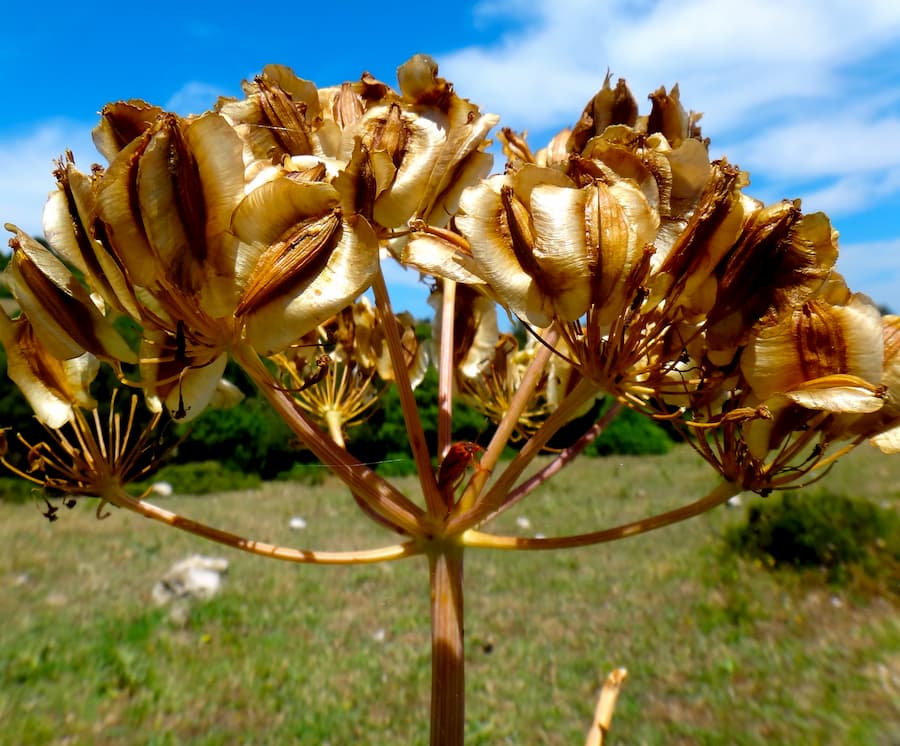
Karen Martinez-Swatson and colleagues investigated the defences of Thapsia garganica, the deadly carrot. The common name might sound like a joke, but the plant’s poisons have a serious effect on anything foolish enough to eat it.
“The anti-herbivory compounds from Thapsia garganica have been used for millennia,” co-author on the paper, Christopher Barnes, said. “There are records of ancient Romans using the plant for dieting, and with the sickness and diarrhea that thapsigargin induces, it was probably pretty effective (but definitely not recommended). More recently, mipsagargin (a prodrug of thapsigargin) was being used in clinical trials to treat skin cancer. Using laboratory experiments, there is also evidence of thapsigargin is also extremely toxic to many different Eukaryotes.”
The project is a collaboration between many authors, instigated by Martiz-Swatson, Barnes explained. “The project was derived from Karen Martinez-Swatson’s ERC funded PhD work into the whole Thapsia genus, as they all produce thapsigargins. She was interested in the variation in defence compounds between species, but was also finding huge differences in thapsigargins within single species.”
“Its use in both nature and society is what drew my attention to the plant,” Barnes added. “With my background in ecology, I was interested in why the same species in relatively close proximity could vary so much in their defence compounds. After reading the literature into this within species variation in plant chemical defences, I found that there were separate models for different components of plant variation (for example between different tissue types and temporal variation), and even multiple models predicting the same thing that would give different predictions. After some confusion, we decided it would make more sense to test multiple models simultaneously and see which gave the best results.
The test came in a survey of deadly carrots on the island of Ibiza. The team set out to sample deadly carrots at six locations and test them to see how their chemical payload varied. The results could be compared against the predictions of plant defence models. The optimal defence theory (ODT) argues that investment in defence has a cost in reproductive success. The model was particularly of interest as it made predictions about which parts of the plant would be most defended. The ODT suggested that flowers, as part of the reproductive system, would be most defended compared to vegetative tissues.
The growth-rate hypothesis (GRH) looks at how plants regrow after a herbivore attack. If resources are low, and regrowth is difficult, the GRH predicts that more resources will go to defence. So carrots from the most nutrient-poor parts of the island should have the deadliest carrots. The growth-differentiation balance hypothesis (GDBH) also looks at resource available, but it is subtly different. In their paper the authors say: "Under the GDBH, two processes regulate the plants entire photosynthate use. Growth refers to any process requiring substantial cell division and elongation, such as the production of roots, stems and leaves, whilst differentiation is essentially everything else, including herbivore defence... Shortages of nutrients and water are thought to slow growth more than photosynthesis. Hence, as carbohydrates accumulate within the plant, the fitness reduction for differentiation processes is lower. Growth and differentiation are hypothesised to be mutually exclusive. Therefore, plants invest in growth-based strategies in resource rich environments (high competition) and in differentiation-based strategies in low resource environments (low competition)."
The fieldwork was timed to run over three trips starting in May 2015 and finishing at the end of June. The plan was to catch the carrots at different stages of the life-cycle, as mentioned in the paper: "Sampling was targeted to be approximately before fruiting where leaves are active, but also during and after fruiting when leaves have senesced." This wasn't entirely straight forward.
"Fieldwork in Ibiza was of course fun," Barnes said, "it is an amazing island with beautiful mountains and a fascinating flora. Importantly, the island is also part of T. garganica's natural range. The plant has proven incredibly difficult to culture in glasshouses, therefore farms are being established on the island, while currently thapsigargin is isolated from seeds from wild populations. It certainly came with challenges, most notably, the aboveground biomass dies off in the height of summer, making it extremely difficult to find carrots to sample during this period. Additionally, the plant is often found in small clusters and is very slow-growing. Our sampling was destructive, and therefore sampling would have too large an effect on the local population for us to consider it ethical.
So which model proved the most accurate? In a way, the most surprising result wasn't the answer, but the need to ask the question, Barnes said. "For me, one of our most interesting results came even before starting the project, discovering just has conflicted the literature was in predicting within species variation of chemical defences. Going forward, I would thoroughly recommend researchers expand upon our work by continuing to validate their findings against multiple models, refining and integrating them into a single model. Additionally, I found it fascinating that T. garganica inhibits fungal associations."
Plants have a complicated relationship with fungi. While many can be pathogenic, others can be benefical. They can aid plant defence, or else form networks beyond plant roots and forage for nutrients. "I have spent a lot of time studying why plants have different fungal communities, for example spending energy in order to maintain mycorrhizal fungi," Barnes said. "At first I was quite concerned our metabarcoding results were incorrect until further testing confirmed that thapsigargins inhibited fungal growth. Something I would like to study more in the future is how some plants are simply better off without any (or very few) fungal interactions."
The results show that there is not yet a single plant defence model that works both for plant tissues and environmental relationships. so there is still no easy way of locating the 'deadliest' carrots. Regardless, the plant itself, and the chemicals it makes remain of interest. "I think these compounds are very interesting as they are normally biologically active, meaning they interact with organisms and cause some kind of effects on them. While many of these effects are negative, they are also a great source of medicines. If we understand why these compounds are produced, it means we streamline our search for new medicines by for example, screening compounds used by plants as a defence against insects in arid environments."