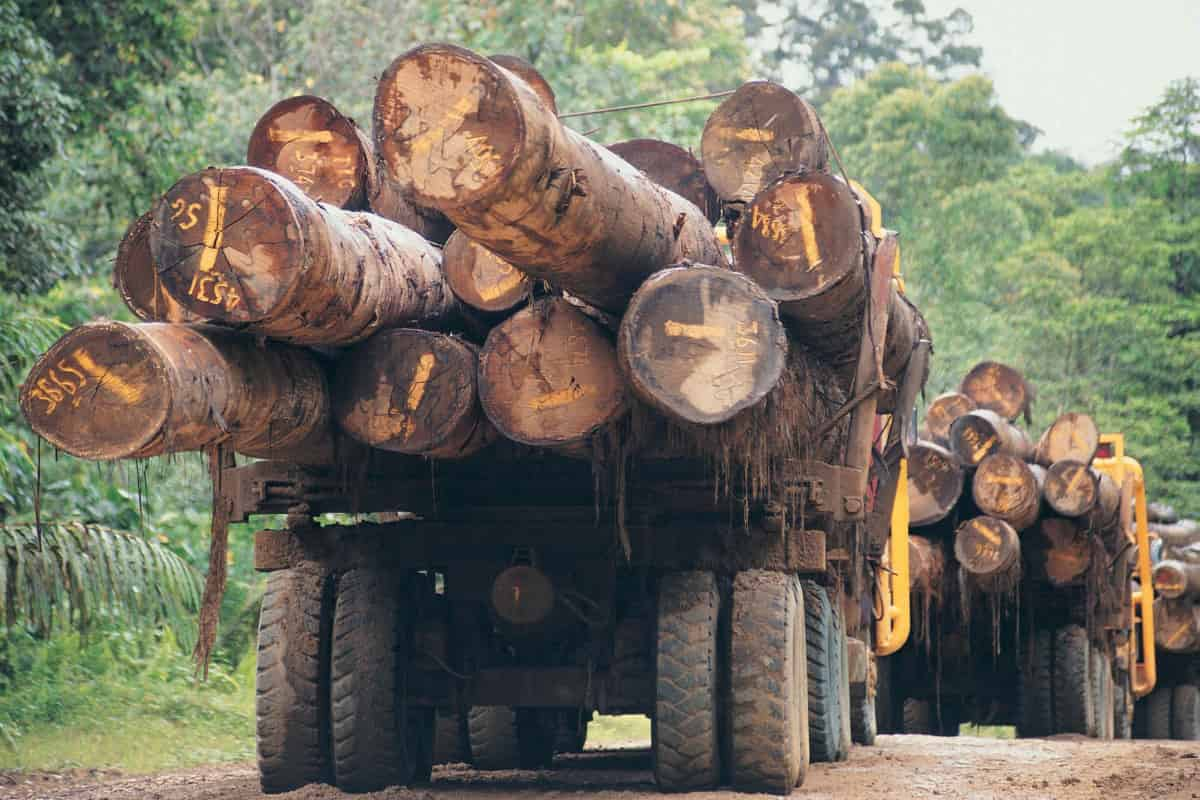



More than half of the world’s aboveground carbon is stored in tropical forests, and many of these forests are under threat of development. When development happens the degraded forest is thought to have little ecological value. However, a new study published in Science by Christopher Philipson and colleagues comparing naturally regenerating and actively restored logged tropical forests have found forest restoration is a solution capable of both replenishing carbon storage and preserving biodiversity. While this concept isn’t new, the adoption of restoration practices has been impeded by uncertainties over its effectiveness.
The researchers studied an area of tropical forest in Malaysian Borneo, where agricultural activities have caused soaring deforestation rates for years. The study site was heavily logged in the 1980s and subsequently protected from further logging or conversion to plantation agriculture. To assess forest recovery, co-author Greg Asner and his colleagues from the Arizona State University Center for Global Discovery and Conservation Science, mapped the area using their Global Airborne Observatory, equipped with powerful lasers and spectrometers, in 2016. The resulting maps revealed the location and amount of carbon stored above ground across thousands of hectares of forest.
The survey used both airborne LiDAR (a bit like a laser-powered version of SONAR) and spectroscopy (a staggeringly accurate way of looking at the colour of things) to map the terrain below the aeroplane to map and identify trees in Sabah, Malaysia. The team took measurements of 257 forest plots that had been protected after being logged thirty to forty years ago.
Greg Asner has been working in the New World, but found that Borneo presented a new challenge for his team. “Technically the tree canopy is fundamentally different than the New World tropical forests. The dipterocarp of Southeast Asian forest canopies evolved in a way that they have a different basic structure. It didn't affect the technology, it affected our algorithms and the interpretation of the data that come from the technology. And now that was a major hill to climb.”
The answer was to repeatedly fly over the sample plots, to compare results with what was seen in the aeroplane. Once the algorithms were calibrated, they were able to interpret the results they were finding in Malaysia.
The new perspective on the forests of Borneo showed that the logged forest could regenerate forest. “Just twenty years ago we kind of looked at secondary forests as trashed forests,” said Asner in a Zoom call to Botany One. “Well, experience and the world give you perspective and these forests still have biological treasures within. Compared to nothing, they have genetic starting points to recover.”
“Chris Philipson and all of us came together. I flew and did the data collection and the core analysis and he did the forestry side of it. With the field plots he figured out that, within that survey area, areas that have the chance to recover are surprisingly capable of doing so. We're really pleased that it does work that you see that management can increase carbon stocks and that these forests should not be viewed as too far gone.”
Areas left to regenerate naturally recovered by as much as 2.9 tons of aboveground carbon per hectare of forest each year, highlighting the ability of degraded forests to recover if protected from full agricultural conversion.
First author Chris Philipson, of the University of Dundee and the ETH Zurich, said in a statement, "This quantitatively confirms that if degraded forests get effective protection, they can recover well naturally."
Even more importantly, the researchers found that forest areas that underwent active restoration recovered 50% faster, from 2.9 to 4.4 tons of aboveground carbon per hectare per year. Restoration methods included planting native tree species, removing tree-climbing vines, and thinning vegetation around saplings to improve their chances of survival. Full aboveground carbon density recovery in a naturally regenerating logged forest would take around 60 years, while recovery for an actively restored forest takes just 40 years.
While in the aeroplane, Asner’s team were also able to see the hidden parts of the forests. “Our crew is a large aircraft. We have up to six crew on board. I was on board as the navigator for the entire project. So I did see both through the data, but also looking out the window. Sabah is a busy landscape like most tropical landscapes, areas that are deeply protected, appear protected deeply, meaning really cordoned off. There are a lot of areas that looked like they were entered from the edges from the agriculture side.” said Asner.
These observations have become a paper of their own. Nearly a fifth of tropical forest is within 100m of a non-forest edge. “Those intact forests that are near to edges of agricultural fields, even as deep into the forest as a kilometre have a different structure to the interior part of the forest, which indicates people are going in there and removing trees. That whole thing started up in the plane, as we're looking at these first edges and thinking, this doesn't look right compared to what I've seen in places elsewhere on the planet where a forest may be cut in half. In Sabah, you see a lot of what I would call the telltale signs of entry.”
The data set runs into trillions of data points, and is effectively a census of forest area. The data therefore could inform many more research projects, Asner said. “We've been giving the data away like crazy. I usually ask, like mainly for my own edification, what do you want to do with the data so that I can answer questions. I'm getting people using the data for animal habitat analysis. We've done a little of that with orangutans but people want to do all kinds of work with animals actually, like, placing the animals in the tree canopy digitally and understanding what canopy is.”
“Another one that I'm seeing is hydrological studies, people would like our data to understand the impacts of forest removal or protection on water quality downstream. So they're using the terrain data. Our lasers can see the terrain underneath the forest as well. It's not just the top of the canopy, we can see the terrain. And that map shows the streams and the gullies and where water would flow. There's a lot of hydrological study. Then there's folks that we do collaborate with across the UK and in Malaysia that we're looking at connectivity between different forest reserves.”
The technique is not just limited to forests. While the technology won’t resolve small plants, the spectroscopy identifies communities of plants found in an area. “We have a bank of postdocs and scientists darting around the planet that utilise our data for non forest applications. Agriculture, grasslands, shrub land and savanna applications,” said Asner.
“In Hawaii right now we're actually using it to map corals on the seafloor. I've been working corals for about five years. I've done it in the Caribbean and the Hawaiian Islands and a few other dots on the planet. And we're getting there. I think that we're within two years of doing the same kind of work we do with tropical forests, but for coral reefs.”
The study in Science is the first time that a long time-series dataset has been used to demonstrate that active restoration helps the regeneration of forests after logging and other disturbances. However, the current carbon price is still not sufficient to pay for the cost of restoration, limiting the impact that this approach can have on the climate change crisis. However, new carbon offset programs could potentially fund these restoration costs.

In a note of optimism, the news doesn’t just apply to Borneo, said Asner. “We have millions and millions of square kilometres of these forests dotting the planet now from Amazonia to the Congo, from the Congo to Southeast Asia, including Borneo and also the Southeast Asian mainland. There are huge amounts, millions of square kilometres of secondary forest that could go into the climate mitigation effort right away, and also can be new harbours for biodiversity or the expanding harbours for what we have left on the planet.”
"Science has laid out a clear pathway for land managers. We now must turn to the economics of the problem to generate the support to pursue these solutions," said Asner. "Restoring degraded tropical forest works to mitigate climate change, and it saves biodiversity along the way."
READ THE ARTICLE
Philipson, C., Cutler, M., Brodrick, P., Asner, G., Boyd, D., Moura Costa, P., Fiddes, J., Foody, G., van der Heijden, G., Ledo, A., Lincoln, P., Margrove, J., Martin, R., Milne, S., Pinard, M., Reynolds, G., Snoep, M., Tangki, H., Sau Wai, Y., Wheeler, C., and Burslem, D. (2020) Active restoration accelerates the carbon recovery of human-modified tropical forests. Science, 369(6505), pp. 838-841. Available at: https://doi.org/10.1126/science.aay4490.