

Archaeologists like disasters, at least when they’re not personally involved with them. Not because they’re particularly psychopathic, but because of the ‘Pompeii premise‘. Archaeologists excavate ruins, and these are abandoned sites. However, abandonment is a process, it takes time. So what you see when you dig a site isn’t a site as it was, but what remains of a site after it’s abandoned. People take useful things away with them, so the distribution of artefacts isn’t going to the same as it was when the site was actually in use.
At least, that’s usually how the ruins are formed. Sometimes though fate takes a hand.
The best-known example is Pompeii, where the city wasn’t evacuated before Vesuvius started raining ash on it. It means that what archaeologists found in Pompeii was a lot closer to a site put on pause, and preserved, instead of one that was robbed and decayed. The ‘Pompeii premise’ is that what you see is a snapshot of the site in use. There are other sites around the world where the Pompeii premise might apply. For example, there’s a buried village in New Zealand and in El Salvador there’s Joya de Cerén.

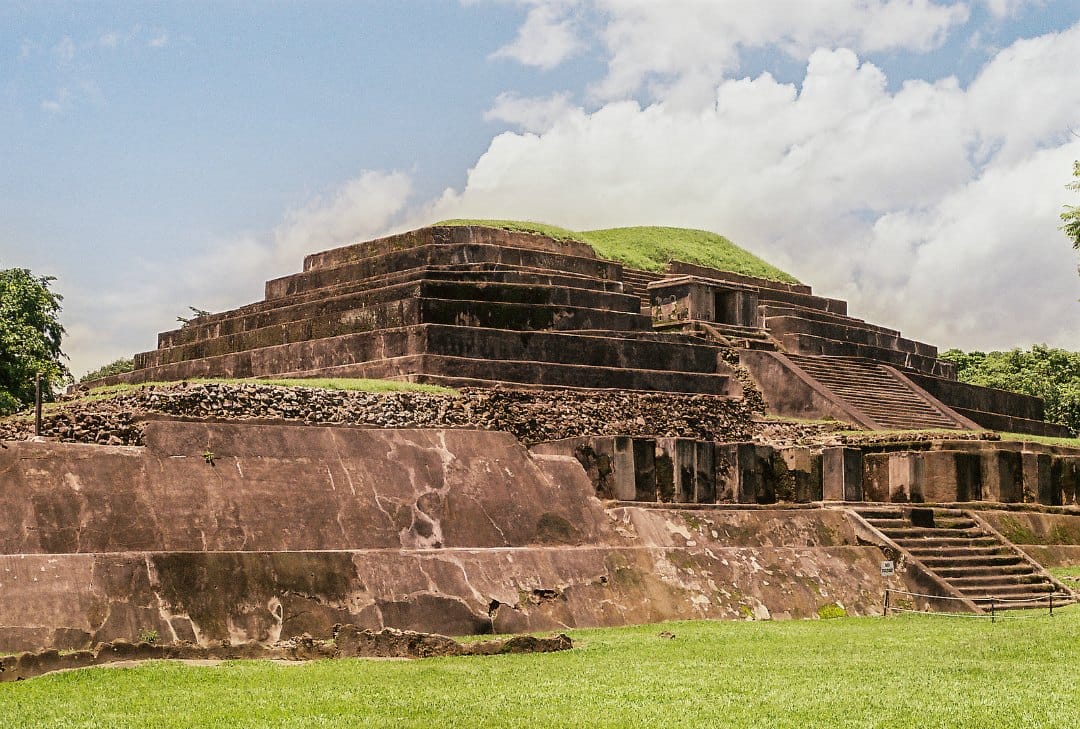
Joya de Cerén was a Mayan village. Farahani et al. have been investigating this site and they say that around AD 660 Loma Caldera erupted causing ash to fall on the village. Happily, they report the place was evacuated but they also note something else. There was quite a rush to abandon the site, so a lot of material was left behind. In particular, there was no time to gather food. What was left were the foodstuffs in the houses and also the crops in the gardens and fields around the houses. If you could identify the plant remains in the house, you could see what was used on-site and how it was stored.
You can just start digging and look for carbonised remains of plants. However seeds are small and easily missed, so what the team used was a common technique in archaeology – flotation. What you do is get dry soil, put in a tank and add water from below. The idea is that as the water rises it lifts the remains you’re looking for. There’s an example from another archaeological site in the video below.
As the team dug they found the ground wasn't entirely solid, what changed the research was when they took the Pompeii premise a bit further.
When excavators dug at Pompeii, they found skeletons were in voids in the earth. What had happened was that the soil formed around the bodies, but the flesh decayed, leaving a hollow. Filling that hollow with plaster of Paris enabled archaeologists to reconstruct a better image of the fallen at Pompeii. Could the same be true of plants? Did the decayed plants leave voids like shadows of where they once stood? Farahani's team investigated these gaps and started making plaster casts. If they were preserved plants, then it might still be possible to identify them.
From the write-up it sounds slightly dispiriting: "Only 450 of the thousands of recovered casts retained sufficient diagnostic characteristics to be identified." Despite that, it's extremely rare to be able to do this, and any success at all is quite an achievement.
Putting together all the different remains, they mapped the results using a GIS, to see how the plants were distributed around the village.
Not surprisingly, maize was the most common plant at the site. However, they also found plenty of manioc Manihot esculenta (cassava) at the site, thanks to the casts. These weren't just in the fields, but also by the houses, and this is archaeological detail that has been lost at other sites. They also found guava and agave, along with chilis, beans and calabash. They show the plants were together which would support use together in food preparation.
But it wasn't all about food. Something else they found was mirasol Tithonia rotundifolia. This, they argue, was construction material for fences and they found other examples like grasses for thatch. The result isn't just an examination of ancient farming, but something much more holistic in plant use.
Farahani et al. argue that what they show is "the difference between living and curated plants". Being able to see the difference between plants being grown and plants being used also gives insight into the complexity of the relationship between people and their crops.
The chief concern I had about this article was in the title: Identifying ‘plantscapes’ at the Classic Maya village of Joya de Cerén, El Salvador. I didn't like the word plantscapes. There are archaeologists love making up jargon, and occasionally I've got the impression they're making up new words to hide the lack of genuinely new content. So why a 'plantscape' instead of a 'landscape'?
I think what plantscape highlights is the richness of the data. Landscape archaeology can be about the spatial relationships between buildings or the local topography. In this research, space isn't simply abstract it's filled with different plants which have different biological properties and different social meanings. It's something that can get lost in landscape archaeology because it's difficult to get that kind of data, and when that data isn't being used it's easy to forget that it's even missing. In reality, all ancient landscapes would also have been plantscapes, so it's a distinction that shouldn't exist. If the word is necessary then this tells us something interesting about landscape archaeology.
I can see this being of interest to modern ethnobotanists. I think it provides an interesting comparison with modern plant use in the region. Also by seeing what correlates with modern ethnobotanical studies, it might make ethnobotanical fieldwork more applicable to interpreting other Maya archaeological sites. Pompeii is a key site in understanding the ancient Roman Empire. The possibilities that Farahani et al. demonstrate here could add a whole new dimension to interpretation of Mayan sites.