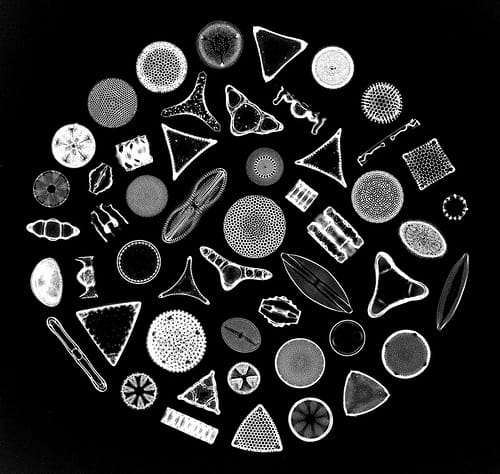



Many phytoplankton share a common feature with their larger non-aquatic cousins, the land plants: chloroplasts. Therefore they are also united in their ability to photosynthesize and their environmental requirement of sunlight. Phytoplankton occupy the surface waters of our oceans where sunlight can penetrate. They account for more photosynthesis, carbon dioxide fixation and oxygen production than all the worlds rainforests combined. As the primary producers of the oceans they provide the basis of the oceanic food chain and have contributed to the evolution of the largest living creatures on earth. Phytoplankton feed zooplankton and these minute organisms in their billions make up the diets of hundred ton whales, alongside other filter feeders. Many predatory fish such as mackerel and tuna feed upon these filter feeders, which we humans in turn enjoy.
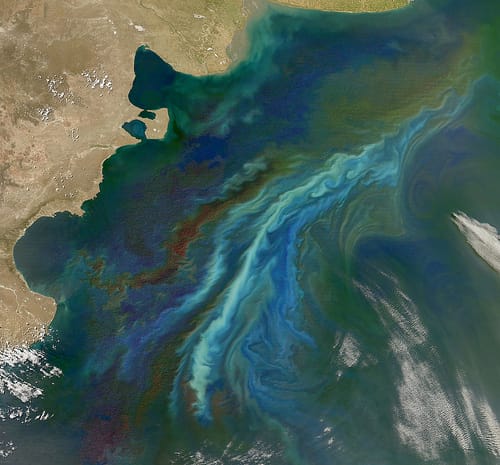
The range of darks blues, bright turquoise hues to deep greens of the world’s oceans is attributable to the range of different compositions of microscopic algae populating different regions. This is also true when more unusual areas of colour such as pinks and reds appear – a result of algal blooms. This spectrum of colours is due to the variety of photosynthetic pigments present in the microscopic organisms. Despite their beauty, not all of these blooms are beneficial to life. Some produce toxic compounds that in high concentrations can exert harmful effects on both the marine and coastal life. For example Karenia brevis secretes neurotoxins potent enough to lead to fatalities of marine life and birds which feed upon them. However algal blooms need not produce toxins to be fatal. Unusually large numbers of phytoplankton in an area can tip the balance from providing vast quantities of food for feeding marine life to producing a fatal depletion of oxygen.
Prior to seeing these organisms at higher magnifications it is too easy to instinctively imagine the constituent parts of algal blooms as relatively undifferentiated globular organic material. The reality of their cellular architecture couldn’t be further from this depiction. Magnified several hundred times the intricate structure of individual unicellular plants is revealed to be highly structured, some with crystalline characteristics reminiscent of snowflakes drifting in the water. Upon first glance at a collection of micrographs, the diversity and complexity between species appears potentially infinite in their highly differentiated conformations. This is just one example of how in nature the closer you look, the more intricate organization presents itself in surprising forms.