

What’s that one plant you can’t start your day without? Where I come from, most people won’t make it through their everyday life if they don’t wake up to a cup of coffee, at least not without a grumpy face. And hopefully not just any old coffee, but a good one. This year, a group of researchers from Costa Rica and the US proved that bees don’t just impact coffee production but also the quality of it ― and thus probably its price, the income of coffee farmers, and the daily joy of us coffee lovers.
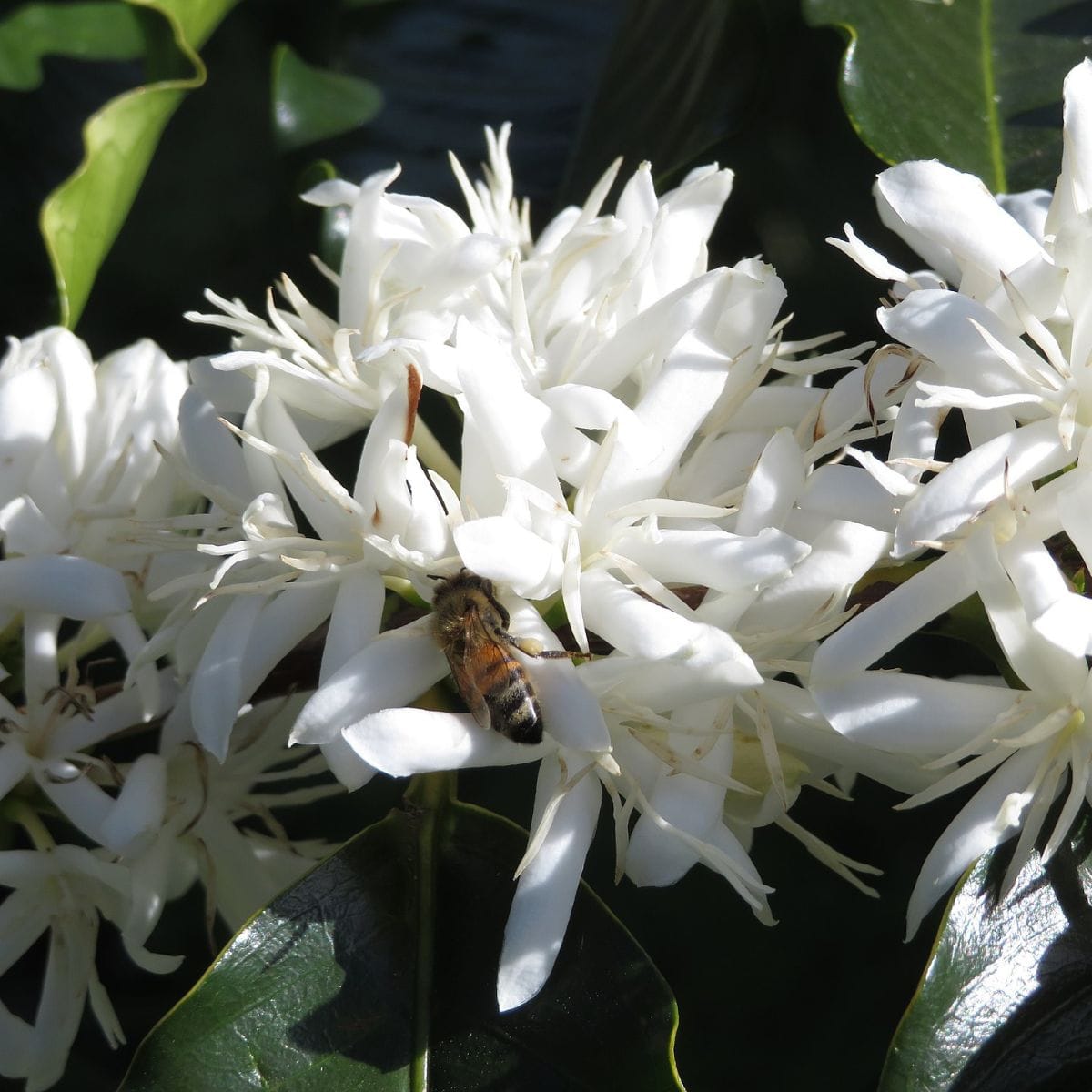
Pollinators are key to the amount of food we humans get from many of our crops; there’s a wealth of evidence for it. Yet, their influence on the quality of those crops, like flavour or nutritional value, has been studied far less. To address this gap, Dr. Natalia Aristizabal and her team set up an experiment on a coffee farm in the hills of Tarrazú, a region in Costa Rica renowned for its gourmet coffee. They used gauze bags to exclude bugs from a handful of coffee flowers, so they could figure out how animal pollination affects both the yield and quality of this major crop. Clearly, it wasn’t only a matter of scientific curiosity. Coffee turns out to be one of the world’s most traded plant products and a vital source of income for millions of smallholder farmers in the tropics.
When the growing season came to an end, the experimental coffee berries were harvested, peeled, left to dry under the sun, and roasted just like the rest. After grinding and brewing the final product, the research team had two certified testers judge the cup profile —a comprehensive set of sensory attributes that determine its quality, like acidity, flavour, and fragrance— of bee- and self-pollinated coffee. The results showed that coffee made of bee-pollinated beans boasted higher quality scores for aroma and body, the latter being the richness and texture of the beverage in your mouth. Also, undesirable flavour descriptors, like ‘herbal’ and ‘green leaves’, were three times more frequent among the self-pollinated samples. On top of that, a higher proportion of flowers turned into coffee berries in bee-pollinated plants, similar to previous yield-oriented studies.
But there was a bitter side to the pollination services of bees. The authors further observed that bee-pollinated fruits weighed less and had lower flavor balance scores in their cup profiles compared to bug-excluded coffee. Such effects of pollination on berry weight could depend on the management intensity of each coffee farm, the researchers say; for example, on the amount of fertilizer used or the frequency of its application. However, confirming these hypotheses would require additional investigation.
Subtle changes in coffee quality attributes can have substantial effects on the economy of coffee producers, even more than yield. In particular, aroma is known to be a crucial feature for the specialitycoffee market worldwide. The prices of high-quality coffee on this speciality market, like the one produced in Tarrazú, can reach up to 20 times the average price of commodity coffee. Moreover, the potential for a better aroma to increase coffee prices is greater than that of a lower balance to diminish them, according to the article.
Promoting pollinator habitats could become a sustainable strategy for coffee stakeholders, balancing ecological benefits with economic gains.
Coffee growers can also pursue higher prices for their product in the speciality market by setting it apart with sustainable practices. Hence, protecting and restoring bee habitats in coffee-producing landscapes could not only be promising for local biodiversity conservation, but also for improving farmers’ incomes. Aristizabal and her colleagues even fancy the idea of a ‘bee-friendly’ label that could boost the value of speciality coffee. Would you invest in a great-smelling, bee-friendly coffee to fuel your days more sustainably?
READ THE ARTICLE
Aristizábal, N., Mora-Mena, S. E., Martínez-Salinas, A., Chain-Guadarrama, A., Castillo, D., Murillo, J. B., Porras, J., Ricketts, T. (2025). Bee pollination affects coffee quality, yield, and trade-offs within them. Agriculture, Ecosystems and Environment, 377: 109258. https://doi.org/10.1016/j.agee.2024.109258
Andrés Pereira-Guaqueta
Andrés is a Colombian biologist fascinated by plant-animal interactions and eager to share scientific knowledge outside academia. He is currently finishing his master’s degree at the National Autonomous University of Mexico. His main research interests revolve around the relationships between flowering plants and their animal pollinators, and how they respond to our rapidly changing world.
Spanish translation by Andrés Pereira-Guaqueta.
Cover picture by Forest & Kim Starr (Wikimedia Commns).