


Billions of seeds from wild plant species are safely stored in seed banks worldwide, preserving genetic diversity for future use. However, a new study has found that the potential of these seed collections is largely unrealised. According to a survey of over 100 seed banks across 34 countries by Fiona White and colleagues, only about 70% of seed banks had ever used their seed collections for reintroducing species to the wild, with an average of just 12 reintroductions per seed bank. The study, published in the journal Biological Conservation, highlights how limited resources and funding are preventing seed banks from fully leveraging their collections to support reforestation and restore plant communities.
Plant reintroductions from seed bank collections are a vital tool for conserving biodiversity. Seed banks exploit the fact that, for many plants, seeds are a long-term survival capsule, capable of surviving much harsher conditions than the adult plant. Reducing the temperature and humidity of storage allows seed banks to preserve plants with much more ease than setting up maintained botanic gardens.
White and colleagues created a questionnaire that they sent to various international organisations to determine how seed banks are contributing to conservation efforts. They also conducted a literature review, searching for evidence in published scientific articles of people reporting using seed bank material in their conservation efforts.
A hundred and four seed banks responded, but there was a significant bias in where the responses came from. Almost sixty responses were from European seed banks, while just one African seed bank replied. White and colleagues accepted this may reflect a bias in the article but also write that the responses may also reflect other circumstances:
...[T]he responses received were skewed towards the Northern Hemisphere, with most (82 %) from Europe and North America. Consequently, the results may not be a true global representation of how seed banks use their collections, with those in Asia and the Southern Hemisphere underrepresented. Nonetheless, there is an inherent bias in the location of seed banks, with over 90 % of ex situ collections held in Europe and North America due to historical and socioeconomic reasons (Mounce et al., 2017).White et al. 2023
Compared to the hundred questionnaire responses, the literature review results were comparatively sparse. Many conservation efforts used fresh seed, with just a dozen publications stating seeds from seed banks were used in a plant translocation.
Around three-quarters of seed banks said they had participated in plant translocations, with an average of 12 projects per seed bank. Ninety-six per cent of seed banks said they would be willing to participate in future projects, so what is preventing them? The researchers found the chief barrier is not scientific.
Almost 90 % of seed banks that responded to our questionnaire indicated they had some form of constraint on plant translocation, with lack of funding and resources identified as the main limitations. Seed banks that had already utilised their collections for plant translocation were more likely to want to carry out or donate seeds for future translocations, suggesting there is a willingness to continue contributing to plant translocation activities.White et al. 2023
White and colleagues also found that the relatively low use of seed from seed banks might be due to differing practices around the world.
Although most questionnaire respondents had performed plant translocations using their collections, the number of translocations per seed bank was relatively small (median of 12). However, the median number of translocations per seed bank in North America and Australia was 2.5 times the global value, suggesting there are regional variations in the priorities of seed banks for plant translocation.White et al. 2023
Another reason for the low number of plant translocation projects may be that plant translocation is usually an action of last resort. White and colleagues suggest that rather than using seeds in seed banks purely as last resorts, they could also bolster in situ conservation efforts. Extra seeds could add population and genetic diversity to a plant population under threat and, in turn, help provide more seeds for the seed bank.
Perhaps most critical of all, White and colleagues highlight the lack of publications based on plant translocations. They attribute this dearth of publications to the nature of the projects. Often they are done with conservation in mind but not a specific research goal, and therefore they may not be seen as suitable projects for a research paper. The authors conclude that developing networks to exchange knowledge could help seed banks increase their capabilities to fight biodiversity loss.
READ THE PAPER
White, F.J., Ensslin, A., Godefroid, S., Faruk, A., Abeli, T., Rossi, G. and Mondoni, A. (2023) “Using stored seeds for plant translocation: The seed bank perspective,” Biological Conservation, 281(109991), p. 109991. Available at: https://doi.org/10.1016/j.biocon.2023.109991.
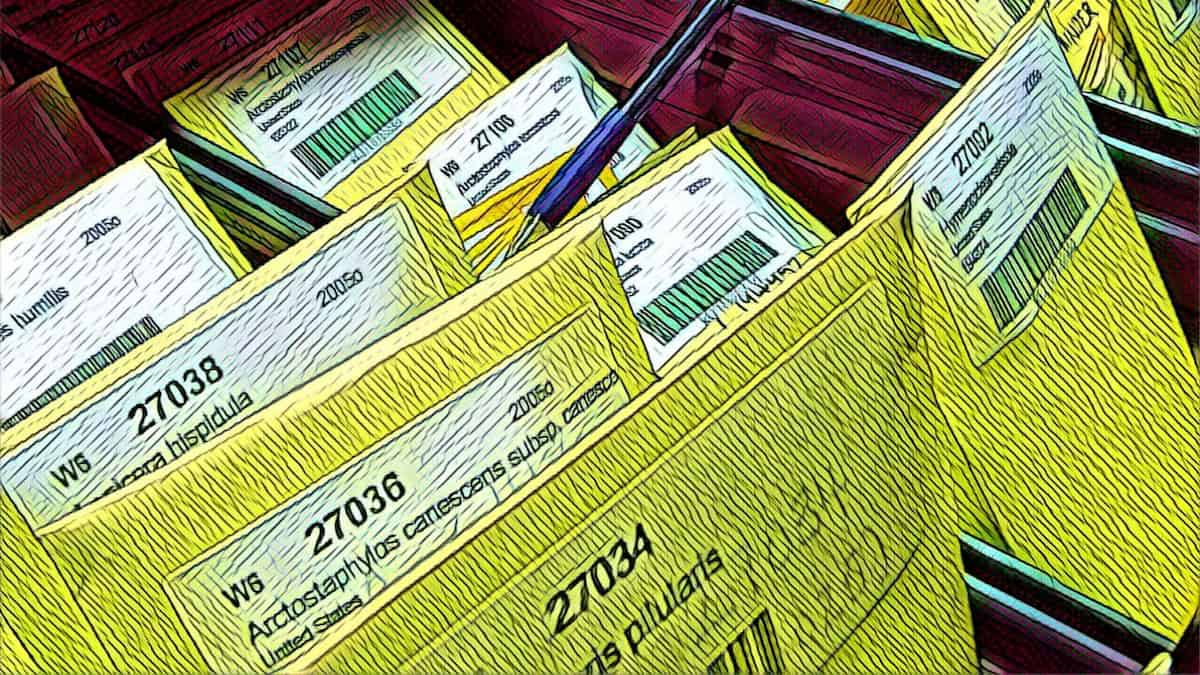
Cover image: Seedbank at the USDA Western Regional Plant Introduction Station by R C Johnson.