Rangewide ploidy variation and evolution in Acacia senegal: a north-south divide?
AoB PLANTS

Rangewide ploidy variation and evolution in Acacia senegal: a north-south divide?

https://www.botany.one/rangewide-ploidy-variation-and-evolution-in-acacia-senegal-a-north-south-divide/

Know someone who'd like this?

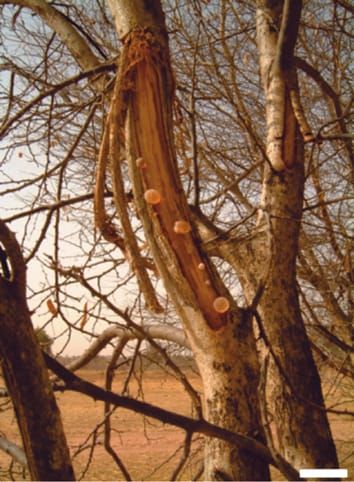
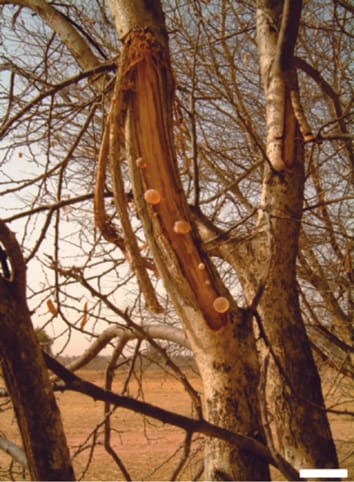
Leafless Acacia senegal tree at Dahra experimental field trial, Senegal during the dry season. Middle branch shows characteristic gum arabic ‘nodules’ formed after tapping (debarking) at the beginning of dry season. Bar represents 10 cm (photo credit: Julia Wilson)

Knowledge of rangewide variation in DNA content and ploidy level may be valuable in understanding the evolutionary history of a species. A recent study of Acacia senegal showed a geographic pattern of genetic variation, which differentiated East and Southern African populations from those in the Sudano-Sahelian region. In a new study published in AoB PLANTS, Odee et al. build on this previous research to explore variation in DNA content using the flow cytometry method and chromosome number. A geographic north-south DNA content pattern was detected, reflecting the previous results. These results suggest that DNA content may also be important in elucidating the evolutionary history and distribution of the species. Furthermore, Odee et al.’s use of external tissues of dried twigs in flow cytometry is new, and provides the opportunity to study numerous other dryland woody species.

Liked this article?

Written by

AoBPLANTS

AoB PLANTS is an open-access, online journal that publishes peer-reviewed articles on all aspects of environmental and evolutionary biology. Published by Oxford University Press, AoB PLANTS provides a

More from this writer

The nonprofit plant magazine

Lab science. Citizen science. Your source for plant science.