
Resilience is the main survival strategy of plants. Due to their sessile nature, they cannot escape hostile growth conditions and must therefore rely on tolerance or recovery mechanisms to survive stressful events. Extended periods of drought and heat waves, as well as soil degradation, are increasing on a global scale and threatening ecosystems and crop production. Developing strategies to increase stress-resilience in plants is therefore more important than ever to ensure food security and protect our environment. Next to conventional breeding or genetic modification, which are time-consuming, laboursome and can pose environmental and safety concerns, more sustainable and affordable solutions are needed to increase plant stress tolerance.
Young plant seedlings are especially vulnerable to stress during germination and emergence. Treating seeds with chemical or biological agents before sowing to prepare plants early on for future stress exposure may be an effective strategy to increase their performance and resilience. The idea to kick-start seedling growth and harden them against stress through seed treatment is not a new one, but has in fact been tested by farmers and gardeners for thousands of years. The Roman naturalist Pliny the Elder (aka Gaius Plinius Secundus) and his fellow agriculturalists experimented with soaking seeds in water sweetened with honey, diluted manure or “the juice of the plant that grows on roof tiles” to improve their germination. Pliny also found that cabbage plants would be immune against insects when the seeds are soaked in the juice of houseleek before sowing, making him probably the first one to report improved stress tolerance through seed treatment.
This ancient knowledge was preserved yet not much further explored until the 1970’s, which saw increased scientific interest into seed physiology, and new seed treatment techniques were developed and tested on different plant species. In his seminal work “Germination of an idea: the priming of seeds”, Nottingham-based researcher Walter Heydecker popularised the term “priming” for the controlled, pre-sowing seed hydration with subsequent drying to initiate metabolic activity without triggering full germination, which leads to improved germination speed, uniformity, and seedling vigour. His consecutive work “Invigoration of seeds?” was still cautiously posed as a question, yet five decades of research into the effects and physiology of seed priming later, we can confidently replace the question mark with a full stop.
In a recent review published in the Journal of Experimental Botany, Dr Gholamreza Gohari and colleagues summarise and discuss seed priming approaches for climate-resilient agriculture. The authors present a range of techniques using different chemical or biological priming agents and their proposed modes of action. A key mechanism underlying the positive effects of seed priming is the repair of DNA that may have been damaged during seed storage, leading to improved germination and seedling emergence. Priming has also been found to activate antioxidative enzymes, which are essential components of the stress tolerance response, to mitigate excessive accumulation of reactive oxygen species. Other protective molecules, such as heat-shock proteins and osmolytes, are also increasingly synthesised in response to seed priming and can protect and repair cellular structures under stress. An exciting and promising new development is the use of nanoparticles less than 100 nm in size as priming agents. Due to their special physicochemical properties, they may be even more efficient in promoting seedling growth and conferring stress resilience. However, more research to evaluate their long-term impacts on plants in agricultural settings and surrounding ecosystems will be required before nanopriming may be commercialised.
A successful example of seed priming to boost tomato stress tolerance was recently presented by a team led by Dr Luca Giovannini. The authors tested the natural compounds chitosan and salicylic acid, a plant hormone, as priming agents either alone or combined with soil inoculation with arbuscular mycorrhizal fungi. Young tomato plants were exposed to drought or salt stress, which can severely compromise plant growth, and their physiological and metabolic stress responses were analysed. The authors found synergistic effects that made primed plants, in combination with mycorrhiza inoculation, more tolerant towards both stress conditions compared to non-treated plants or treatment with priming agents alone. Among other physiological adaptations, the plants’ antioxidant and osmoprotective machinery were upregulated, making them better equipped to respond to water deprivation or soil salinity, respectively. Importantly, the improved stress tolerance was tested several weeks after sowing, highlighting the long-lasting beneficial effects of seed priming.
Science has come a long way from the mysterious “roof tile plant juice” used in ancient Rome to our current understanding of molecular processes underlying the positive effects of seed priming to prepare plants for environmental constraints they may encounter. However, to use its full potential, we still need a better understanding of the effects of seed priming, especially in different contexts. Both the review by Gohari and the work by Giovannini highlight that the effects of seed priming can be very variable across plant species, environments, priming agents and application methods. Future work will need to focus on the effects of seed priming in different settings and under combined stress treatments that resemble natural growth conditions, to establish effective and sustainable approaches to mitigate stress effects in the field and grow more resilient crops.
READ THE ARTICLES:
Giovannini L, Pagliarani C, Cañizares E, et al.. 2024. Mycorrhization and chemical seed priming boost tomato stress tolerance by changing primary and defence metabolic pathways. Journal of Experimental Botany 76: 6410-6433. https://doi.org/10.1093/jxb/erae457
Gohari G, Spanos A, Ioannou A, et al.. 2025. Seed priming approaches for climate-resilient agriculture. Journal of Experimental Botany 77: 2013-2026. https://doi.org/10.1093/jxb/eraf440
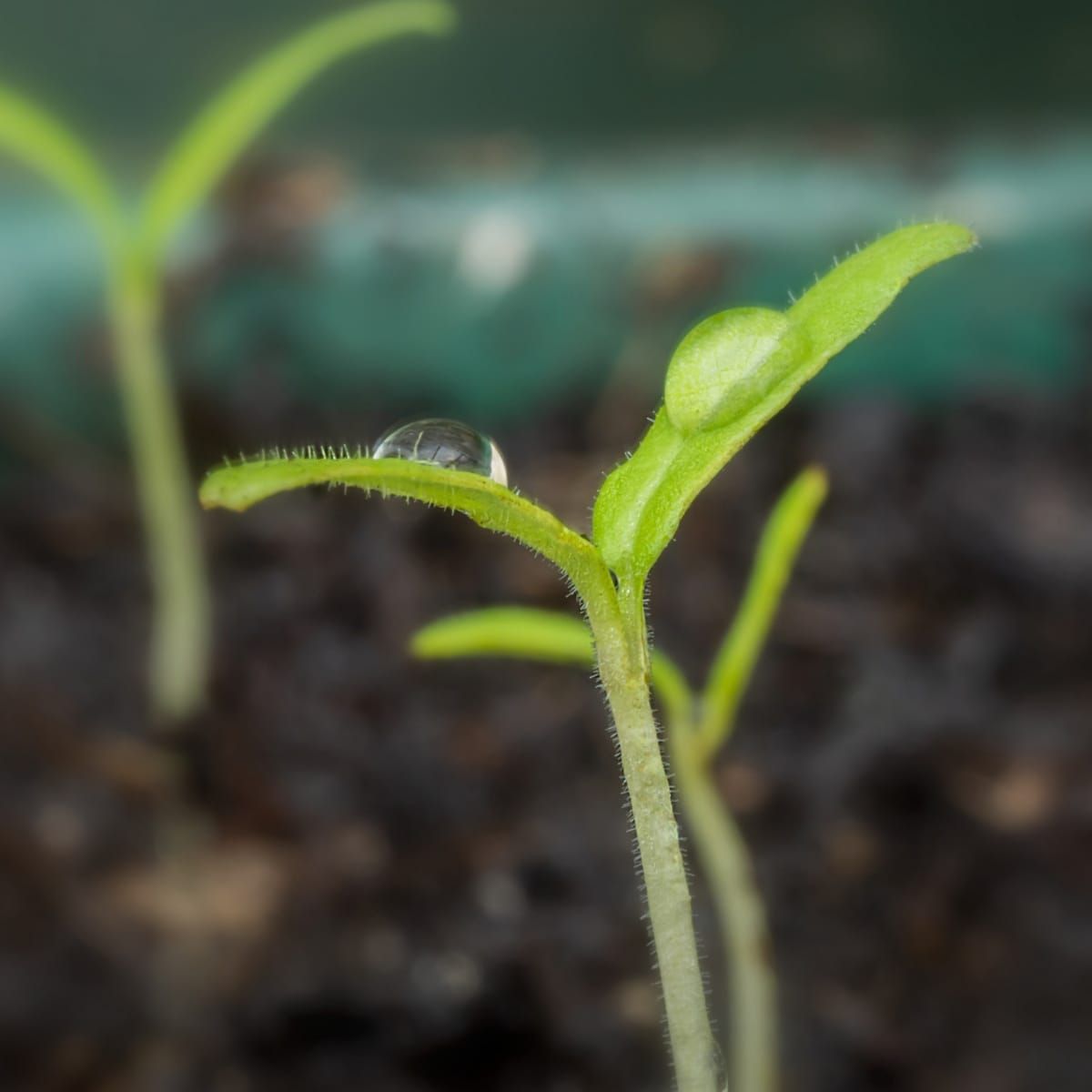
Cover picture: Tomato seedling by Jonathan Billinger (Wikimedia Commons).