

Mountain ranges host a considerable number of endemic species, which is considered to be the result of the complex origin of mountain ranges, shaped by geographic isolation, climate changes and strong microhabitat differentiation. The distribution of narrowly endemic species often coincides with Pleistocene refugia, suggesting that Pleistocene climate fluctuations had major impacts on the biogeography of endemic taxa. However, for narrowly endemic taxa restricted to formerly heavily glaciated areas, alternative explanations have to be sought. The origin of such range-restricted diploid species is little understood.
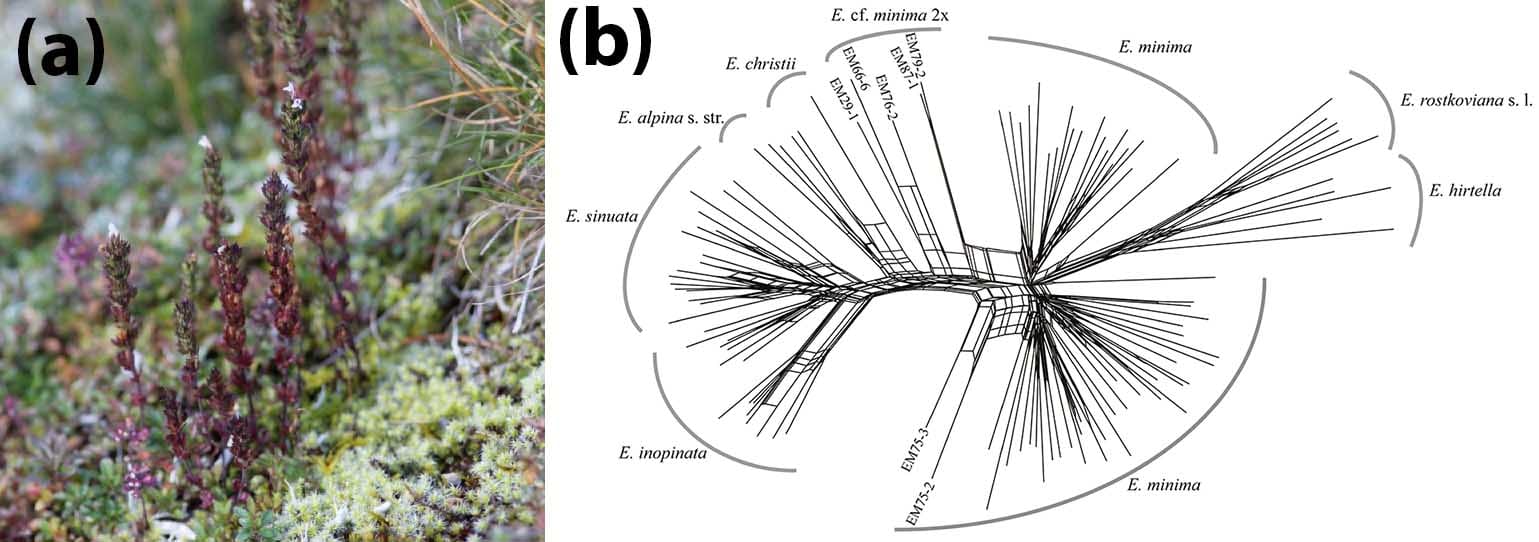
Pan et al. recently addressed this question in AoBP by studying a group of two autogamous eyebright species, Euphrasia inopinata and E. sinuata, each known only from a few sites in the eastern European Alps. Previous hypotheses suggested these species to be either remnants of the diploid ancestor of the equally autogamous but widespread and polyploid E. minima or as peripheral segregates of a more widespread allogamous diploid species. The molecular data collected by Pan et al. provided clear evidence that E. inopinata and E. sinuate are phylogenetically closely related to the diploid allogamous E. alpina instead of E. minima. Shifts in pollination system from allogamy in E. alpina to autogamy in E. inopinata and E. sinuata, genetic drift in small populations and geographic isolation at the periphery of the range of E. alpina probably contributed to the morphological and ecological differentiation of E. inopinata and E. sinuata.