Photosynthetic responses of trees in high-elevation forests: Comparing evergreen species along an elevation gradient in the Central Andes
AoB PLANTS

Photosynthetic responses of trees in high-elevation forests: Comparing evergreen species along an elevation gradient in the Central Andes

https://www.botany.one/photosynthetic-responses-of-trees-in-high-elevation-forests-comparing-evergreen-species-along-an-elevation-gradient-in-the-central-andes/

Know someone who'd like this?

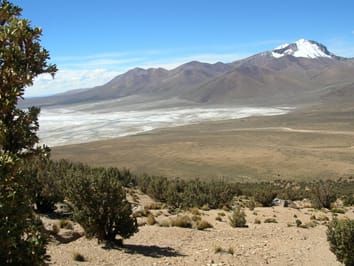
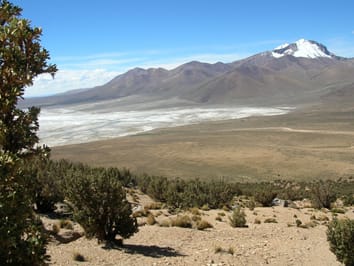
Study site of the Polylepis tarapacana forest in the Salar de Surire, Central Andes (Photo credit: Duncan Christie).

Plant growth at extremely high elevations is constrained by high daily thermal amplitude, strong solar radiation, and water scarcity. These conditions are particularly harsh in the tropics, where the highest-elevation treelines occur. In this environment the maintenance of a positive carbon balance requires the protection of photosynthetic apparatus and the ability to take advantage of any climatically favorable period. Polylepis tarapacana forms the world’s highest forest, being able to grow up to 5,200 m above sea level. A new study published in AoB PLANTS by Garcia-Plazaola et al. focuses on the photosynthetic responses of Polylepis species and how they are able to cope with such a challenging environment. The authors performed all measurements and samplings in their natural environment. This strategy allowed them to observe unexpected patterns of daily adjustments in photosynthetic pigments, which reflect major changes in the structure and organization of the photosynthetic apparatus.

Liked this article?

Written by

AoBPLANTS

AoB PLANTS is an open-access, online journal that publishes peer-reviewed articles on all aspects of environmental and evolutionary biology. Published by Oxford University Press, AoB PLANTS provides a

More from this writer

The nonprofit plant magazine

Lab science. Citizen science. Your source for plant science.