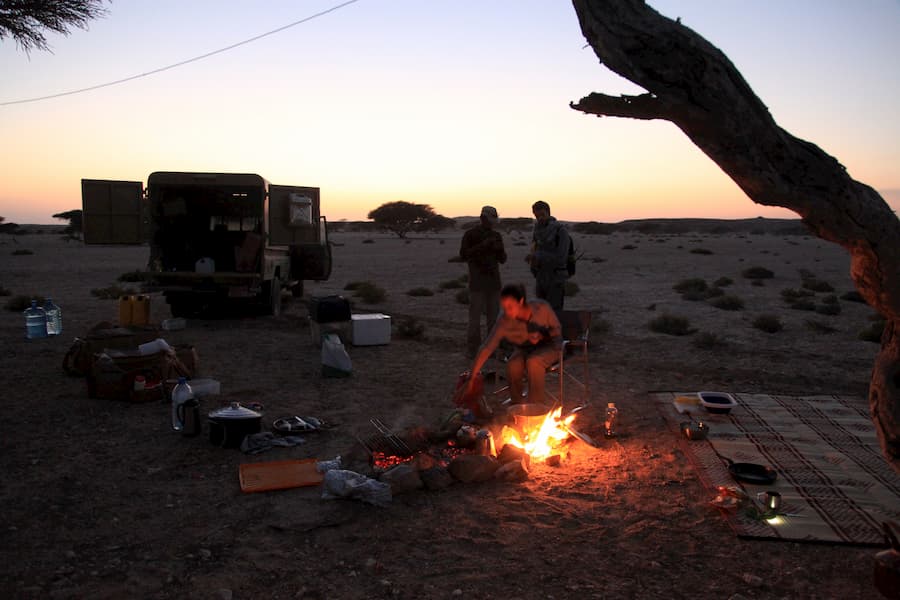



It might surprise you to learn that southern Arabia is a global biodiversity hotspot. While the landscape is not the lushest, a high proportion of the vegetation are endemic desert-adapted plants. A new survey, by James Borrell and colleagues, finds evidence for a climate refugium in the Central Oman Desert. The area could be the northernmost remnant of a continuous belt of mesic vegetation formerly ranging from Africa to Asia.
James Borrell said: “Many researchers interested in the diversity and distribution of Northern Hemisphere plants and animals will be familiar with the idea of glacial refugia. In Europe the expansion and recolonization of species after the last glaciation is probably one of the single most important factors influencing plant distributions today. However, these ideas have rarely been demonstrated in the extremely arid environments of the Middle East. Therefore, this study provides a useful corollary to more established European and North American examples.”
“Over broader time scales, it is now increasingly established that areas with long-term climate stability have an important role to play in species evolution. We think this is one of the drivers of the high level of endemism found in the flora of the Central Desert, and in our paper we narrow in on precisely the region that we think has acted as a refugium.”
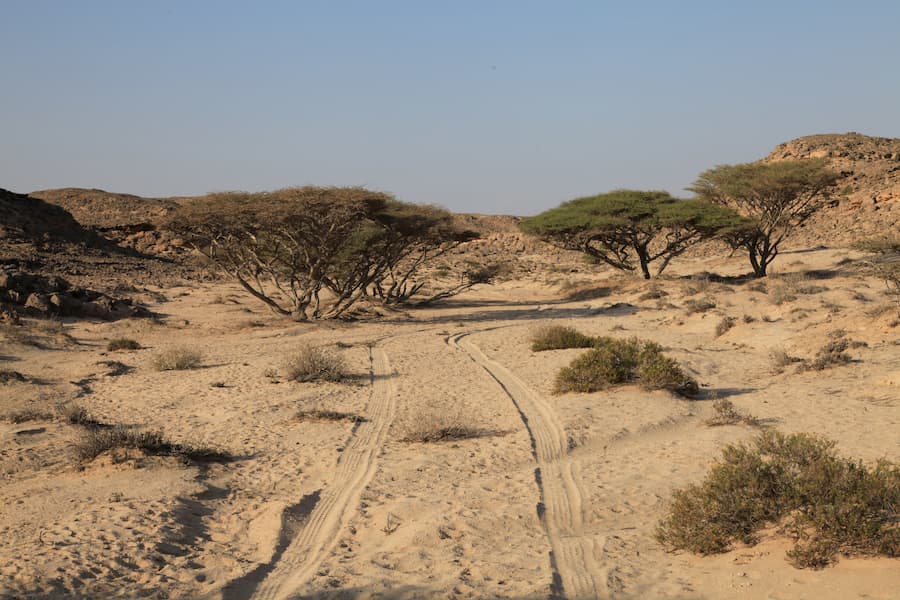
The desert is not somewhere that leaps to mind when thinking of botanical opportunities. I asked James Borrell what drew him to Oman. He replied: “Many of the international authors on this study have various long-running associations with Oman, having been enthralled by Omani hospitality and culture. I was first involved with a biodiversity survey expedition to Dhofar in 2012, and others have run a diverse array of botanical expeditions.
“It’s true, when I first visited Oman – as a biologist – I also pictured vast empty sand deserts and wondered if there would be enough life to keep me occupied. You only need to sleep out on the sand and in the morning inspect the imprint of hundreds of insect and small mammal tracks to realise these deserts really are full of life!”
The survey ran from Ras Madrakah southwest 270km across the coastal plain. Every 30km the team would drive a transect northwest for 20km to survey the area. The plan was to cross multiple environmental gradients that tend to run parallel to the coast. Sometimes wadis crossing the transects meant the team could not travel as far as thet would have liked. Borrell said: "Organising the logistics for surveying the Central Desert were extremely difficult. We used three 4x4 (hire!) vehicles and certainly put them through their paces. I have to really credit Andrew Stokes-Rees for making this work. But we were also well supported by a Toyota Landcruiser and team from the Oman Botanic Garden. Each day, we divided up the quadrats and arranged rendezvous locations and set off to find our plants."
"Botanically, the area is only just becoming well described. This is in large part thanks to the work of the Oman Botanic Gardens and their series of recent publications. Nevertheless, I’m sure there is plenty still to be discovered!"
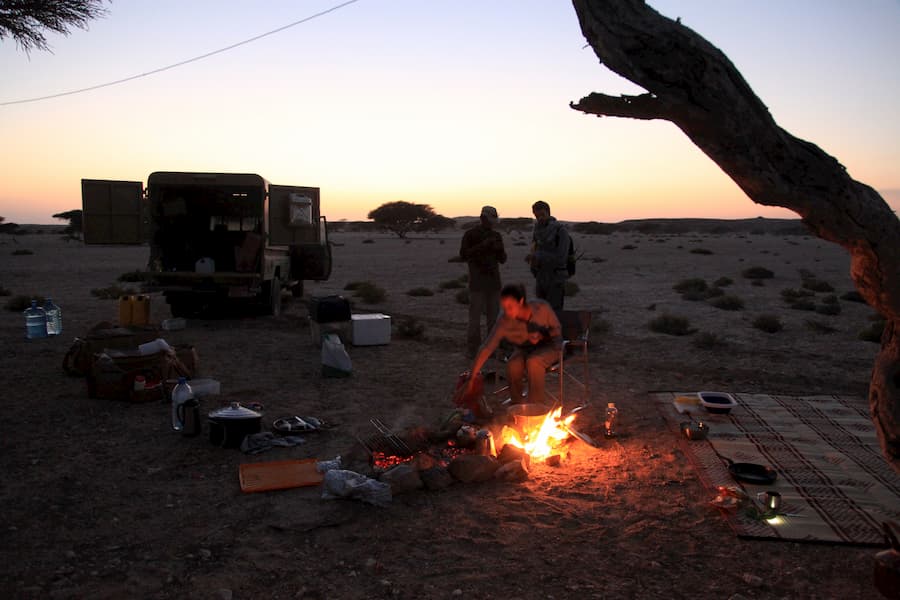
However, it wasn't all hardship. Borell said: "We camped every night, out under the vast night sky of the Central Desert and cooked communally over an open fire. One evening, camped on a beach at dusk, a rusty old 4x4 pulled up. Two friendly Omanis emerged with a cooler box full of freshly caught fish, thrust it on us with the words 'You are most welcome here' and disappeared back towards a small village. Just one example of the endless hospitality that made fieldwork in Oman such a remarkable experience."
"The study in Oman certainly marks a change of location from previous for Borrell, as he explained: "I’ve also worked on Dwarf birch in Scotland and Scandinavia – very different environments to Oman, but in both, the plants are barely knee-high and grazing and livestock are certainly a threat."
"I think the important message from both projects is that what we found in the end, was very different from what we expected at the beginning. For the heavily fragmented dwarf birch populations, we expected to see significant loss of genetic diversity, but surprisingly, this wasn’t the case. In Oman we set out to map a group of rare endemics, but discovered very unexpected spatial overlaps along the way."
"Both took much longer to publish than we planned, because we wanted to follow the emerging story and fully understand what the data could tell us. I think you have to be very open to that, even though there is a pressure to produce publishable results as quickly as possible."
However, while results may have taken time to produce, they are worth the wait. Borrell said: "I think this kind of collaborative study is very exciting for two reasons. Firstly, much of the previous work in Oman, and rightly so, has been about describing, documenting and mapping the flora. But now, we’re in a position to start understanding the processes and the drivers of that diversity – to start asking questions and testing hypotheses."
"Secondly, and looking to the future, I would hope to see these kind of spatial data fed into the identification and designation of ‘IPAs’ (Important Plant Areas in Arabia). This would be a really wonderful way of translating modelling and data into real impact."
It is tempting to get carried away sometimes when looking at refugia. It's easy to see them as gateways to the past, but in this case it might be (almost) true. Borrell said: "One thing that I’m very excited about is the implications of this research on other groups of species, especially on the story of human migration out of Africa. Of course, it’s not plant science, but the other group of researchers who have been thinking about Arabian refugia are human geneticists and archaeologists. Does our finding overlap with theirs? Are there other refugia scattered along the coast that humans could have followed? I can’t wait to find out."