


Attracting pollinators is a key action in reproduction for many plants. If there aren’t suitable pollinators available at a location, then it’s difficult to maintain a population. Some plants are happy to attract generalist pollinators and risk losing pollen to incompatible partners. Some plants take a different tack. They attract specialist pollinators. By encouraging a pollinator to favour one specific species, they ensure their pollen is delivered to another plant that can use it.
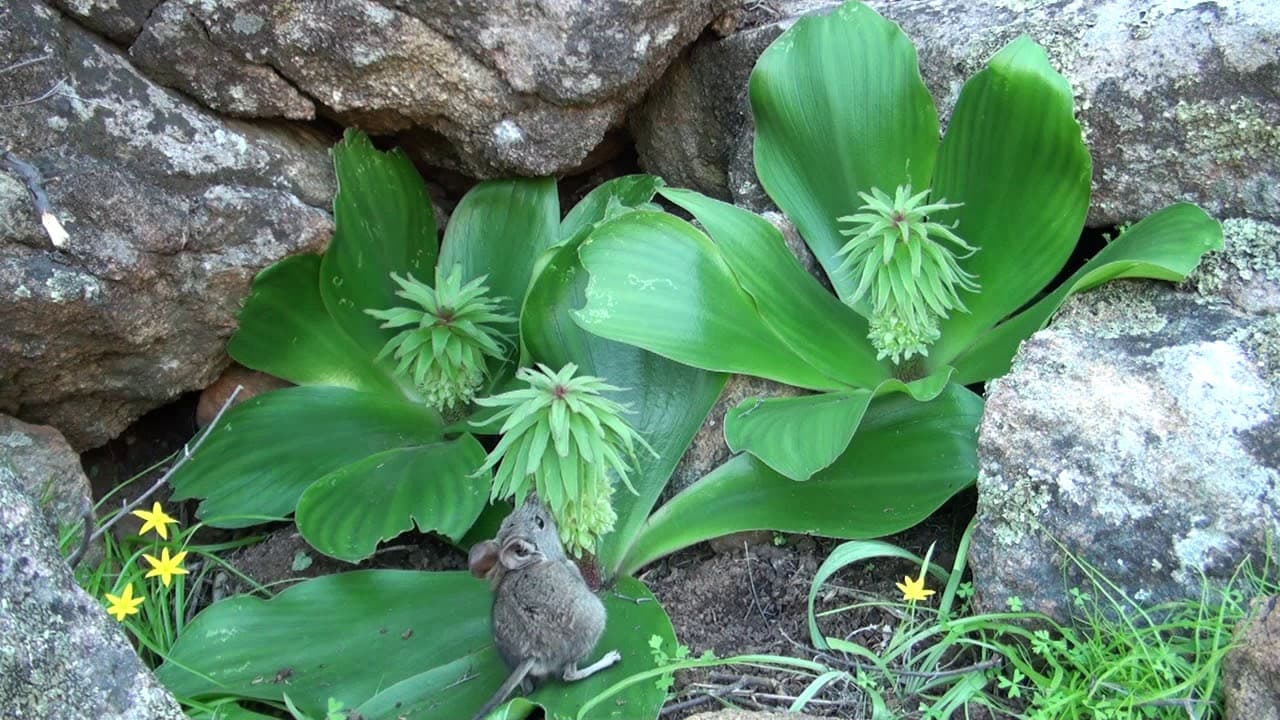
Eucomis regia, the pineapple lily, is an odd plant. It has open flowers, so its nectar is available to whatever chooses to visit. Insects and birds don’t visit. This doesn’t seem to bother the pineapple lily, which doesn’t seem interested in attracting them. Its flowers are green, giving the impression that the plant would rather not attract visitors. And the scent is odd.
Petra Wester and colleagues, who have studied E. regia, describe the smell as like boiled potatoes. It’s unusual and got the botanists thinking. Is the reason the plant looks like it’s not attracting visitors is because it really isn’t, and using scent instead of flower shape to attract specialist pollinators? The smell of the flower is due to some sulphur compounds. Wester and her co-authors knew that this was used by some plants to attract plants, but the pineapple lily flowers are close to the ground. Could some other mammal be pollinating the plant? The team set out to find what was going on.
To find if mammal pollination is going on, the team set out to examine multiple questions.
* What is visiting the flowers?
The scent hints at mammal visitors, but are other insects attracted to the smell?
* If mammals are visiting, are they transferring pollen, or are they just getting a free meal of nectar from the plant?
If the visitors aren’t actually transferring pollen, it could be they’ve learned to identify the scent with food, but the plant isn’t in a position to use them as carriers.
* Do the plants need these visits?
Is the pollen the visitors transfer significant, or are the plants self-pollinating and the transfer isn’t contributing much to the plant’s reproduction.
Wester and colleagues set up cameras around some E. regia plants. They found that the cameras didn’t see any insect of bird visitors, even though other nearby plants attracted them as pollinators. What they did find at the plants were small mammals. Micaelamys namaquensis is the Namaqua Rock Mouse. It would lap at the flower’s nectar and get dusted with pollen as it did so. The mice were not perfect pollinators for the plant, as sometimes they’d groom themselves to remove pollen.
Another frequent visitor was the amazingly cute Elephantulus edwardii. This is the Cape Rock Elephant-shrew, though recent research has found they're closer to elephants than shrews and it has been suggested that they're renamed Sengi. They have quite a nose, and this gets covered in pollen as they feed at the flower. They would visit a lot of flowers in an evening, so when they were spotted on camera at a flower, they might well have been part-way through a forage. Wester and co-authors say: "Often the nose was already covered with pollen before flower visits, but during almost all observations the amount of pollen on the nose visibly increased."
Some representative mammals were tested in a terrarium to see if they could transfer pollen. There were two plants, the first they visited was dusted with a dye. They could then access the second plant and feed there. After the mammal left, the flowers of the second plant were examined to see if the mammal had transferred dye. If there was dye on the plant, then that showed the mammals could carry pollen from one plant and leave it at another.
Wester and colleagues also tested to see if mammals were affecting the seed set of plants. They did this by covering the plants in mesh with holes big enough to allow insects (and the occasional pygmy mouse) but small enough to exclude the mammals. The authors say: "Almost no seed set occurred in flowers from which all visitors were excluded."
The experiments show that the pineapple lily is using mammals as specialist pollinators, despite having open flowers. So how has it attracted a specific audience? The scientists returned to the scent. In particular, they examined methional, a sulphur compound.
To test the mammals' nose for a scent, they set up a terrarium to house the mouse or sengi. They added a Y-shaped passed. At one end of the fork, a fan wafted white mineral oil. In the other arm of the Y, another fan blew the scent of white mineral oil with the addition, of just one part in a thousand, of methional. Crucially, there was no reward for the animal at the end of the fork and no training. So the choice the mammal made was purely on the attraction of the scent. The mice chose the route to the methional scent over 80% of the time. The scientists ran the experiment over fifty times. If you flipped a coin fifty times and it landed heads over forty times, you'd think this wasn't just random chance acting.
One of the impressions I got reading the paper was that this easily could have been more than one publication. That would be two lines or more on the resume instead of one, but it would also have damaged their message. By putting everything together, the authors have given a strong overview of the problem they were tackling. They haven't just demonstrated that scent is attracting mammals, but also that it's scent instead flower architecture that has changed the plant from insect-pollination to mammal-pollination.
Because they're taking a broad view of the pollination system, they're able to write well. The text is admirably clear because the authors know why they're doing what it is that they're doing. They conclude "...[T]he production of different sulphur compounds (e.g.DMDS and methional) in Eucomisseems to have played a pivotal role in shifts between wasp, carrion fly and mammal pollination." By putting everything together, in one place, the paper makes a very persuasive argument for that.
Note: You can see more video of the pollinators in the supplementary data of the paper or at New Phytologist's You Tube channel.