


Erosion is one of the most environmentally destructive processes, leading to loss of biodiversity in plants and animals, as topsoil with all its nutrients washes and blows away, ending with stony ground that cannot sustain plants or store water. When water is not stored, plants need continuous rain, making them drought-prone, and rainfall runs off fast, causing flooding downstream, collapse of hillsides, and silting up of dams (although seasonal inundations with topsoil and its nutrients have been part of traditional cropping in many areas).
I sometimes ask classes to think about the question of ‘how far is the human race from extinction?’; answers come back in terms of the months of food we have stored now, the random time until the next huge volcano erupts or asteroid hits us, the years until there is not enough food with current unsustainable production methods, or a few decades before wars over water or hunger lead to our extinction. My answer to the question: we are about 15 cm or 6 inches from extinction, the depth of the topsoil that sustains most plant and microbial life.
Erosion has been with us from the start of agriculture: traditional slash-and-burn agriculture was able to grow crops for only a few years before plots lost topsoil and nutrients, so they were abandoned without production for several decades before restarting the cycle. Landscape-wide erosion caused huge areas of limestone to be exposed in the Burren area of Ireland, now interestingly conserved as a very special ecosystem but with minimal biological productivity compared to the temperate rain forests that preceded the limestone pavements. In the US, the dustbowls of the 1930s, with many plowed (ploughed) and fallow fields displacing deep-rooting perennial grasses.
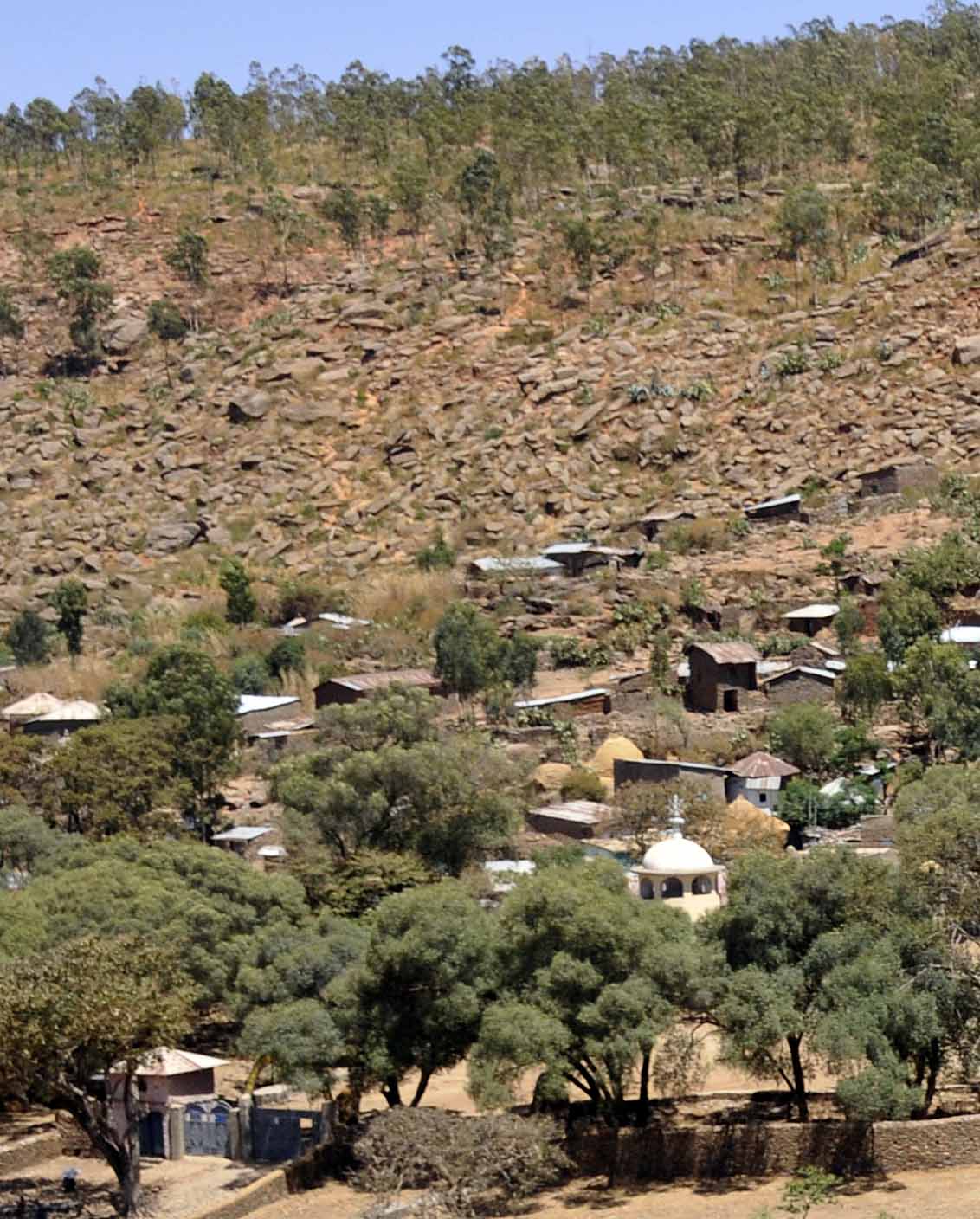
In the video, we start with the hillsides behind the city of Aksum (Axum) in Tigrai, northern Ethiopia, about 45km / 30 miles south of the Eritrean border. Eucalyptus is growing at the top of the hillside, but between the settlement and the top, it is obvious that in recent years, all the sticks and wood have been collected to burn in open fires, while smaller plants have been eaten by groups of goats driven by a goat-herd. While the top of the hill, still with Eucalyptus, only has a few visible rocks and stones, much of the sandy soil the lower part of the hillside has washed and blown away leaving boulders exposed. Among the few plants doing well, as seen in the walk up to the base of the hillside, is the central American invasive poppy species, Argemone mexicana. This is one of the few plants that is 'goat proof' with both vicious spines and toxic seeds (resembling closely Brassica seeds): it has no value.
I didn't see any signage about the erosion control project, but it was clear that goats and firewood collection had been controlled within the area being planted. Rudimentary terracing had been constructed, important to slow the runoff of surface water, as farmers have known for 8000 years. In pits, some Eucalyptus has been planted, but mostly another Australian species is being introduced, Grevillea robusta. This is physically the largest species in the plant family Proteaceae, growing upto 35m tall, and does well in dry forests with more than 1000mm rain per year, and it seems to be increasingly used for erosion control by planting along contours or in gulleys. As well as the men involved in planting, irrigation is critical and a chain of women is seen carrying 25 litre yellow containers of water about 1km from the water tanks, involving a steep climb of 100m or more up the slopes starting at 2100 m in the highlands. In flatter areas, donkeys are carrying four of the containers. Presumably, the employment from this
back-breaking work is more valuable than an expensive pumping and piping system. The containers themselves are reused 25 l drums from palm oil, notably imported from Indonesia, rather than across from the traditional producing areas of West Africa.
From 400BC, Axum was a powerful centre and the capital of the Aksumite kingdom until the 10th century. Among the reasons quoted for the fall of the empire was environmental degradation and over-farming, along with climate change. Hopefully the erosion control and reforestation seen in this video will enable the current Axum to increase its prosperity in the next few years.
Part of www.AoBBlog.com
This material is used in University of Leicester course BS2072 - Biodiversity and Sustainability.
Related video: Grain and Chilli Mills in Axum