
Islam and co-authors published an extensive review focused on dissecting the C4 metabolic pathway for use in C3 plants.
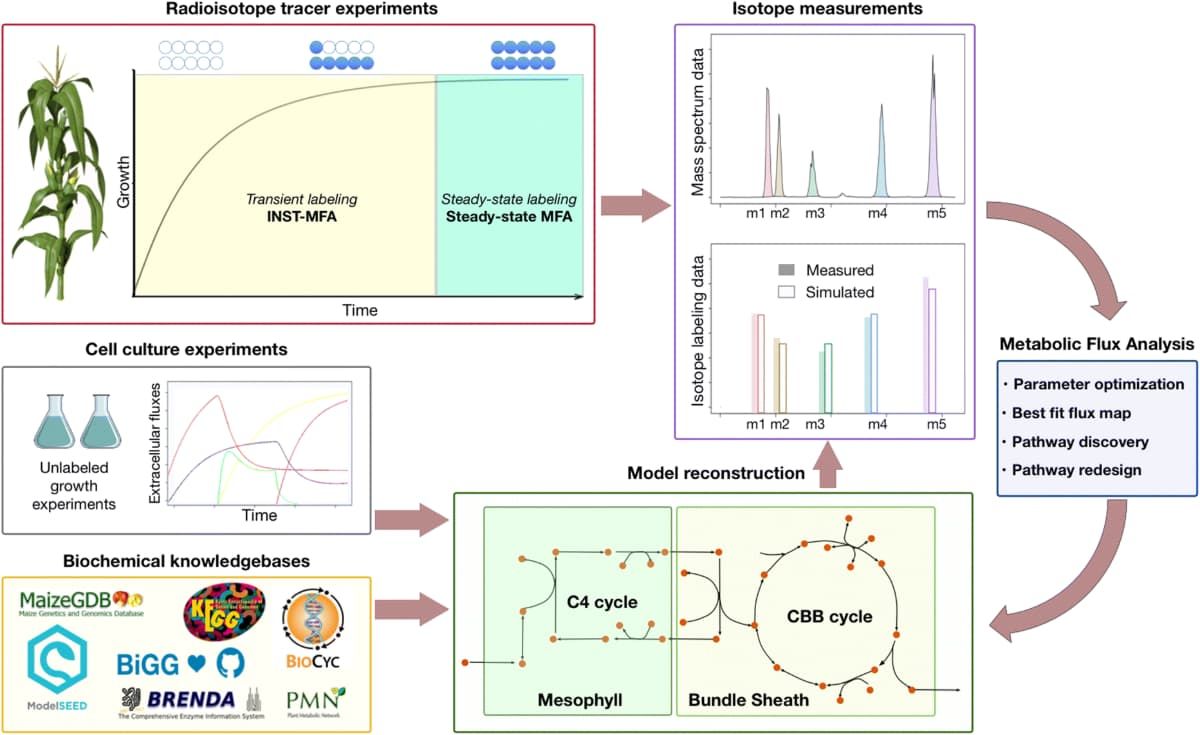
In one section, the authors call for collaborative experimental and theoretical approaches to dissect the C4 photosynthetic machinery and plant systems as a whole to enable a comprehensive understanding of metabolic network in C4 plants. Computational approaches like flux balance analysis (FBA) are needed to interpret experimental metabolic flux analysis (MFA) data in the context of metabolic flux distribution among the pathways. Conversely, metabolic network models require experimental inputs to validate and improve reconstructed models.

Image from Islam et al. 2018.
The authors describe the limitations to the integration of experimental and theoretical approaches. For example, the use of metabolic network models in steady-state MFA has limited application to photoautotrophic biological systems due to significant diurnal changes in metabolic flux. Nonstationary MFA also has challenges: simplifications in network modeling, such as pool lumping or neglecting storage metabolism. In addition, there is a lack of a standard workflow for pool size measurements. Kinetic models capture the dynamics of metabolic networks but also have limitations. They require large quantities of experimental data to estimate the required parameters. Furthermore, most of the rate laws used to characterize enzyme kinetics are nonlinear, making it computationally intractable to iterate over the system of equations in moderately large systems. The Monte Carlo approach circumvents the need for kinetic parameters by creating an ensemble of models through parameter sampling, but has its own obstacles.
The paper concludes that collaborative studies are essential, and researchers should identify and share the specific questions to address.