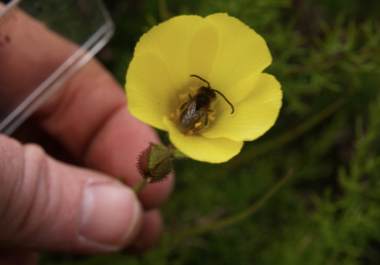

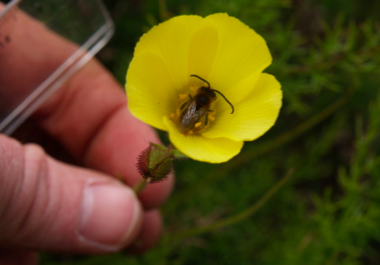
Despite being a highly autogamous or self-pollinating species, the carnivorous plant Drosophyllum lusitanicum (Drosophyllaceae) produces large, bright-yellow flowers. In a recent study published in AoB PLANTS, Salces-Castellano et al. used a flower removal and a pollination experiment to assess, respectively, whether large flowers in this species may serve as an attracting device to prey insects or whether previously reported high selfing rates for this species in peripheral populations may be lower in more central, less isolated populations. They detected a significant increase (15–25%) in the seed set of experimentally self-pollinated flowers and flowers exposed to insect visitation compared with bagged, untouched flowers whose seeds were produced only by spontaneous self-pollination. Given that the key life-history stage of this fire-adapted plant species is the formation of a persistent seed-bank, any increase in seed production through insect pollinator activity would increase plant fitness. This in turn would explain the maintenance of large, showy flowers in a highly autogamous plant.