



For International Women’s Day 2018, we celebrate the life and work of Anna Atkins, a pioneer of photography. She pushed the technology of her day to its limit, breaking new ground and created cyanotypes that remain beautiful works of art to this day.
What is a Cyanotype?
The cyanotype was an early method of photography invented in 1842 by Sir John Herschel, the astronomer son of William Herschel, the discoverer of Uranus. The first thing you need to create a cyanotype is photosensitive paper. Anna Atkins was the daughter of a chemist, and friend of Herschel and so fortunate to be familiar with these chemical processes that you could do with patience and skill at home.
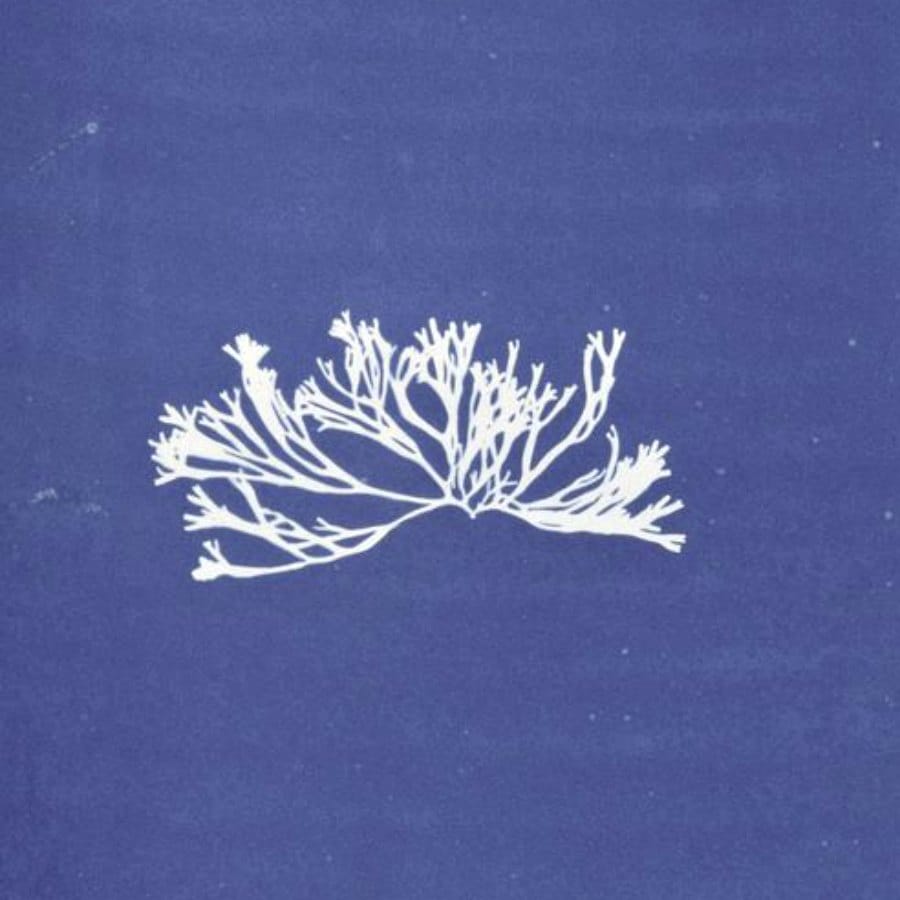
Once you have the paper prepared, place an object over the paper, fix some glass over to keep it in position and expose it to the sun. The result is a photogram, a photo made without a camera focussing the image.
The first book of scientific photographs
When she heard of the process, Anna Atkins applied it to her collection of seaweed, making the first book of photographic images. Photographs of British Algae: Cyanotype Impressions eventually ran into three volumes. Her work enabled the reproduction of fine details in algae that would be painstakingly difficult to reproduce in the traditional botanical art of the period.
She would later go on to produce books of ferns and flowering plants.
Plant photographs today
While we don’t use cyanotypes today for scientific images, they are still appreciated as art. And while many botanical photographers still ‘gram though these days, they ‘Instagram’ rather than photogram. However, looking at some of the good images that people have posted on Instagram, Anna Atkins’ algae compare well with modern photographs.
Cystoseira
Cystoseira ericoides A cyanotype by Anna Atkins from 1843, one of the earliest scientific photographs or 'photograms'. Uploaded for an International Women's Day post at Botany One. #botany #internationalwomensday #algae
A post shared by Botany Too (@botany_too) on Mar 8, 2018 at 12:58pm PST
Fantàstic bosc de Cystoseira crinita a Mallorca, en queden pocs, però aquest és espectacular. Fantástico bosque de C. crinita, quedan pocos, pero este es espectacular. Amazing forest of C. crinita, there are few left, but this one is awsome. Foto by #kikeballesteros #seaweed #seaforest #mallorca #merces #fundacionbiodiversidad #reptes #restoration #betlem #cystos #cystoseira
A post shared by Emma Cebrian (@cebrianemma) on Jun 28, 2016 at 12:27pm PDT
Ectocarpus
Ectocarpus siliculosus A cyanotype by Anna Atkins from 1843, one of the earliest scientific photographs or 'photograms'. Uploaded for an International Women's Day post at Botany One. #botany #internationalwomensday #algae
A post shared by Botany Too (@botany_too) on Mar 8, 2018 at 1:00pm PST
#Ectocarpus #phaeophyta #brown #algae #lab3 #filamentous #colonial #eukaryotes #plant #morphology #lab #biology #science #microscope #collage #uni #uob
A post shared by University of Bahrain (@fatima_biologist) on Mar 16, 2013 at 8:55am PDT
Fucus
Fucus canaliculatus A cyanotype by Anna Atkins from 1843, one of the earliest scientific photographs or 'photograms'. Uploaded for an International Women's Day post at Botany One. #botany #internationalwomensday #algae
A post shared by Botany Too (@botany_too) on Mar 8, 2018 at 1:01pm PST
#FACT: Fucus is a type of brown algae found worldwide along coastal areas. These algae species are similar to kelp and provide an important source of alginates - often used as a thickening agent in both food and industrial products. Credit: Jim Haseloff #olympus #bioscapes #confocal #biology #microscopy #microscope #microscopic #micro #microscopes #nature #science #research #optics #imaging #objective #fucus #algae #photooftheday #photomicrograph #🔬
A post shared by Olympus Life Science (@olympuslifescience) on Oct 20, 2017 at 11:36am PDT
You can see more of Anna Atkins's work Photographs of British Algae: Cyanotype Impressions, thanks to the New York Public Library on Flickr.