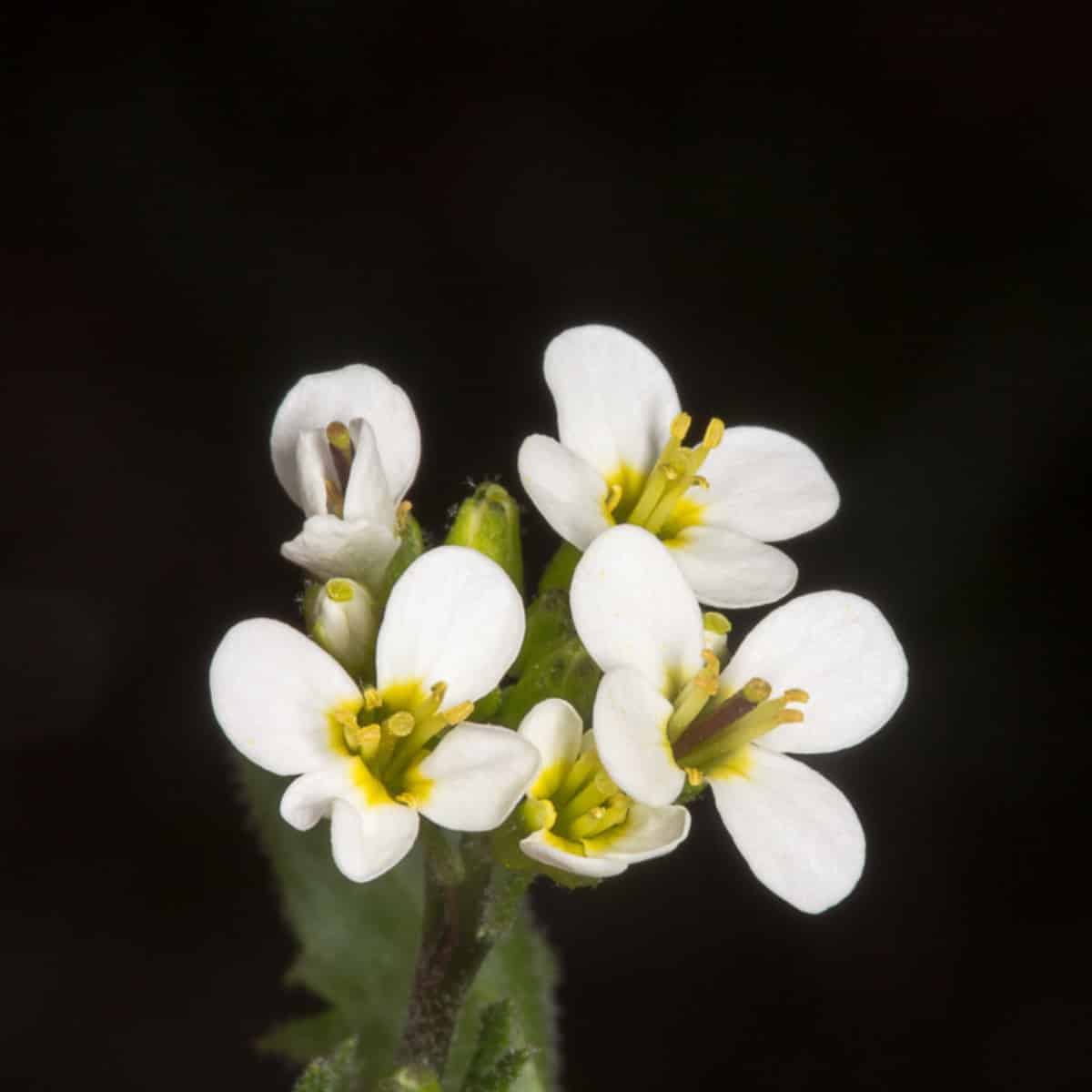



You’d expect plants of the same species to behave the same way. If they look the same, why wouldn’t they attract pollinators the same way? But research by Hanna Thosteman and colleagues shows that, in the Italian Apennine mountains, two populations of Arabis alpina, just 4 km apart, produce detectably different floral perfumes and attract partly different pollinator communities.
The key difference between the plants is their elevation. The lower-altitude plants live around 900 m above sea-level where they host bombyliid flies as well as hummingbird hawkmoths and honeybees. Higher into the mountains at 1700 m they are still visited by the flies, but the moths and bees are replaced by hoverflies and orange-tip butterflies instead.
To find out how the plants were interacting with their pollinators, Thosteman and colleagues staked out the plants to see who visited where. They used mesh nets to see if pollination happened by day or night, and in Sweden, they grew plants from both populations to sample their scent at four times across a 24-hour cycle under controlled conditions. They also dissected individual flowers to pin down which tissues produce which compounds.
They found that the scent differences are not spread evenly across the flower. They write:”The among-population floral scent variation was localized to petals and reproductive organs...“ Despite these differences, each population pumps out scent at steady rates day and night, regardless of temperature. Even dropping the temperature to 5°C didn't change things. This constant emission suggests scent is cheap to produce for this species. So cheap it would be more effort to build the biological machinery to switch it on and off.
They also found that the scent differences persisted, even when the plants were grown in a greenhouse in Sweden. This shows that the differences are genetic, not environmental. They may be the same species, but they’re built different.
The puzzle is how and why such similar plants, so close, have such different scents. The obvious choice is the need to attract different pollinators. However, Thosteman and colleagues can’t rule out other possibilities. For example, maybe local antagonists, like florivores, could make it sensible to change scent, though they found little sign of it in these populations. It could even be genetic drift, though they note that this would require quite a meandering colonisation of the hillsides just to move four kilometres upwards.
Why the two populations diverged is a question for future research. For now, the takeaway is that a plant most people would dismiss as just another white flower on a rocky slope is chemically distinct from its neighbours down the valley. If Arabis alpina can surprise botanists, then what diversity is hiding in the plants you pass as you travel to work?
READ THE ARTICLE
Thosteman, H., Eisen, K., Montgomery, C., Cheng, X., Pace, L., and Friberg, M. (2025) Generalist‐pollinated Arabis alpina exhibits floral scent variation at multiple scales. Nordic Journal of Botany. Available at: https://doi.org/10.1002/njb.04893.
Cover image: Arabis alpina by Drepanostoma / iNaturalist CC BY