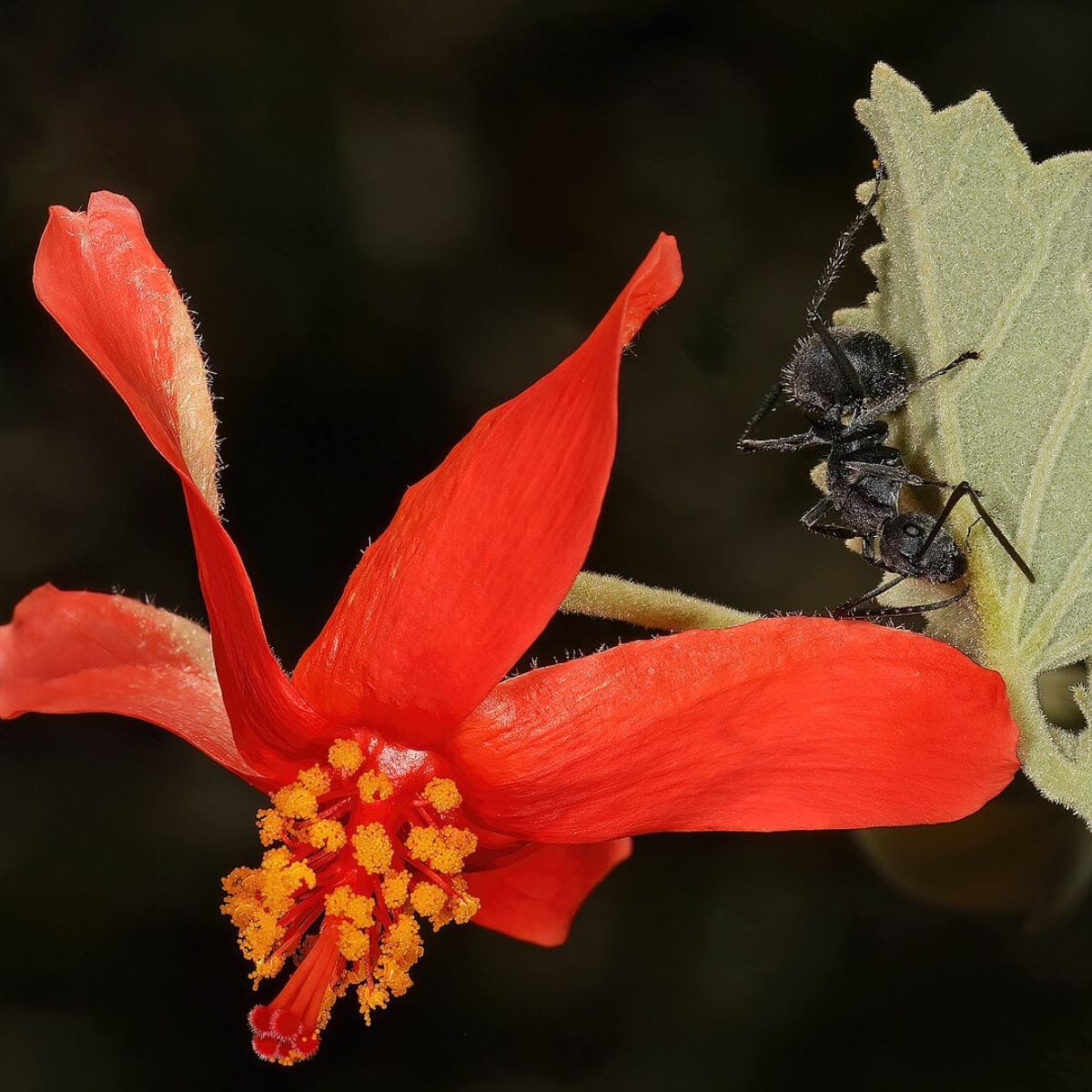



Imagine a royal castle guarded by loyal sentinels who protect its treasures at all costs. Those guards will need paying, and extrafloral nectaries are plants way of making that happen, as they offer sweet nectar to reward the ants that patrol their leaves and flowers. These ants act as fierce bodyguards, driving away hungry herbivores and other intruders who want to feast on the castle’s precious parts.
But sometimes, these guards are so zealous that they scare away the visitors the castle wants to welcome, its pollinators. Where these guards are positioned makes all the difference. If they stand near the main entrance, the flowers, visitors may hesitate to enter. But if they patrol the outer walls, such as leaves or stems, coexistence becomes easier. Not all visitors react the same way either: bees tend to avoid these bodyguards while butterflies are less intimidated.
Previous studies have shown different results for this relationship, with some showing that ants harm pollination, while others suggest that the benefits of protection outweigh the costs. This uncertainty hinders our understanding how plants evolve their defences, how pollinators adapt, and how ecosystems function. If plants can find a way to keep ant protectors without losing pollinators, it might explain why so many plants have these nectar rewards.
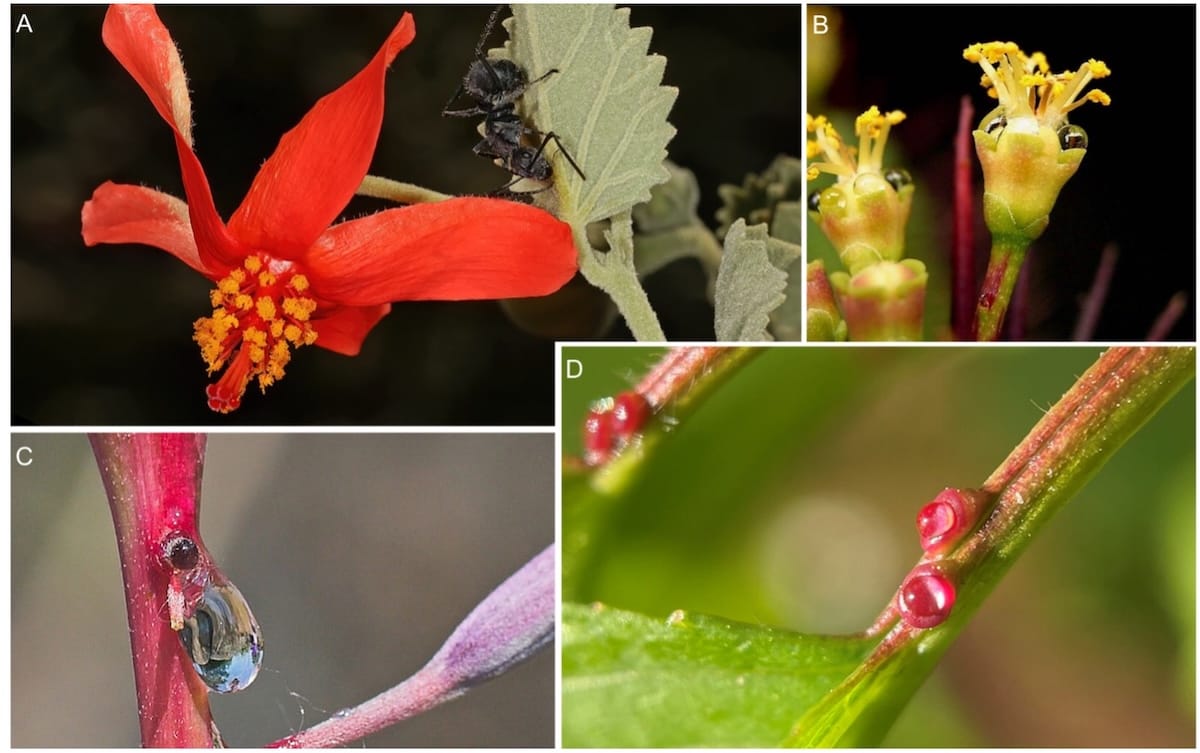
To untangle this mystery, Amanda Vieira da Silva and her team combined data from 27 separate studies comparing plants with and without ants, measuring how often flowers were visited and how well plants reproduced.
The authors found that ants generally reduced flower visits, especially from bees. This effect was strongest when the nectar glands were located right on or near the flowers. In this scenario, we can imagine ants acting as vigilant guards standing at the flower’s entrance, intimidating these crucial visitors.
Interestingly, butterflies were not affected in the same way. Unlike bees, butterflies seemed less bothered by the ants and continued to visit flowers even when ants were present. This difference might be because butterflies are more cautious or have behaviours that help them avoid direct encounters with ants by, for example, using their long proboscis to reach nectar without touching the parts of the flower where ants patrol and spending only brief moments on each flower.
Despite the fewer flower visits, plants did not suffer a clear decline in their ability to produce seeds and fruits. In fact, plants that had nectar glands on their leaves or stems often showed improved reproduction when ants were around. This suggests that ants help protect these plants from harmful insects that might otherwise damage leaves, flowers, or fruits, boosting the plant’s overall health and success.
These results reveal a fascinating balance. While ants can sometimes chase away pollinators like bees, their protective role against plant-eating insects may help plants reproduce better in some cases. This means that the presence of ants is not simply beneficial or harmful but depends on the location of nectar glands and which pollinators are involved. Furthermore, the study highlights how plants may have evolved strategies to keep these bodyguards close without losing the essential pollinators. Understanding these trade-offs could reveal how complex mutualisms shape the evolution of flowers, nectar glands, and the insects that visit them, offering a fresh perspective on how cooperation and conflict intertwine in nature.
READ THE ARTICLE:
Vieira da Silva, A., Nogueira, A., Bronstein, J. L., Rey, P. J., & Leal, L. C. (2025). Ants on flowers: Protective ants impose a low but variable cost to pollination, moderated by location of extrafloral nectaries and type of flower visitor. Journal of Ecology. https://doi.org/10.1111/1365-2745.70087

Victor H. D. Silva
Victor is a biologist passionate about the processes that shape interactions between plants and pollinators. He is currently focused on understanding how urbanisation influences plant-pollinator interactions and how to make urban green areas more pollinator-friendly. For more information, follow him on ResearchGate as Victor H. D. Silva.
Portuguese translation by Victor H. D. Silva.