


In nature, no species exists in isolation. Every living being is part of a massive web of connections. Some connections are between predator and prey, like lions hunting zebras. Others are silent partnerships in which species help each other survive, such as that between trees and ants. Some trees provide food and shelter for ants, and in return, the ants protect the plants from herbivores. These partnerships are called mutualisms, and they shape entire ecosystems.
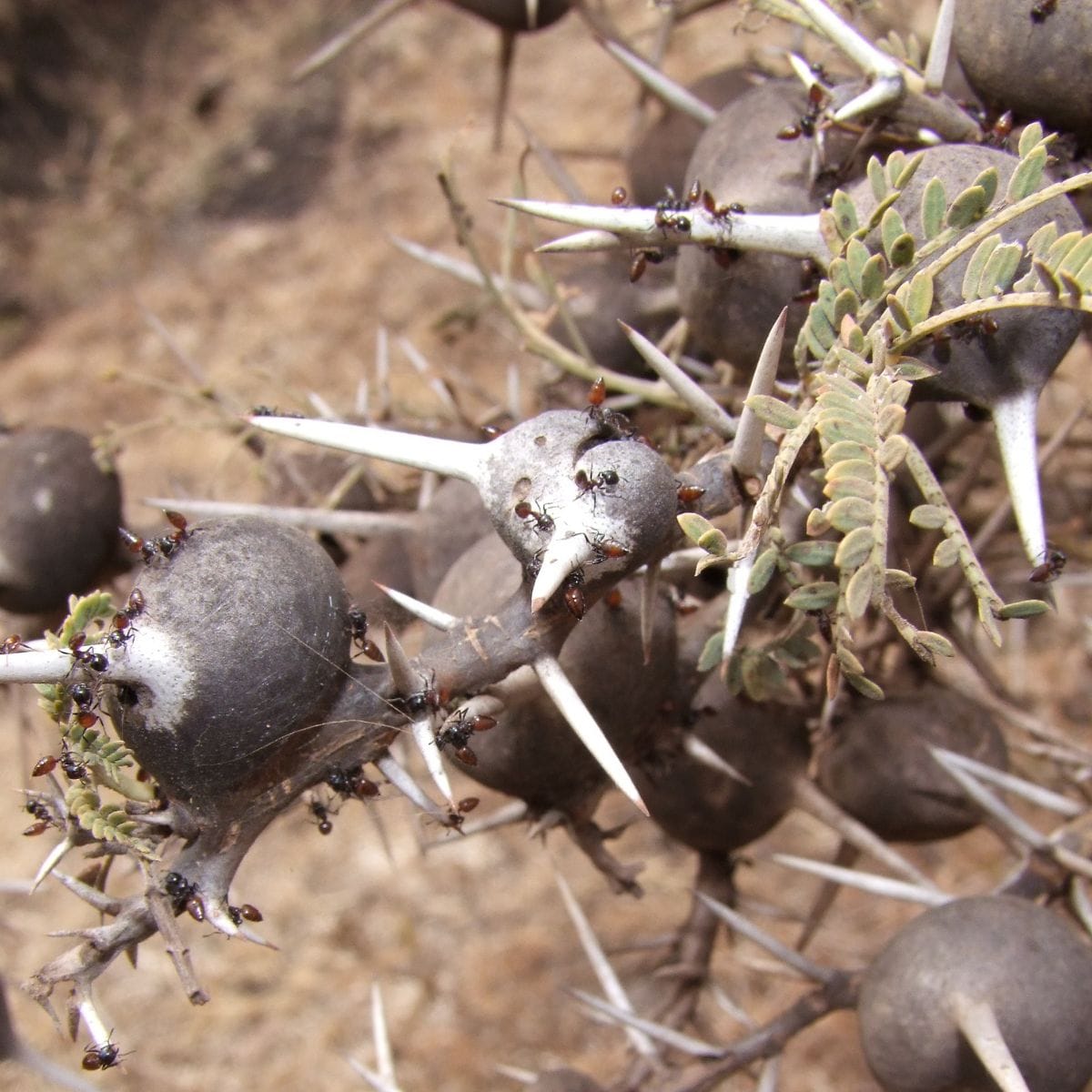
In the savannas of East Africa, whistling-thorn trees and native Crematogaster ants had a mutualistic system. The trees offered nectar and hollow thorns as shelter. The ants defended the trees against elephants and other herbivores. This partnership helped maintain a healthy landscape, with shaded areas, hiding spots for prey, and balanced plant growth. The interactions of ants, trees, elephants, zebras, and lions created a complex but stable ecosystem.
However, this balance was disrupted when invasive big-headed ants arrived from islands in the Indian Ocean, wiping out native ants. Without their guardians, the whistling-thorn trees became vulnerable. Elephants began knocking them down, opening up the forest canopy. Suddenly, areas that were once shaded and protected became open and exposed.
Fascinated by this scenario, Douglas N. Kamaru and his team decided to study the consequences of this invasion. They set up an experiment in invaded and non-invaded areas. Some plots were fenced to keep elephants out, while others were left open.
They discovered that in areas dominated by invasive ants and visited by elephants, visibility increased because fallen trees left the landscape more open. As a result, lions found it much harder to catch zebras. In non-invaded areas, lions killed almost three times more zebras than in invaded areas.
This study illustrates how a single small species can trigger a cascade of effects across an entire ecosystem. The invasion of ants disrupted a tree-ant interaction, altering tree survival, which in turn changed landscape structure, affecting prey visibility, which ultimately influenced predator behaviour. Nature is a complex web of interactions where even minor changes can have far-reaching consequences.
Understanding these connections is essential not only for science but also for conservation. Protecting ecosystems requires recognising how species depend on each other. A tiny ant, a tree, or a lion’s hunting choice can shape the destiny of an entire landscape, showing that in nature, even the most minor players can have a considerable impact.
READ THE ARTICLE:
Kamaru, D. N., Palmer, T. M., Riginos, C., Ford, A. T., Belnap, J., Chira, R. M., … & Goheen, J. R. (2024). Disruption of an ant-plant mutualism shapes interactions between lions and their primary prey. Science, 383(6681), 433-438. DOI: 10.1126/science.adg1464

Victor H. D. Silva
Victor H. D. Silva is a biologist passionate about the processes that shape interactions between plants and pollinators. He is currently focused on understanding how urbanisation influences plant-pollinator interactions and how to make urban green areas more pollinator-friendly. For more information, follow him on ResearchGate as Victor H. D. Silva.
Cover picture: Crematogaster ants in the whistling-thorn trees. Photo by Pharaoh han.
Portuguese translation by Victor. H. D. Silva