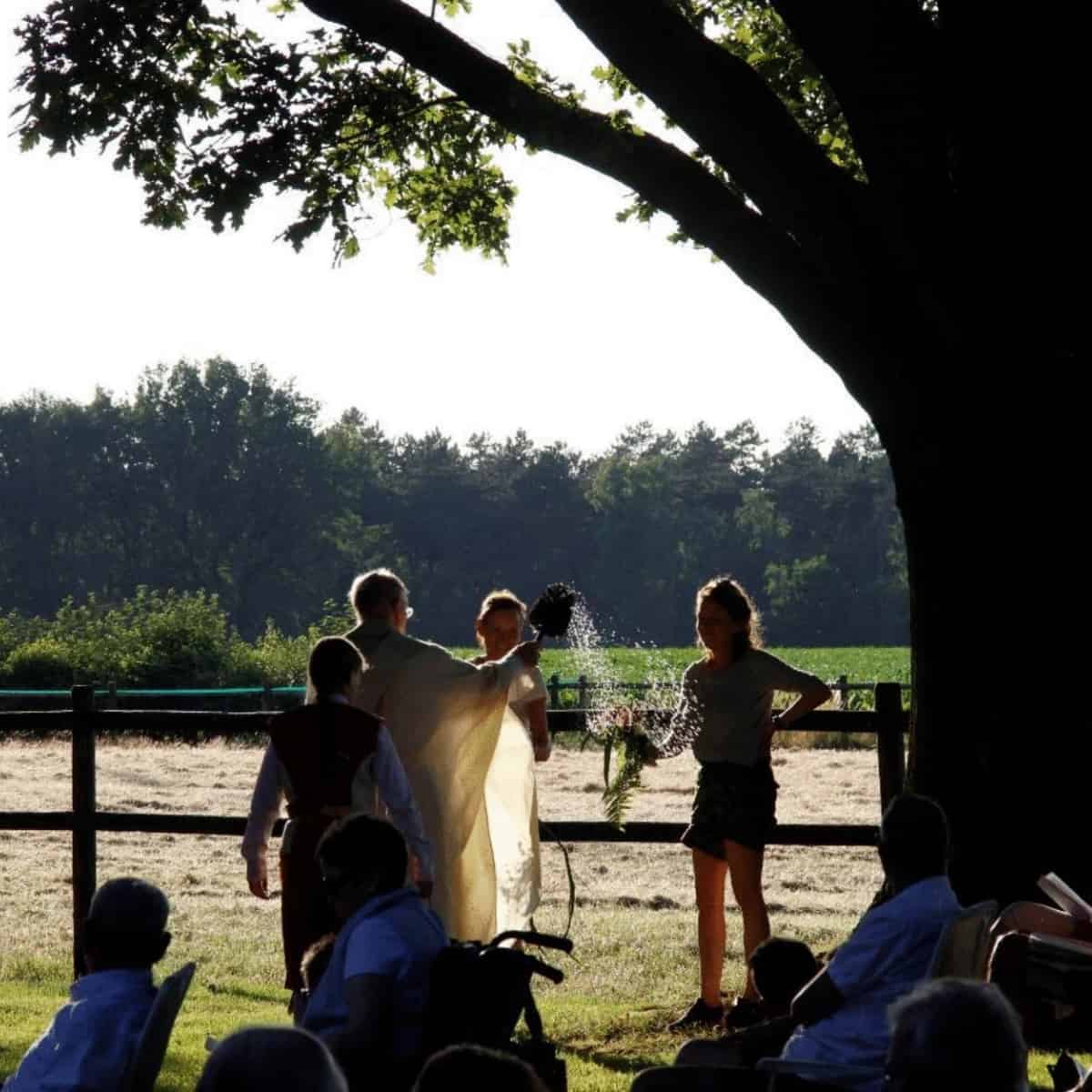



Plants can bring joy through their natural beauty. They can fulfill our physical needs in food and medicine. But in some folklore, their traditional uses go further. The right plant, at the right time, can protect people from harm.
For hundreds of years, in the Netherlands, it was a widespread tradition to hang blessed bouquets as amulets to ward off misfortune. Now, this practice is restricted to the south of the Netherlands, on St. John’s Day (24 June, traditional midsummer), and the bouquets are hung around homes to protect against lightening and other evils.
“In the Netherlands, possibly the earliest mention of herbs used on St. John’s Day stems from 1685,” write Pombo Geertsma et al.
The tradition invokes St. John the Baptist to protect against misfortune. A manual from the 17th century on how to be a good Christian lists “St. John’s wort harvested before sunrise” as a means of protecting against lightening. However, the tradition is fading, and so Pombo Geertsma et al set out to document this ritualistic plant use before the knowledge is lost.
To better understand the tradition in its modern practice, Pombo Geertsma et al conducted interviews with people who make, bless, or use these bouquets. They documented which plant species are used, why it was included and the person’s intent in creating the bouquet. They also evaluated whether the bouquets differ by village in the south of the Netherlands.
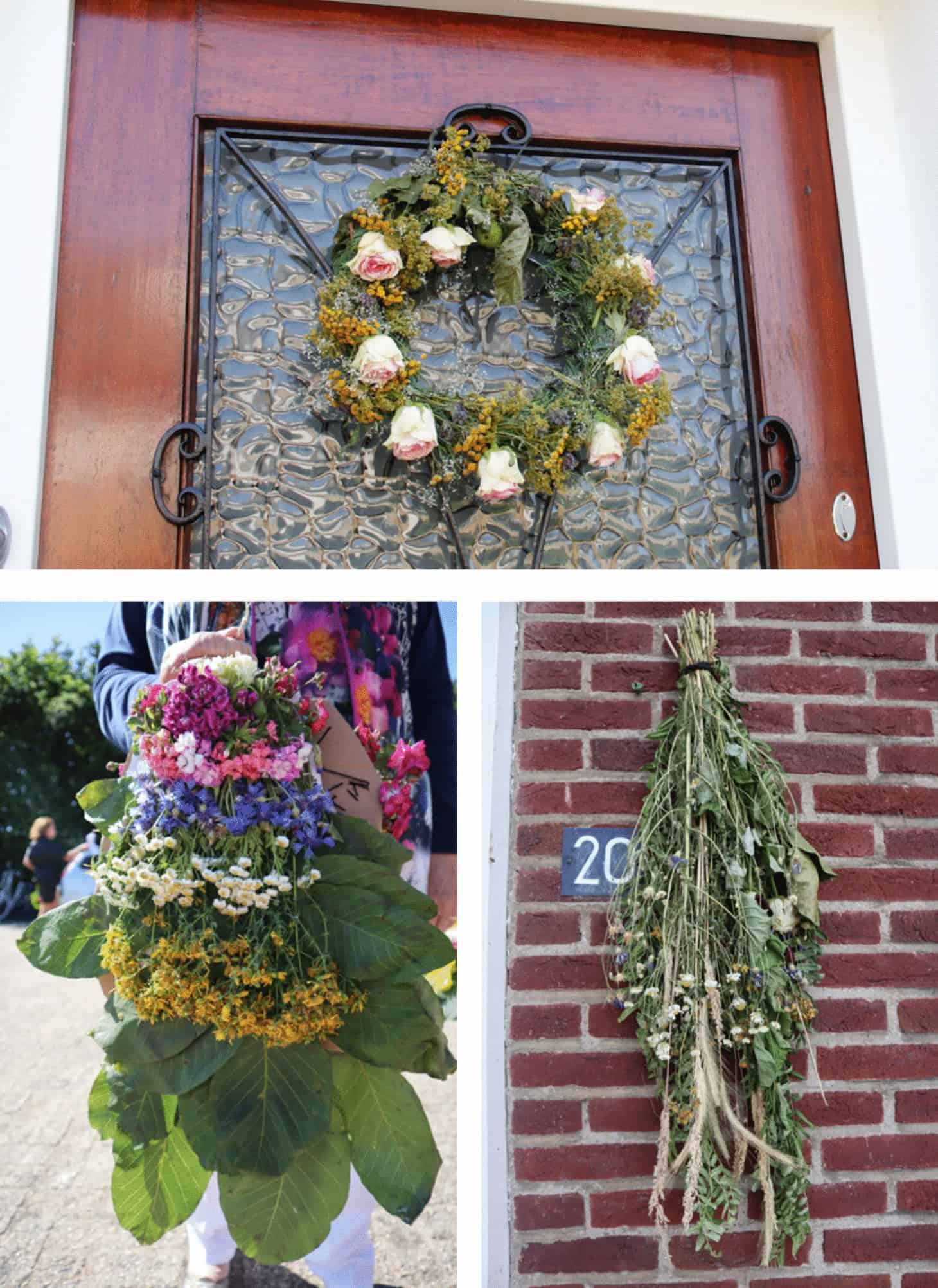
“Ultimately, we found planned St. John’s celebrations associated with St. John bouquets or wreaths in the villages of Oerle, Duizel, Leenderstrijp, Soerendonk, and Sambeek,” write Pombo Geertsma et al. “Right before and after St. John’s Day mass, we asked as many attendees carrying a St. John’s bouquet as time allowed whether we could ask them some questions about their bouquets and take some pictures of these.”
The research team also conducted interviews in the villages while participating in St. John’s Day activities such as attending a St. John bouquet workshop, plant-gathering walks, and bouquet assembly. They conducted a total of 93 semi-structured interviews to build a picture of how St. John’s bouquets are currently produced and used. The plant species were identified while out gathering on walks or from photographs.
The authors found a total of 184 different species belonging to 58 families in the 206 bouquets studied. On average, each bouquet included 10 different species. The most common ones being Rose spp., Juglans regia, Centaurea cyanus, Hypericum spp., Alchemilla spp., “chamomiles”, Hylotelephium telephium (L.) H.Ohba, Dianthus barbatus/chinensis, Achillea millefolium, and Tanacetum parthenium. The most common intended purpose of the bouquet was protection.
“Of the 80 people whom we asked how they used their St. John’s bouquet/wreath, 57 (71%) responded that it was used for protection. Of these, 47 (59% of 80) specified that it protected against thunder and lightning — usually through fumigation of (part) of the bouquet — evil in general (14, 18%), spirits or ghosts (6, 8%), and illnesses (5, 6%). One respondent answered that it was used to protect against witchcraft (1%),” write Pombo Geertsma et al.
When asked why the respondents, who all live in the south of the Netherlands in villages where St. John is the patron saint, continue the tradition, the respondents cited the tradition itself. Continuing the tradition allowed respondents to connect with their community and cultural heritage as well as preserve local identity.
The practice is not, however, restricted to the Netherlands. In Poland, bouquets are blessed on Assumption Day and Corpus Christi Octave. In Croatia, bouquets are blessed on Saint Anthony’s Day and St. John’s Day. In Ukraine, these bouquets are blessed on Corpus Christi and St John’s Day.
“The fact that these types of floral bunches were reported up until the twenty-first century in diverse parts of Europe indicates that this custom was once widespread and could imply that it was an ancient common phenomenon predating the Christianization of Europe,” write Pombo Geertsma et al. “However, an in-depth historical analysis of this custom in diverse European archives should be undertaken to verify this compelling possibility.”
Whether the tradition is ancient or more modern, the preservation of this protective practice connects community members to their past, present – and future.
READ THE ARTICLE
Pombo Geertsma, I., Zandstra, B.E., Duinhouwer, M.E.M., Alcántara Rodríguez, M. and van Andel, T.R. (2025) “Saint John’s bouquets: Species composition and protection against evil in the southern Netherlands,” Economic Botany. Available at: https://doi.org/10.1007/s12231-025-09648-y
Cover image: A St. John’s bouquet being blessed by a priest during an open-air mass in Leenderstrijp. Photograph by I. Pombo Geertsma. CC-BY