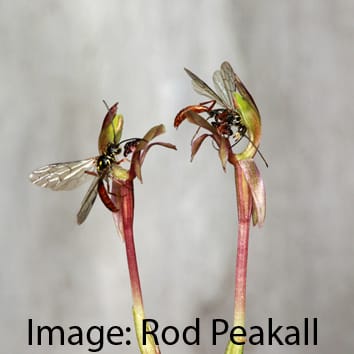



Australian Chiloglottis orchids employ novel semiochemicals called ‘chiloglottones’ to sexually attract their specific male wasp pollinators. Falara et al. show that chiloglottone is only produced in specific floral tissues, the labellum calli and sepals. They also determine that chiloglottone production requires continuous sunlight, and by conducting light-treatment experiments they show the optimal wavelength of light to be in the UV-B range with a peak of 300 nm. This discovery appears to be the first known case where plant floral odour production depends on UV radiation at normal levels of sunlight.