

The melon family, commonly known as cucurbits, boasts a remarkable diversity of plants with truly fascinating fruits. This includes some of the most beloved food crops on Earth, like pumpkins, cucumbers, watermelons, and squashes. Many species also provide hard-shelled fruits that have long been crafted into all kinds of objects around the globe: from ladles, bowls, and containers to an astounding array of musical instruments. Other cucurbit fruits have further served as eco-friendly sponges, botanical soaps, and even natural home air fresheners.
But human uses are definitely not the sole thing that makes cucurbit fruits so cucumber-cool. It is also their beautiful evolutionary twists to ensure dispersal, as revealed by a recent paper of the journal Plants, People, Planet.
Take the example of the squirting cucumber. The tiny fruits of this Mediterranean herb build up massive internal hydrostatic pressure as they ripen, so when they detach from their stalks, their seeds are launched in a squirt of mucilaginous fluid up to 10 m away. Or consider gourds, the main cucurbit source of handicrafts: their stiff rind makes them highly buoyant, allowing them to ride water currents as a means of shipping their seeds to brand new places. There is also the Javan cucumber, a climbing species from the rainforests of Southeast Asia; its fruits are dry and split open high in the canopy, so they can release their winged seeds to glide away with the wind.
And then, at the other end of the spectrum, there is an eccentric African species that does something truly mysterious: it buries its melon-like fruits deep into the ground.
While countless plant species have spent millions of years fashioning showy, colorful fruits to attract all kinds of hungry animals, Cucumis humifructus has come up with this radically different strategy. Like many of its more popular cousins, this sub-Saharan species is a creeping vine that can sprawl across vast arid areas. Its tiny yellow flowers open close to the ground and are typically pollinated by native bees. So far so good, but here comes the weird part: after pollination, flower stalks bend downwards, pierce the soil, and keep pushing their developing ovaries underground.
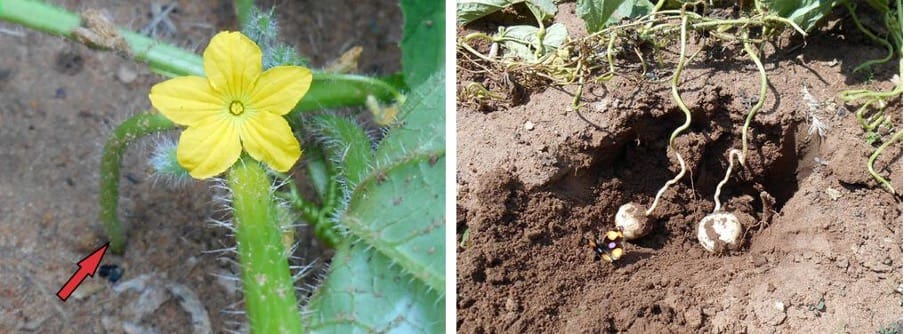
Now, other plants are known to bury their fruits to aid seed germination—peanuts being the most classic example—but there is a profound difference with Cucumis humifructus: while peanuts end up just about 5 cm below the surface, these subterranean melons can go down as deep as 30 cm! There is no way that a brand-new seedling can reach the surface from such an abyss, and anyway, most cucurbit seeds are incapable of germinating while still embedded in the juicy pulp of their fruits. So why on Earth would this plant do that?
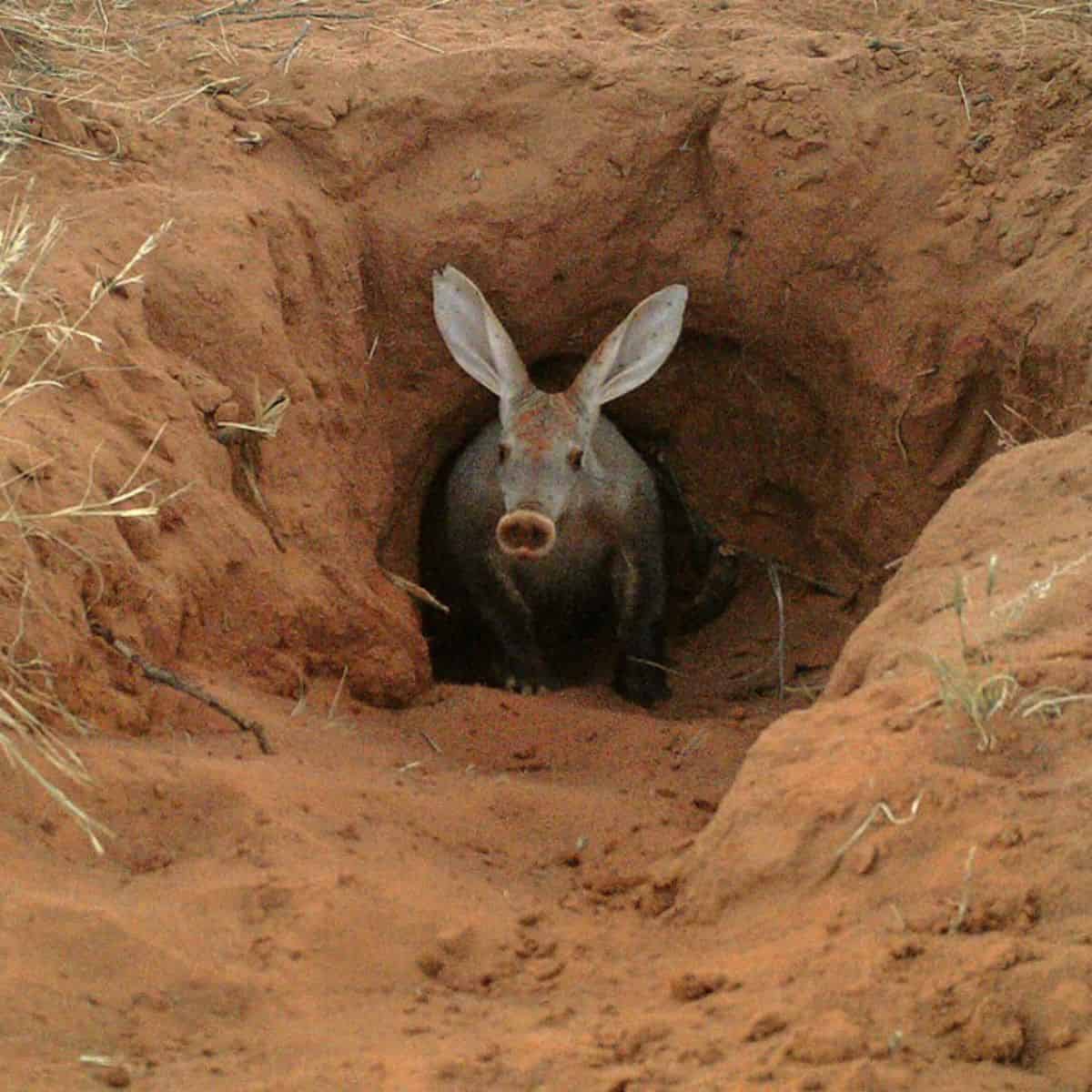
To find out, Dr. Steven D. Johnson from the University of KwaZulu-Natal and his colleagues went on a fieldwork trip to the savannahs of central Namibia. Their primary mission was to test out some old rumours about this plant. Back in the ‘50s, a Dutch botanist and a Belgian zoologist suggested that the treasure-hidden seeds of Cucumis humifructuscould be dispersed by an equally eccentric, nocturnal mammal locally known as aardvark —which is Afrikaans for “earth pig”. Although this elusive African animal is perfectly adapted to its restricted diet of ants and termites, both gentlemen found seeds of the earthy melons in aardvark faeces and intestines. They also argued that aardvarks were widely known by local indigenous people to eat the hidden fruits as a source of water.
Yet, the whole story was mainly built upon anecdotal observations, as the mysterious ways of both species made it difficult to investigate, and, until now, our main question remained unanswered: why would the plant want to bury its fruits so deeply underground? In fact, if the aardvarks were to disperse the seeds, how could they actually locate them?
Once in Namibia, Johnson and his team had to find some underground melons, which is no easy task. Not only because the fruits are buried, but also because the plants are annuals. That means that they will only germinate and grow during a short favourable season of the year, and their stems and leaves will have vanished by the time of fruit maturity. So the researchers arrived early, spotted the crawling plants, and marked the positions of flowers and buds that could later turn into invisible fruits, where they would set up camera traps in the weeks ahead. They also took advantage of the plants’ leafy stage to follow the trails formed by their stems across the soil, and check if there were leftovers of aardvark poop at the base of their roots—which was indeed the case for all the plants inspected.
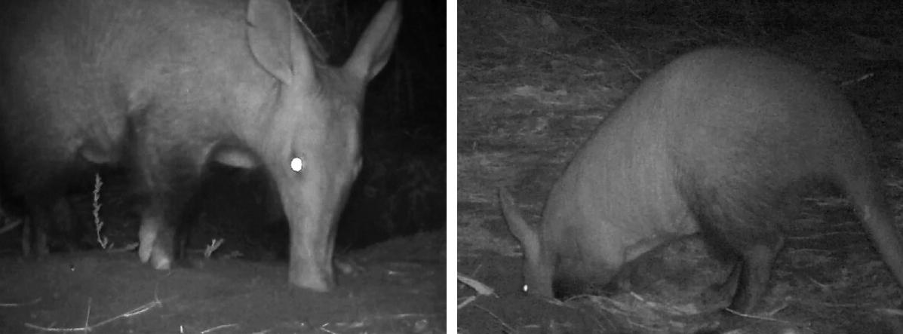
Months on, when it was time to look at the cameras’ footage, the researchers found some conclusive nocturnal scenes. Of the seven mammals they spotted wandering around the buried melons of Cucumis humifructus, aardvarks were the only ones capable of locating and reaching them. They eagerly sniffed the ground with their potent snouts—these animals have one of the keenest senses of smell among vertebrates—and used their powerful claws to dig right into the fruits and crack them open, swallowing their pulp and seeds with their long, sticky tongue, just as they do when hunting for bugs.
The study crew decided to dig out some fruits themselves, take them to the lab, and perform a chemical analysis of their scent. What came to the surface was outstanding. Not only do these fruits have a very unique smell, different from that of other related cucurbits in the region, but they are also able to keep emitting fragrant compounds for at least six months after reaching maturity, including molecules that could resemble ant pheromones or rotting wood associated with termites. The importance of these compounds for attracting aardvarks remains an exciting hypothesis to be tested in the future.
Now we have clear insights on how aardvarks manage to find the hidden melons, but still, why so deep? Johnson and colleagues went through the experiment of unearthing several fruits, burying them at shallower depths or leaving them on the surface, fixing more cameras, and waiting to see what happened. This time, it was porcupines who were most frequently registered eating the fruits.
Antbears and porcupines interacting with fruits of Cucumis humifructus Video by Steve Johnson, Anka Eichhoff & Jeremy Midgley
Unlike ant-suctioning aardvarks, porcupines have strong, sharp teeth that could easily damage the soft seeds of most cucurbits. In fact, the authors experimentally fed captive porcupines with similar melons and found that no intact seeds made it through their digestive system, as opposed to what happens with aardvarks. So they finally came to a solid conclusion: deep fruit burial probably evolved in Cucumis humifructus as a strategy to avoid seed predators, those animals that only take advantage of the tasty pulp but destroy the seeds while feeding on it. In turn, that led the species to rely on a trustworthy animal that does a great job carrying and cultivating its seeds over long distances.
Such specialized seed dispersal mutualisms are rare in nature. Most examples come from long-lived woody species, which can easily withstand one or two years of bad luck dispersing their seeds without major consequences. But being an annual plant whose seeds cannot even germinate without the aid of a specific animal makes Cucumis humifructus all the more unique, and sadly, very vulnerable. Every year, the persistence of this wild melon species depends on its aardvark allies having released some of its seeds from their underground enclosure. No aardvark, no plants. Indeed, the authors report that Cucumis humifructus has become extremely rare in several parts of Africa and suggest that this may be related to rapid declines in aardvark abundance. So, now that we know the magic of underground melons, it is our duty to keep it safe. There is no doubt that preserving plants will require us to protect all sorts of collaboration networks they rely on, which might include some of the quirkiest mammals in the world.
READ THE ARTICLE:
Johnson, S.D., Eichhoff, A. and Midgley, J.J. (2025). Antbears and underground melons: A highly specialized seed dispersal mutualism mediated by scent. Plants, People, Planet. https://doi.org/10.1002/ppp3.10638.
Andrés Pereira-Guaqueta
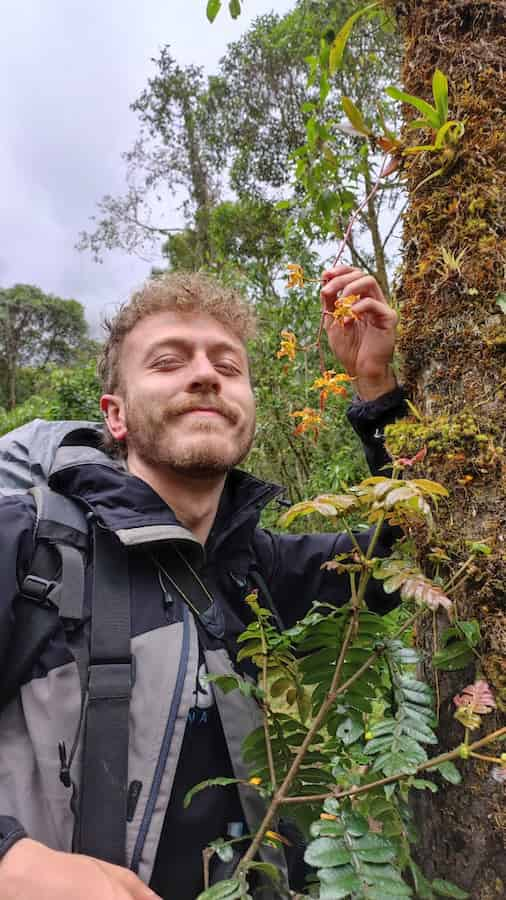
Andrés is a Colombian biologist fascinated by plant-animal interactions and eager to share scientific knowledge outside academia. He is currently finishing his master’s degree at the National Autonomous University of Mexico. His main research interests revolve around the relationships between flowering plants and their animal pollinators, and how they respond to our rapidly changing world.
Spanish translation by Andrés Pereira-Guaqueta.
Cover picture by Louise Joubert (Wikimedia Commons).