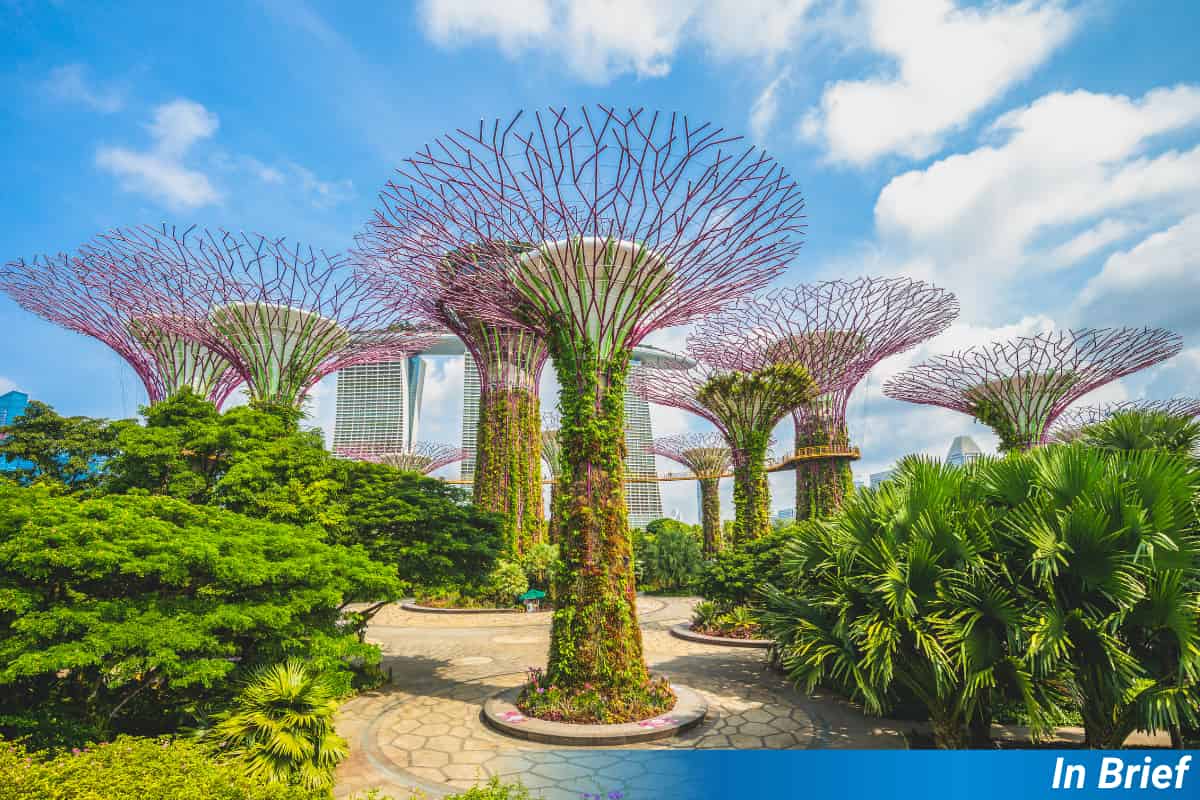



How are plants responding to climate change? Records kept at Singapore Botanic Gardens are helping answer that question. Ho and colleagues examined the intervals between leaf flushing events, which is when trees produce a burst of new leaves. They compared these intervals using records from the past to see how they had changed over time. They found evidence of more frequent leaf flushing, tied to more distinct wet and dry seasons.
Ho and colleagues conducted their study by comparing old records from the 1920s and 1930s with recent observations. They found that most tree species are now producing new leaves more often than they did 90 years ago. For example, some trees that used to sprout new leaves every 9 or 10 months now do so about every 6 months. This change wasn’t just in one or two species – it was seen in most of the trees studied. his shift in leafing patterns could have big implications for the forest ecosystem, affecting everything from the insects that munch on leaves to the way nutrients cycle through the environment.
Looking for a cause of the increased leafing, the scientists turned to weather records. They found that February has become drier since the 1960s and May has become wetter. The changes have made two distinct dry and wet seasons per year, compared to just the one in the past.
Ho and colleagues found that the trees leafing responded to changes in rainfall. Buy while rainfall often triggers leaf production, it doesn’t happen immediately. There’s usually a delay of 1 to 4 months between rain changes and leafing events. Interestingly, trees don’t all respond the same way. Some prefer to leaf after dry periods, while others respond to the rain. The results show there is no simple single response.
“While the phenological behaviour of cultivated specimens may not be the same as that in natural tropical forests where individual trees grow much closer together, the accessibility of botanical gardens allows for the monitoring of more individuals and species with fewer resources, possibly even incorporating elements of citizen science or crowd-sourcing from photographs posted on social media given the typically high visitorship to botanical gardens and their mission in public education and outreach on botany and environmental issues”
Ho, B.-C., Chia, E. J. J., Chong, K. Y., Tan, J. S. Y., Tan, W. X., Lai, S., Choo, T. Y. S., Tan, P. Y., & Er, K. B. H. (2024). Changes in tropical leafing behaviour with climate change over nine decades: A case study from the Singapore Botanic Gardens. Plants, People, Planet, 1–11. https://doi.org/10.1002/ppp3.10547 (OA)