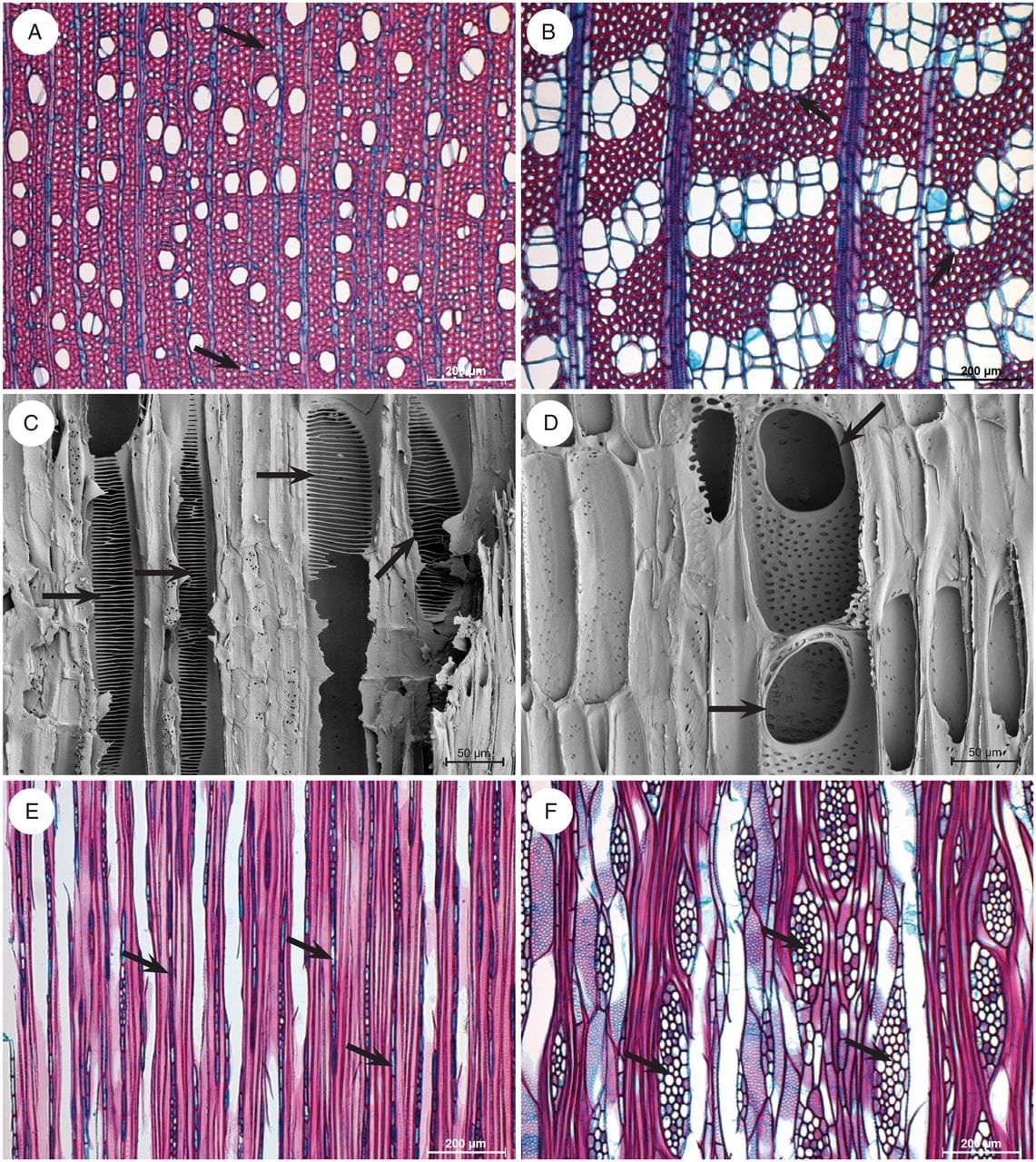


Flowering plants with simple vessel perforations have evolved from species bearing scalariform perforations but there is a scarcity of integrative studies explaining why these transitions in wood evolution have happened.

Lens et al. find that Viburnum, characterised by scalariform vessel perforations (ancestral), diversified earlier than the closely related Sambucus, characterised by simple perforations (derived). The lack of selective pressure for high conductive efficiency during early diversification resulted in Viburnum retaining the ancestral perforation plate type, while higher temperatures during early diversification of Sambucus triggered the evolution towards simple vessel perforations, resulting in more efficient long distance water transport mechanisms.
You can follow @Federic_Lens on Twitter.