

In As You Like It, Shakespeare famously wrote that “All the world’s a stage, and all the men and women merely players”. With these words, he compared life to a play, with people acting out shifting roles. Yet he likely never imagined that theatre would become a space for examining environmental challenges such as climate change in the forestry sector. That is precisely what happens in Three Words for Forest, a research project that brings the uncertainties of modern forestry onto the stage.
In a study recently published in People and Nature, Dr Rachel Clive and colleagues used interviews with forestry professionals across Europe to create Three Words for Forest—a play exploring how people navigate complex, often conflicting challenges, from planting decisions to pest outbreaks to the realities of climate change.
Thirty forestry professionals were interviewed, from commercial foresters and nursery managers to policy-makers, ecologists and community groups. The interviews were open and story-driven, designed to let people speak freely about their work, their worries and their hopes for the forests they care for. Questions included “How did you get into forestry?”, “What are the risks, challenges and uncertainties facing you and the forest you work with?” and “How do you imagine the forests you work with in 10, 50, 100+ years’ time?”. These conversations were then transcribed, anonymised and analysed by both arts and social science researchers, who compared notes to identify recurring themes and tensions.
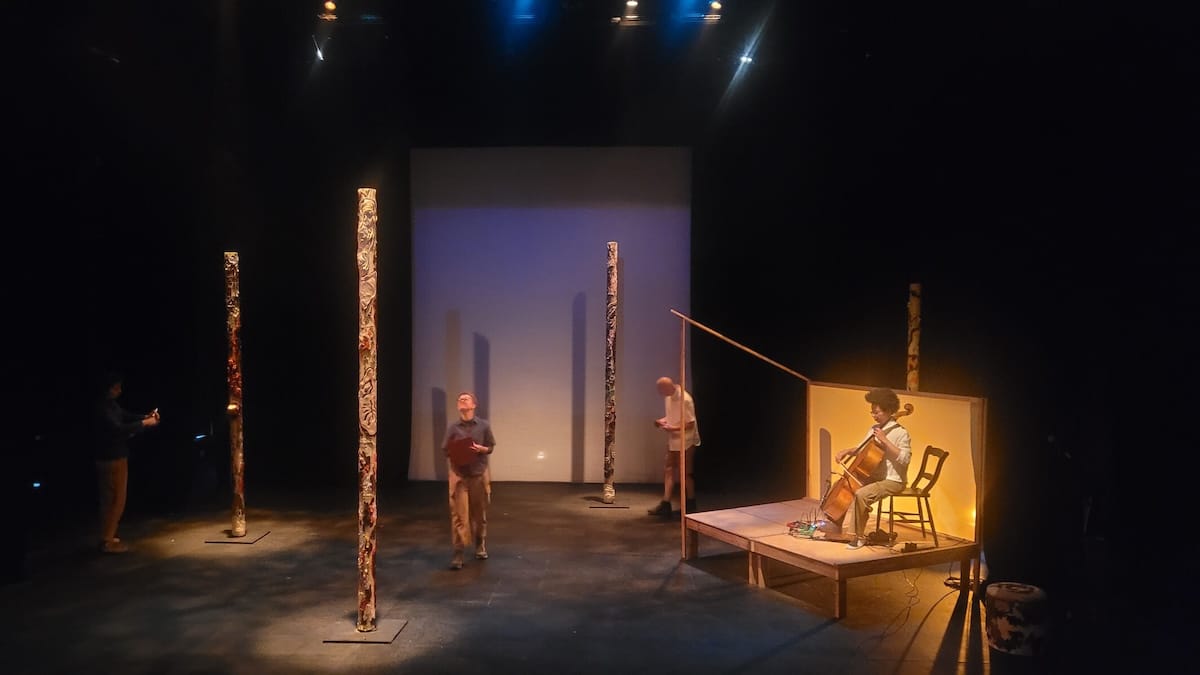
What happened next was the heart of the project: instead of summarising the interviews in a report, the team turned the participants’ exact words into a script. This approach, called verbatim theatre, preserves the rhythm, emotion and nuance of real speech. Over several months, the researchers worked with actors, musicians and designers to stage the material. The play was then performed live at the National Treescapes Conference (2024) and filmed for broader audiences. The final phase took the research off the stage and back into communities, through 12 co-designed workshops, where the audience, mostly from forestry backgrounds, could reflect, discuss, respond creatively or join practical activities.
When all those interviews, performances and workshops came together, three big lessons stood out. First, the team found value in not rushing to answers. The play deliberately refused to promote one “right” way to manage forests. Instead, it held conflicting views side by side: different ideas about planting, regeneration and risk sat in the same space. What kept this from feeling chaotic was a shared thread. Across very different roles and opinions, people expressed a deep, often bodily connection to trees, and a sense of time that stretches far beyond a human lifetime. That common ground made it possible to explore disagreement safely.
Second, the project showed the power of many voices. By condensing 30 hours of interviews into a one-hour play, the team had to choose what to highlight. They centred practitioners working directly with forests, presenting four contrasting types of forestry practice. With just three actors playing people who might rarely talk to each other in real life, the production “depersonalised” conflict and made it easier for audiences to consider unfamiliar perspectives.
Third, experimentation and improvisation proved essential. The creative team tried different ways of representing real people’s words, shifting attention between actors, recorded voices, music and a moving forest-like set built from recycled materials. This constantly changing stage world reminded everyone that forests and their futures are never fixed. Staying open to change, and to the more-than-human world of trees themselves, became part of the message.
Clive’s team found that uncertainty is not just an abstract challenge for forestry but something deeply felt by the people whose working lives are tied to forests. Interviewees spoke of climate change, shifting policies and social pressures as sources of both creativity and strain. What stands out is how theatre opened doors that traditional research rarely does. By inviting audiences to respond directly—writing on the stage, joining discussions, mapping local tree-planting sites—the play became a meeting point for foresters, researchers and community groups. These encounters did not simply share information; they produced new insights. Practitioners said it was rare to see forestry represented with such nuance. Others, new to the field, came away with a deeper sense of the complex decisions behind the trees they walk past every day.
The takeaway is clear: when dealing with uncertainty—whether in forests or any other complex system—plurality and collaboration matter. Creative methods like theatre can reveal shared ground, expose hidden tensions and spark conversations that technical reports alone cannot. And in doing so, they point to new ways of thinking and working that extend far beyond forestry.
By bringing foresters, researchers, artists and communities into collective reflection, Three Words for Forestdemonstrates how creative practice can make complex science more accessible and more humane. As climate pressures grow and decisions become ever more consequential, this dramaturgy of uncertainty encourages us to think in terms of “what if?”, to pause and listen, and to imagine alternatives together. If anything, Clive’s work shows how we, players on this changing planet, may need out-of-the-box methods to understand the environmental challenges of our time better and, hopefully, help us rewrite the script toward concrete, positive action.
READ THE ARTICLE:
Clive, R., Heddon, D., Rydlewski, J., Edwards, D., & Fremantle, C. (2025). A dramaturgy of uncertainty: Transdisciplinary manoeuvres across forestry and theatre. People and Nature. https://doi.org/10.1002/pan3.70192
WATCH THE PLAY:
Erika Alejandra Chaves-Diaz
Erika is a Colombian biologist and ecologist passionate about tropical forests, primates, and science communication. She holds a Master’s degree in Ecology and Wildlife Conservation from the Federal University of Minas Gerais (Brazil) and has been part of Ciencia Tropical since 2020—a science communication group that aims to connect people with biodiversity and raise environmental awareness. You can follow her and her team on Instagram at @cienciatropical.
Spanish and Portuguese translation by Erika Alejandra Chaves-Diaz.
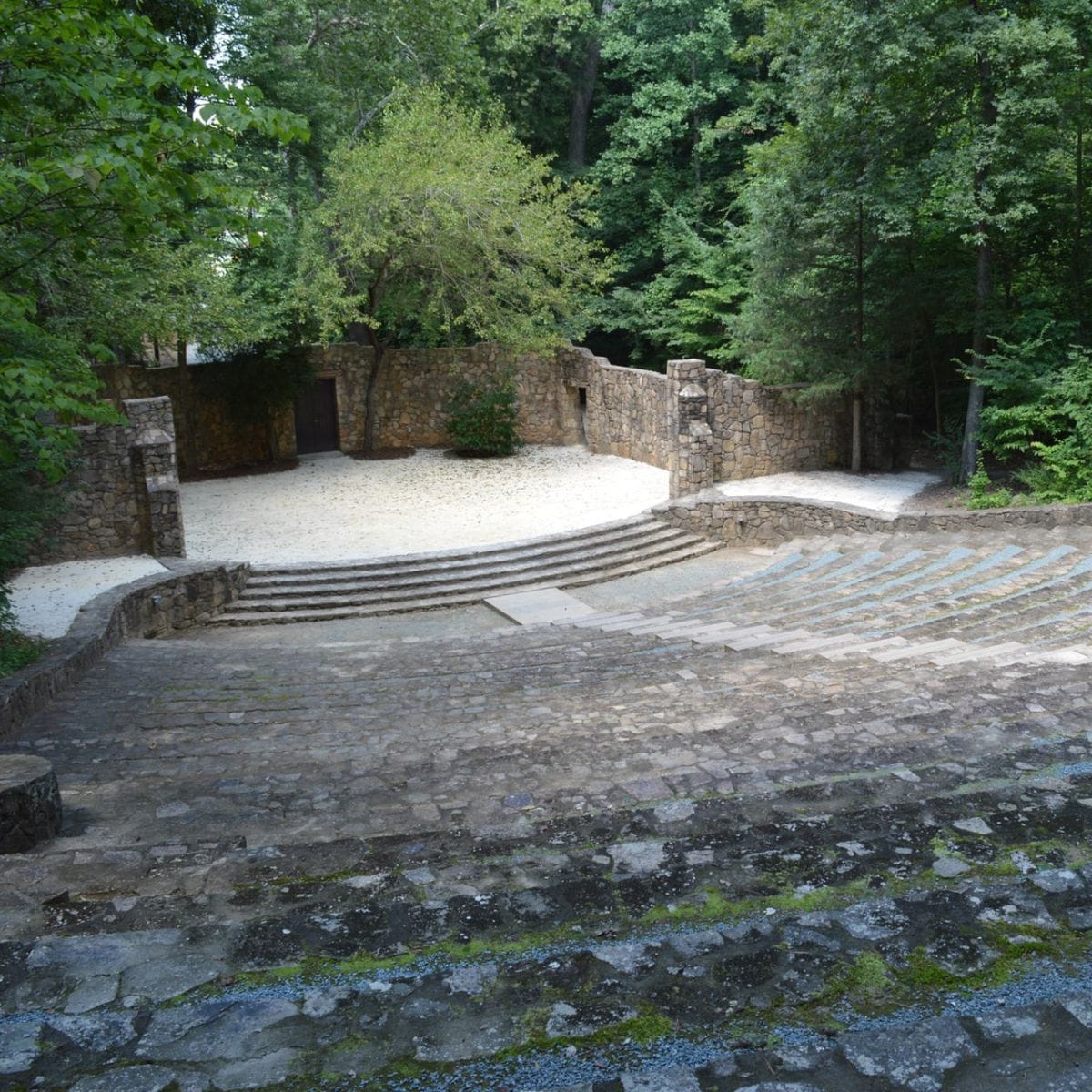
Cover picture: Forest Theatre at the University of North Carolina at Chapel Hill. Photo by William Yeung, Wikimedia Commons.


.jpeg?ref=botany.one)